Efecto de la aplicación de bioestimulantes en la huella hídrica del frijol (Phaseolus vulgaris L.)
Barra lateral del artículo
Contenido principal del artículo
Resumen
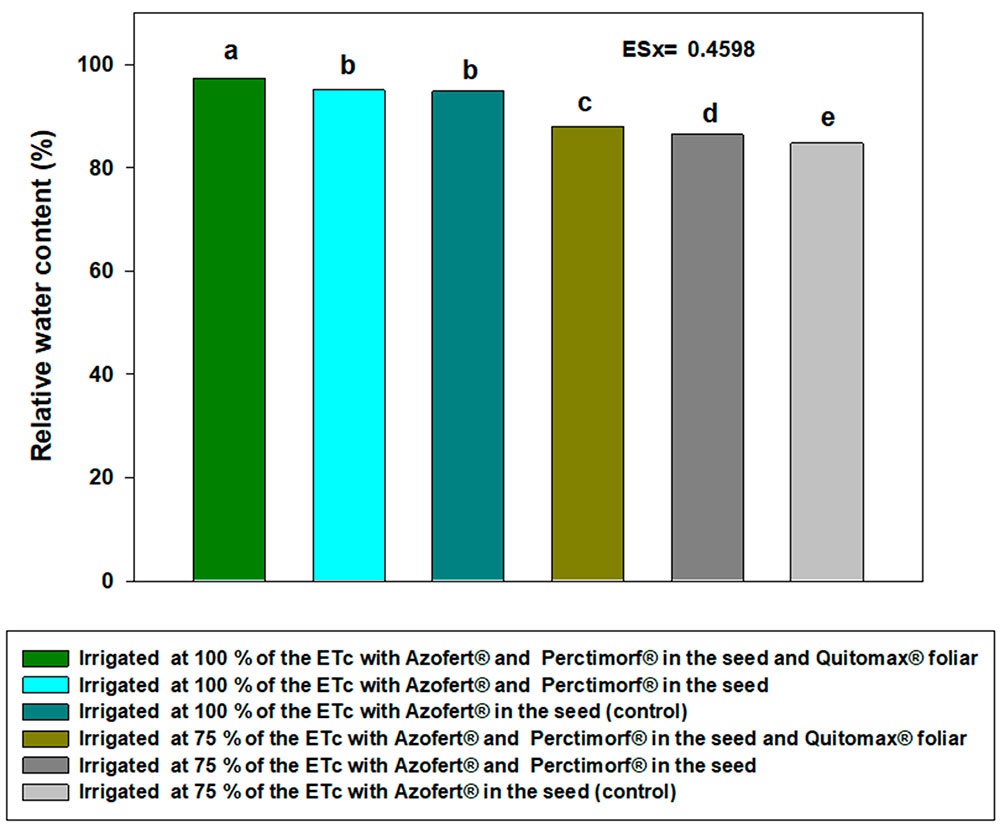
El trabajo se realizó con el objetivo de estimar la huella hídrica del frijol (Phaseolus vulgaris L.) sometido a dos regímenes de riego y aplicaciones de bioestimulantes. Se utilizaron semillas de la variedad de frijol negro Triunfo 70 sembradas en 18 contenedores. Los tratamientos consistieron en aplicar en 9 contenedores el 100 % de la ETc (Evapotranspiración del cultivo) en condiciones estándares y en los otros 9 al 75 %. Antes de la siembra todas las semillas de todos los contenedores fueron inoculadas con Azofert®-frijol (A), a 12 contenedores (seis de cada variante de riego) se le adicionó Pectimorf® (P) junto con el Azofert®- frijol y a seis (a tres de cada variante de riego) se le asperjó el Quitomax® (Q) al inicio de la floración. Los tratamientos en los que se les repuso el 75 % de la ETc fueron cubiertos con mantas de polietileno transparente para evitar la incidencia de las precipitaciones. Los resultados indican que, la aplicación tanto de Pectimorf® en la semilla, como de Quitomax® en aspersión foliar al inicio de la floración favorecen el crecimiento y el rendimiento del cultivo del frijol, así como, contribuyó a mantener un mejor estado hídrico en las plantas. Ambos productos mejoraron la eficiencia en el uso del agua por las plantas y contribuyeron a disminuir la huella hídrica, en casi un 20 % respecto al tratamiento control. El Quitomax®, mostró señales de ejercer una acción antitranspirante en las plantas.
Detalles del artículo

Esta obra está bajo una licencia internacional Creative Commons Atribución-NoComercial 4.0.
Aquellos autores/as que tengan publicaciones con esta revista, aceptan los términos siguientes:
- Los autores/as conservarán sus derechos de autor y garantizarán a la revista el derecho de primera publicación de su obra, el cuál estará simultáneamente sujeto a la Licencia Creative Commons Attribution-NonCommercial 4.0 International (CC BY-NC 4.0) que permite a terceros compartir la obra siempre que se indique su autor y su primera publicación esta revista. Bajo esta licencia el autor será libre de:
- Compartir — copiar y redistribuir el material en cualquier medio o formato
- Adaptar — remezclar, transformar y crear a partir del material
- El licenciador no puede revocar estas libertades mientras cumpla con los términos de la licencia
Bajo las siguientes condiciones:
- Reconocimiento — Debe reconocer adecuadamente la autoría, proporcionar un enlace a la licencia e indicar si se han realizado cambios. Puede hacerlo de cualquier manera razonable, pero no de una manera que sugiera que tiene el apoyo del licenciador o lo recibe por el uso que hace.
- NoComercial — No puede utilizar el material para una finalidad comercial.
- No hay restricciones adicionales — No puede aplicar términos legales o medidas tecnológicas que legalmente restrinjan realizar aquello que la licencia permite.
- Los autores/as podrán adoptar otros acuerdos de licencia no exclusiva de distribución de la versión de la obra publicada (p. ej.: depositarla en un archivo telemático institucional o publicarla en un volumen monográfico) siempre que se indique la publicación inicial en esta revista.
- Se permite y recomienda a los autores/as difundir su obra a través de Internet (p. ej.: en archivos telemáticos institucionales o en su página web) antes y durante el proceso de envío, lo cual puede producir intercambios interesantes y aumentar las citas de la obra publicada. (Véase El efecto del acceso abierto).
Citas
ALFONSO, A.C.: Guía técnica para el cultivo del frijol en Cuba, Inst. Instituto de Investigaciones Hortícola, Liliana Dimitrova, Informe técnico, Qivican, Mayabeque, Cuba, 38 p., 2000.
ALLEN, R.G.; PEREIRA, L.S.; RAES, D.; SMITH, M.: “Evapotranspiración del cultivo: guías para la determinación de los requerimientos de agua de los cultivos”, Roma: FAO, 298(0), 2006.
AVILA, R.G.; MAGALHÃES, P.C.; DA SILVA, E.M.; GOMES JÚNIOR, C.C.; DE PAULA LANA, U.G.; DE ALVARENGA, A.A.; DE SOUZA, T.C.: “Silicon supplementation improves tolerance to water deficiency in sorghum plants by increasing root system growth and improving photosynthesis”, Silicon, 12(11): 2545-2554, 2020, ISSN: 1876-990X, DOI: https://doi.org/10.1007/s12633-019-00349-5.
ÁVILA, R.G.; MAGALHÃES, P.C.; VITORINO, L.C.; BESSA, L.A.; DE SOUZA, K.R.D.; QUEIROZ, R.B.; JAKELAITIS, A.; TEIXEIRA, M.B.: “Chitosan induces sorghum tolerance to water deficits by positively regulating photosynthesis and the production of primary metabolites, osmoregulators, and antioxidants”, Journal of Soil Science and Plant Nutrition, 23(1): 1156-1172, 2023, ISSN: 0718-9508, DOI: https://doi.org/10.1007/s42729-022-01111-4.
BEAVER, J.S.; GONZÁLEZ-VÉLEZ, A.; LORENZO-VÁZQUEZ, G.; MACCHIAVELLI, R.; PORCH, T.G.; ESTEVEZ-DE-JENSEN, C.: “Performance of Mesoamerican bean (Phaseolus vulgaris L.) lines in an unfertilized oxisol”, Agronomía Mesoamericana, 32(3): 701-718, 2021, ISSN: 1659-1321, DOI: https://doi.org/10.15517/am.v32i3.44498.4.
BERLIANA, A.; KUSWANDARI, C.; RETMANA, B.; PUTRIKA, A.; PURBANINGSIH, S.: “Analysis of the potential application of chitosan to improve vegetative growth and reduce transpiration rate in Amaranthus hybridus”, En: IOP Conference Series: Earth and Environmental Science, Ed. IOP Publishing, vol. 481, p. 012021, 2020, DOI: https://doi.org/10.1088/1755-1315/481/1/012021, ISSN: 1755-1315.
BITTELLI, M.; FLURY, M.; CAMPBELL, G.S.; NICHOLS, E.J.: “Reduction of transpiration through foliar application of chitosan”, Agricultural and Forest Meteorology, 107(3): 167-175, 2001, ISSN: 0168-1923.
CISNEROS, Z.; CUM, G.R.; HERRERA, P.J.; GONZÁLEZ, R.; RODRÍGUEZ, S.; GARCÍA, O.: “Efecto de los polímeros en la economía del agua.”, Ingeniería Agrícola, 10(1), 2020.
DELL AMICO, J.; MORALES, D.; JEREZ, E.; RODRÍGUEZ, P.; ÁLVAREZ, I.; MARTÍN, R.; DÍAS, Y.: “Efecto de dos variantes de riego y aplicaciones foliares de Pectimorf® en el desarrollo del frijol (Phaseolus vulgaris L.)”, Cultivos Tropicales, 38(3): 129-134, 2017, ISSN: 0258-5936.
GARCÍA-LEÓN, M.; CUYAS, L.; EL-MONEIM, D.A.; RODRIGUEZ, L.; BELDA-PALAZÓN, B.; SANCHEZ-QUANT, E.; FERNÁNDEZ, Y.; ROUX, B.; ZAMARREÑO, Á.M.; GARCÍA-MINA, J.M.: “Arabidopsis ALIX regulates stomatal aperture and turnover of abscisic acid receptors”, The Plant Cell, 31(10): 2411-2429, 2019, ISSN: 1532-298X.
GIRÓN, I.; CORELL, M.; GALINDO, A.; TORRECILLAS, E.; MORALES, D.; DELL’AMICO, J.; TORRECILLAS, A.; MORENO, F.; MORIANA, A.: “Changes in the physiological response between leaves and fruits during a moderate water stress in table olive trees”, Agricultural Water Management, 148: 280-286, 2015, ISSN: 0378-3774, DOI: https://doi.org/10.1016/j.agwat.2014.10.024 .
GONZÁLEZ-CUETO, O.; MONTAÑA-VALLADARES, A.; LÓPEZ-BRAVO, E.; SÁNCHEZ-VALLE, S.; ZAMBRANO-CASANOVA, D.E.; MACIAS-MARTÍNEZ, L.M.; HERRERA-SUÁREZ, M.: “Productividad del agua de riego en cultivos seleccionados de la región central de Cuba”, Revista Ciencias Técnicas Agropecuarias, 29(1), 2020, ISSN: 2071-0054.
HERNÁNDEZ-JIMÉNEZ, A.; PÉREZ-JIMÉNEZ, J.M.; BOSCH-INFANTE, D.; SPECK, N.C.: “La clasificación de suelos de Cuba: énfasis en la versión de 2015”, Cultivos tropicales, 40(1), 2019, ISSN: 0258-5936.
HIDANGMAYUM, A.; DWIVEDI, P.; KATIYAR, D.; HEMANTARANJAN, A.: “Application of chitosan on plant responses with special reference to abiotic stress”, Physiology and molecular biology of plants, 25(2): 313-326, 2019, ISSN: 0971-5894, DOI: https://doi.org/10.1007/s12298-018-0633-1.
HOEKSTRA, A.Y.; CHAPAGAIN, A.K.; ALDAYA, M.M.; MEKONNEN, M.M.: The water footprint assessment manual: setting the global standard, [en línea], London/Washington, DC: Earthscan ed., 2011, Disponible en:https://waterfootprint.org/media/downloads/TheWaterFootprintAssessmentManual_2.pdf.
IRAWATI, E.; SASMITA, E.; SURYAWATI, A.: “Application of chitosan for vegetative growth of kemiri sunan plant in marginal land”, En: IOP Conference Series: Earth and Environmental Science, Ed. IOP Publishing, vol. 250, p. 012089, 2019, ISBN: 1755-1315.
IRITI, M.; PICCHI, V.; ROSSONI, M.; GOMARASCA, S.; LUDWIG, N.; GARGANO, M.; FAORO, F.: “Chitosan antitranspirant activity is due to abscisic acid-dependent stomatal closure”, Environmental and Experimental Botany, 66(3): 493-500, 2009, ISSN: 0098-8472, DOI: https://doi.org/10.1016/j.envexpbot.2009.01.004.
JAFARI, L.; SHAMEKH, M.R.; ABDOLLAHI, F.; HAMID, R.: “Elicitor potential of chitosan and its derivatives to enhancing greenhouse tomato (Lycopersicon esculentum Mill.) performance under deficit irrigation conditions”, Scientia Horticulturae, 349: 114259, 2025, ISSN: 0304-4238, DOI: https://doi.org/10.1016/j.scienta.2025.114259.
JAWAD, A.A.; AL-SHAMMARI, G.N.H.: “Effect of Anti-Transpiration Inhibitors Copper and Chitosan, Pomegranate Peel and Thyme Leaves Extracts and Storage Period on the Chemical Traits of Local Orange Fruits”, En: IOP Conference Series: Earth and Environmental Science, Ed. IOP Publishing, vol. 1262, p. 042014, 2023, DOI: https://doi.org/10.1088/1755-1315/1262/4/042014, ISSN: 1755-1315.
KHALIL, H.A.; BADR ELDIN, R.: “Chitosan improves morphological and physiological attributes of grapevines under deficit irrigation conditions”, Journal of Horticultural Research, 29(1): 9-22, 2021, ISSN: 2300-5009, DOI: https://doi.org/10.2478/johr-2021-0003.
LOAYZA, H.; CALDERÓN, A.; GUTIÉRREZ, R.O.; CÉSPEDES, E.; QUIROZ, R.: “Estimación de las concentraciones relativas de clorofila en foliolos de papa (Solanum tuberosum L.) Utilizando técnicas de reflectancia de la vegetación”, Ecología aplicada, 21(2): 91-101, 2022, ISSN: 1726-2216, DOI: https://doi.org/10.21704/rea.v21i2.1961.
LOPEZ-BELLIDO, R.; SHEPHERD, C.; BARRACLOUGH, P.: “Predicting post-anthesis N requirements of bread wheat with a Minolta SPAD meter”, European Journal of Agronomy, 20(3): 313-320, 2004, ISSN: 1161-0301, DOI: https://doi.org/10.1016/S1161-0301(03)00025-X.
MAGAÑA, L.D.; GAUCÍN, S.D.; FLORES, L.D.: “Análisis sectorial y de la dinámica de los precios del frijol en México”, Compendium: Cuadernos de Economía y Administración, 2(3): 1-21, 2015, ISSN: 1390-9894.
MORALES-GUEVARA, D.; DELL AMICO-RODRÍGUEZ, J.; JEREZ-MOMPIE, E.; RODRÍGUEZ-HERNÁNDEZ, P.; ÁLVAREZ-BELLO, I.; DÍAZ-HERNÁNDEZ, Y.; MARTÍN-MARTÍN, R.: “Efecto del Quitomax® en plantas de (Phaseolus vulgaris L.) sometidas a dos regímenes de riego. II. Variables Fisiológicas”, Cultivos Tropicales, 38(4): 92-101, 2017, ISSN: 0258-5936.
NC 1048: Calidad del agua para preservar el suelo. Especificaciones. Normas de Calidad del agua, Oficina Nacional de Normalización, La Habana, Cuba, 2014.
OTTAIANO, L.; DI MOLA, I.; CIRILLO, C.; COZZOLINO, E.; MORI, M.: “Yield performance and physiological response of a maize early hybrid grown in tunnel and open air under different water regimes”, Sustainability, 13(20): 11251, 2021, ISSN: 2071-1050, DOI: https://doi.org/10.3390/su132011251.
POSADA-PÉREZ, L.; PADRÓN-MONTESINOS, Y.; GONZÁLEZ-OLMEDO, J.; RODRÍGUEZ-SÁNCHEZ, R.; BARBÓN-RODRIGUEZ, R.; NORMAN-MONTENEGRO, O.; RODRÍGUEZ-ESCRIBA, R.C.; GÓMEZ-KOSKY, R.: “Efecto del Pectimorf® en el enraizamiento y la aclimatización in vitro de brotes de papaya (Carica papaya L.) cultivar Maradol Roja”, Cultivos Tropicales, 37(3): 50-59, 2016, ISSN: 0258-5936, DOI: http://dx.doi.org/10.13140/RG.2.1.1642.2642.
RODRÍGUEZ-LARRAMENDI, L.A.; SALAS-MARINA, M.; HERNÁNDEZ-GARCÍA, V.; CAMPOS-SALDAÑA, R.A.; CRUZ-MACÍAS, W.O.; CRUZ-MORALES, M.; GORDILLO-CURIEL, A.; GUEVARA-HERNÁNDEZ, F.: “Efecto fisiológico de la disponibilidad de agua y nitrógeno en plantas de guayaba”, Tropical and subtropical Agroecosystems, 24: 19, 2021, DOI: https://doi.org/10.56369/tsaes.3391.
ROMERO-FÉLIX, C.S.; LÓPEZ-CASTAÑEDA, C.; KOHASHI-SHIBATA, J.; MIRANDA-COLÍN, S.; AGUILAR-RINCON, V.H.; MARTÍNEZ-RUEDA, C.G.: “Changes in yield and its components in bean under irrigation and drought”, Revista mexicana de ciencias agrícolas, 10(2): 351-364, 2019, ISSN: 2007-0934, DOI: https://doi.org/10.29312/remexca.v10i2.1607.
ROUPHAEL, Y.; COLLA, G.: “Biostimulants in agriculture”, Frontiers in plant science, 11: 40, 2020, ISSN: 1664-462X, DOI: https://doi.org/10.3389/fpls.2020.00040.
SÁEZ-CIGARRUISTA, A.E.; MORALES-GUEVARA, D.; GORDÓN-MENDOZA, R.; JAÉN-VILLARREAL, J.E.; RAMOS-MANZANÉ, F.P.; FRANCO-BARRERA, J.: “Effect of a Pectic Oligosaccharide on the Root Development of Maize”, Revista Ciencias Técnicas Agropecuarias, 33(2), 2024, ISSN: 2071-0054, DOI: https://doi.org/10.1186/s13568-019-0932-0.
SANCHES, M.; NOGUEIRA, M.A.; HUNGRIA, M.: “Microbial inoculants: reviewing the past, discussing the present and previewing an outstanding future for the use of beneficial bacteria in agriculture”, Amb Express, 9(1): 205, 2019, ISSN: 2191-0855.
TAWAHA, R.M.; JAHAN, N.; ODAT, N.; RAMAMNEH, E.A.D.; ZAITOON, Y.M.; FANDI, K.; ALHAWATEMA, M.; RAUF, A.; WEDYAN, M.; SHALAT, M.; TAWAHA, I.K.; TURK, M.; KHANUM, S.: “Growth, yield and biochemical responses in barley to DAP and chitosan application under water stress”, Journal of Ecological Engineering, 21(6): 86-93, 2020, DOI: https://doi.org/10.1911/22998993/123251.
TURNER, N.C.: “Techniques and experimental approaches for the measurement of plant water status”, Plant and soil, 58(1): 339-366, 1981, ISSN: 0032-079X, DOI: https://doi.org/10.1007/BF02180062.
VALVERDE-OTÁROLA, J.C.; ARIAS, D.: “Efectos del estrés hídrico en crecimiento y desarrollo fisiológico de Gliricidia sepium (Jacq.) Kunth ex Walp”, Colombia forestal, 23(1): 20-34, 2020, ISSN: 0120-0739, DOI: https://doi.org/10.14483/2256201X.14786.
VAN OOSTEN, M.J.; PEPE, O.; DE PASCALE, S.; SILLETTI, S.; MAGGIO, A.: “The role of biostimulants and bioeffectors as alleviators of abiotic stress in crop plants”, Chemical and Biological Technologies in Agriculture, 4(1): 5, 2017, ISSN: 2196-5641, DOI: https://doi.org/10.1186.
WINKLER, A.J.; DOMINGUEZ-NUÑEZ, J.A.; ARANAZ, I.; POZA-CARRIÓN, C.; RAMONELL, K.; SOMERVILLE, S.; BERROCAL-LOBO, M.: “Short-chain chitin oligomers: Promoters of plant growth”, Marine drugs, 15(2): 40, 2017, ISSN: 1660-3397, DOI: https://doi.org/10.3390/md15020040.