Influence of efficient microorganisms on germination and seedling growth (Vigna unguiculata. L) cv. Canton 1
Article Sidebar
Main Article Content
Abstract
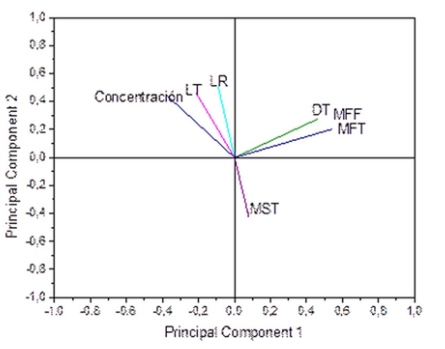
This research was conducted in the province of Pinar del Río in 2018, with the aim of evaluating the influence of effective microorganisms on the germination and seedling growth of Vigna sesquipedalis L. cv. Cantón 1 (yardlong bean). Two experiments were designed: the first to measure germination rate and germination percentage, and the second to observe seedling development under three concentrations of effective microorganisms (2%, 4%, and 6%). Morphological parameters assessed included stem diameter, radicle and hypocotyl length, total dry mass, and fresh leaf mass. The results established that the application of effective microorganisms exerted a favorable effect on the longitudinal development of both the stem and the radicle. Conversely, variables such as stem thickness, fresh leaf weight, and total fresh mass exhibited no direct relationship with the concentration applied, responding independently of the treatments. It is concluded that effective microorganisms represent a promising tool for enhancing the early development of Vigna sesquipedalis L. cv. Cantón 1, although the response of certain morphological variables may be independent of the concentration employed.
Article Details

This work is licensed under a Creative Commons Attribution-NonCommercial 4.0 International License.
Aquellos autores/as que tengan publicaciones con esta revista, aceptan los términos siguientes:
- Los autores/as conservarán sus derechos de autor y garantizarán a la revista el derecho de primera publicación de su obra, el cuál estará simultáneamente sujeto a la Licencia de reconocimiento-no comercial de Creative Commons 4.0 que permite a terceros compartir la obra siempre que se indique su autor y su primera publicación esta revista. Bajo esta licencia el autor será libre de:
- Compartir — copiar y redistribuir el material en cualquier medio o formato
- Adaptar — remezclar, transformar y crear a partir del material
- El licenciador no puede revocar estas libertades mientras cumpla con los términos de la licencia
Bajo las siguientes condiciones:
- Reconocimiento — Debe reconocer adecuadamente la autoría, proporcionar un enlace a la licencia e indicar si se han realizado cambios. Puede hacerlo de cualquier manera razonable, pero no de una manera que sugiera que tiene el apoyo del licenciador o lo recibe por el uso que hace.
- NoComercial — No puede utilizar el material para una finalidad comercial.
- No hay restricciones adicionales — No puede aplicar términos legales o medidas tecnológicas que legalmente restrinjan realizar aquello que la licencia permite.
- Los autores/as podrán adoptar otros acuerdos de licencia no exclusiva de distribución de la versión de la obra publicada (p. ej.: depositarla en un archivo telemático institucional o publicarla en un volumen monográfico) siempre que se indique la publicación inicial en esta revista.
- Se permite y recomienda a los autores/as difundir su obra a través de Internet (p. ej.: en archivos telemáticos institucionales o en su página web) antes y durante el proceso de envío, lo cual puede producir intercambios interesantes y aumentar las citas de la obra publicada. (Véase El efecto del acceso abierto).
References
Altieri, M. A., & Nicholls, C. I. (2020). Agroecology and the reconstruction of a post-COVID-19 agriculture. The Journal of Peasant Studies, 47(5), 881-898. https://doi.org/10.1080/03066150.2020.1782891
Barrios, M., Silva, A., & Romero, M. (2024). Germinación de semillas de leguminosas inoculadas con diferentes dosis de bioinsumos. Revista ESPAMCIENCIA, 15(1), 54-63. https://doi.org/10.51260/revista_espamciencia.v15i1.499
Canchignia-Martínez, H. F., Meza-Holguín, C. J., Tapia-Quintana, D. N., Macías-Holguín, T., Anguila, J. S., & Vera-Barahona, L. F. (2025). Bacterias productoras de ácido indol-3-acético y solubilizadoras de fósforo y potasio como promotoras de crecimiento en Oryza sativa L. Terra Latinoamericana, 43, e1969. https://doi.org/10.28940/terra.v43i0.1969
Carpio, M., Vera, J., Yugsan, F., Gavin, C., & Barzallo, D. (2025). Biofertilizer enriched with Paenibacillus polymyxa y Trichoderma sp. for radish cultivation. Revista Caatinga, 38, e13759. https://doi.org/10.1590/1983-21252025v38n13759rc
Garg, F. C. (2024). Role of microorganisms in seed germination. En E. Yildirim, S. Ermis & E. Özden (Eds.), New perspectives on seed germination. IntechOpen. https://doi.org/10.5772/intechopen.1006270
Morocho, M. T., & Leiva-Mora, M. (2019). Microorganismos eficientes, propiedades funcionales y aplicaciones agrícolas. Centro Agrícola, 46(2), 93-103. http://scielo.sld.cu/scielo.php?script=sci_arttext&pid=S0253-57852019000200093
Navarro-Torres, L., Valdés-Sánchez, M., & Pérez-Rodríguez, J. (2023). Bioestimulantes promueven la germinación de semillas de arroz (Oryza sativa) cultivar INCA LP-7 en medio salino. Cultivos Tropicales, 43(2), e10. https://ediciones.inca.edu.cu/index.php/ediciones/article/view/1661
Ferrer-Castro, R., Rodríguez-Pérez, C., & Martínez-Gómez, L. (2013). Respuesta del cultivo de la habichuela (Phaseolus vulgaris L. var. coccineus) a diferentes dosis de abono orgánico. Revista Cubana de Ciencias Agrícolas, 47(3), 253-258. http://scielo.sld.cu/scielo.php?script=sci_arttext&pid=S0258-59362013000300001
Quispe-Quispe, E., & Salas-Macías, C. (2022). La imbibición de semillas en solución con microorganismos eficientes mejora el desarrollo de plántulas de Daucus carota L. Manglar, 19(3), 279-284. https://doi.org/10.17268/manglar.2022.035
Rodríguez-Cruz, A., Hernández-García, M., & López-Pérez, J. (2021). Respuesta productiva de la habichuela (Vigna unguiculata subsp. unguiculata) bajo diferentes niveles de fertilización orgánica en el municipio de Madruga. Revista Caleidoscopio, 16(2), 12-21. https://portal.amelica.org/ameli/journal/441/4412849010/html/
Sánchez-López, D. B., Pérez-Pazos, J. V., Luna-Castellanos, L. L., García-Peña, J. A., & Espitia-Montes, A. A. (2018). Evaluación de Azotobacter vinelandii y Pseudomonas denitrificans en Dioscorea rotundata en condiciones de campo. Fave. Sección Ciencias Agrarias, 17(1), 35-43. https://www.scielo.org.ar/scielo.php?pid=S1666-77192018000100003&script=sci_arttext
Sangoquiza-Caiza, C., Borgues-García, M., & Cho, K. J. (2024). Respuesta del maíz harinoso (Zea mays L. var. Amylacea) a la inoculación de Azospirillum y Pseudomonas. La Granja. Revista de Ciencias de la Vida, 39(1), 150-159. https://doi.org/10.17163/lgr.n39.2024.09
Sarandón, S. J. (2021). Agroecología: una revolución del pensamiento en las ciencias agrarias. Ciencia, Tecnología y Política, 4(6), e055. http://sedici.unlp.edu.ar/handle/10915/120647
Taiz, L., Møller, I. M., Murphy, A., & Zeiger, E. (2022). Plant physiology and development (7.ª ed.). Sinauer Associates/Oxford University Press.
Terry, A. E., González, E. Y., & Martínez, R. Y. (2023). Prácticas agroecológicas para incrementar la productividad en fincas agrícolas de Cuba. Investigación Agraria, 25(1), 32-38. https://doi.org/10.18004/investig.agrar.2023.junio.2501755
Vera-Rodríguez, J. H., Barzallo, D., Villamar-Aveiga, M. del R., & Barcia-Anchundia, J. X. (2024). Efecto bioestimulante de los microorganismos sobre la germinación in vitro de semillas híbridas de pimiento. Ciencia y Tecnología Agropecuaria, 25(1), e3306. https://doi.org/10.21930/rcta.vol25_num1_art:3306