Determination of the Sustainability of a Rabbit Production System Using the Emergetic Synthesis Methodology
Article Sidebar
Main Article Content
Abstract
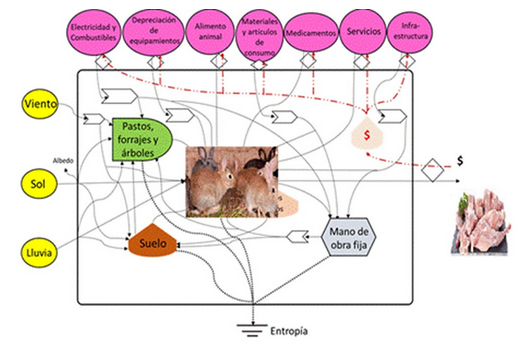
This study evaluates the sustainability of a rabbit production system using the Emergetic Synthesis methodology, which integrates energy, material, and economic service, flows into a single unit (emjoule or sej). The research was conducted on a rabbit production system established at the "El Guayabal" University Farm, belonging to the Agrarian University of Havana (UNAH). The analysis considered the production closing period of 2025, with data extending into January 2026. An initial herd of 100 rabbits and a final herd of 239 rabbits were analyzed, fed a specific diet and receiving basic health management. Traditional emergetic indices (Transformability, Energy Performance Ratio, Environmental Load Ratio, and Emergetic Sustainability Index) were calculated and analyzed, as well as economic indicators (Net Income, Total Cost, Net Benefit, and Benefit/Cost Ratio). The results indicate that the system exhibits efficiency in the use of local renewable resources, with moderate transformation and a low environmental impact, reflecting acceptable sustainability but with room for improvement. Economically, the system showed profitability. These results demonstrate that Emergetic Synthesis is a robust tool for diagnosing the overall sustainability of rabbit production systems, recommending the optimization of non-renewable input use and the strengthening of food self-sufficiency.
Article Details

This work is licensed under a Creative Commons Attribution-NonCommercial 4.0 International License.
Aquellos autores/as que tengan publicaciones con esta revista, aceptan los términos siguientes:
- Los autores/as conservarán sus derechos de autor y garantizarán a la revista el derecho de primera publicación de su obra, el cuál estará simultáneamente sujeto a la Licencia de reconocimiento-no comercial de Creative Commons 4.0 que permite a terceros compartir la obra siempre que se indique su autor y su primera publicación esta revista. Bajo esta licencia el autor será libre de:
- Compartir — copiar y redistribuir el material en cualquier medio o formato
- Adaptar — remezclar, transformar y crear a partir del material
- El licenciador no puede revocar estas libertades mientras cumpla con los términos de la licencia
Bajo las siguientes condiciones:
- Reconocimiento — Debe reconocer adecuadamente la autoría, proporcionar un enlace a la licencia e indicar si se han realizado cambios. Puede hacerlo de cualquier manera razonable, pero no de una manera que sugiera que tiene el apoyo del licenciador o lo recibe por el uso que hace.
- NoComercial — No puede utilizar el material para una finalidad comercial.
- No hay restricciones adicionales — No puede aplicar términos legales o medidas tecnológicas que legalmente restrinjan realizar aquello que la licencia permite.
- Los autores/as podrán adoptar otros acuerdos de licencia no exclusiva de distribución de la versión de la obra publicada (p. ej.: depositarla en un archivo telemático institucional o publicarla en un volumen monográfico) siempre que se indique la publicación inicial en esta revista.
- Se permite y recomienda a los autores/as difundir su obra a través de Internet (p. ej.: en archivos telemáticos institucionales o en su página web) antes y durante el proceso de envío, lo cual puede producir intercambios interesantes y aumentar las citas de la obra publicada. (Véase El efecto del acceso abierto).
References
Bassan, E., Arcaro, I., & Ambrosio, L. (2015). Sustainability of milk production system: Capital diagnosis and emergy synthesis. Emergy synthesis 8. Proceedings of the 8th Biennial Emergy Conference.
Bastianoni, S., Campbell, D., Susani, L., & Tiezzi, E. (2005). The solar transformity of oil and petroleum natural gas. Ecological Modelling, 186(2), 212-220, ISSN: 0304-3800, Publisher: Elsevier.
Bernabé, R. J., Garreta, A., & Lage, O. (2024). A decentralized private data marketplace using blockchain and secure multi-party computation. ACM Transactions on Privacy and Security, 27(2), 1-29, ISSN: 2471-2566, Publisher: ACM New York, NY.
Brandt, W. S., & Fogelberg, S. (2004). Nested comparative emergy assessments using milk production as a case study. 3rd Biennial Emergy Research Conference.
Cavalett, O., De Queiroz, J. F., & Ortega, E. (2006). Emergy assessment of integrated production systems of grains, pig and fish in small farms in the South Brazil. Ecological Modelling, 193(3-4), 205-224, ISSN: 0304-3800, Publisher: Elsevier.
Coelho, O., Ortega, E., & Comar, V. (2003). Balanço de emergia do Brasil. Engenharia Ecol’ogica e Agricultura Sustent’avel (Ecological Engineering and Sustainable Agriculture). Enrique Ortega.
Funes, M. F. R. (2009). Agricultura con futuro. La alternativa agroecológica para Cuba. Universidad de Matanzas, Estación Experimental “Indio Hatuey.
Giampietro, M., Bukkens, S. G., & Pimentel, D. (1994). Models of energy analysis to assess the performance of food systems. Agricultural Systems, 45(1), 19-41, ISSN: 0308-521X, Publisher: Elsevier.
Hernández, A., Pérez, J. M., Bosch, D., & Speck, N. C. (2019). La clasificación de suelos de Cuba: Énfasis en la versión de 2015. Cultivos tropicales, 40(1), ISSN: 0258-5936, Publisher: Ediciones INCA.
Lomas, P., Di Donato, M., & Ulgiati, S. (2007). La síntesis emergética: Una valoración de los servicios de los ecosistemas con base termodinámica. Ecosistemas, 16(3), ISSN: 1697-2473.
López, B. E. J., García, M. Y., & Valdés, L. A. (2018). Evaluación de la sostenibilidad de la producción de azúcar crudo mediante el análisis emergético. Centro Azúcar, 45(2), 59-67, ISSN: 2223-4861, Publisher: Universidad Central" Marta Abreu" de Las Villas.
Odum, H. T. (1996). Scales of ecological engineering. Ecological Engineering, 6(1-3), 7-19, ISSN: 0925-8574, Publisher: Elsevier.
Odum, H. T., Brown, M. T., & Brandt-Williams, S. (2000). Handbook of emergy evaluation Folio 1: Introduction and global budget. University of Florida, Gainesville, 16.
Ortega, E., Anami, M., & Diniz, G. (2002). Certification of food products using emergy analysis. 227-237.
Palma, O., & Hurtado, E. (2010). Comportamiento productivo de conejos durante el período de crecimiento-engorde alimentados con frutos de mango (Mangifera indica) en sustitución parcial del alimento balanceado comercial. Idesia (Arica), 28(1), 33-37, ISSN: 0718-3429, Publisher: SciELO Chile.
Riverón, S. (2000). Present situation of rabbit production in Cuba. 7th World Rabbit Congress, vol B, (págs. 131-134). Valencia.