Methodology for sedimentation studies in water sources. Case of the “Niña Bonita” reservoir
Article Sidebar
Main Article Content
Abstract
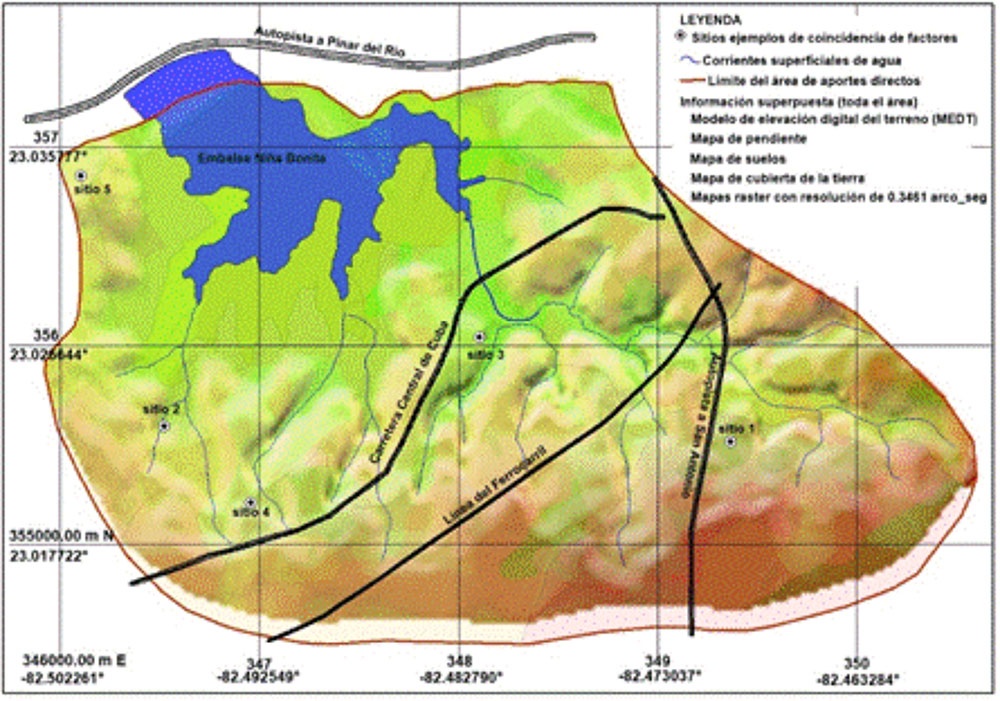
The importance of taking into account all the key factors that affect the process of sediment entrainment and deposition in the Niña Bonita reservoir, in the province of Havana, Cuba, is analyzed. This reservoir is located within the Jaimanitas River watershed and receives water supplies from one of the sub-basins. It is a territory that serves as a reference, from the methodological point of view, to address this problem in other watersheds of the Country. Among the factors of greatest incidence are the soil, the land cover, surface water currents and the slope. A strategy is needed in the use and management of natural resources, with emphasis on water, soils and land cover. To follow up the problem with advanced information technologies: Global Positioning System by Satellite (GPS); Remote Sensing (TD); Computer-Aided Model (CAD) and Geographic Information System (GIS). The objectives of the work are summarized in: (1) to create the Geographic Information System (GIS) for the territory that contributes the sediments to the aforementioned reservoir; (2) comprehensive characterization of the incident territory on the Niña Bonita reservoir, with emphasis on the contributions of sediments.
Article Details

This work is licensed under a Creative Commons Attribution-NonCommercial 4.0 International License.
Aquellos autores/as que tengan publicaciones con esta revista, aceptan los términos siguientes:
- Los autores/as conservarán sus derechos de autor y garantizarán a la revista el derecho de primera publicación de su obra, el cuál estará simultáneamente sujeto a la Licencia de reconocimiento-no comercial de Creative Commons 4.0 que permite a terceros compartir la obra siempre que se indique su autor y su primera publicación esta revista. Bajo esta licencia el autor será libre de:
- Compartir — copiar y redistribuir el material en cualquier medio o formato
- Adaptar — remezclar, transformar y crear a partir del material
- El licenciador no puede revocar estas libertades mientras cumpla con los términos de la licencia
Bajo las siguientes condiciones:
- Reconocimiento — Debe reconocer adecuadamente la autoría, proporcionar un enlace a la licencia e indicar si se han realizado cambios. Puede hacerlo de cualquier manera razonable, pero no de una manera que sugiera que tiene el apoyo del licenciador o lo recibe por el uso que hace.
- NoComercial — No puede utilizar el material para una finalidad comercial.
- No hay restricciones adicionales — No puede aplicar términos legales o medidas tecnológicas que legalmente restrinjan realizar aquello que la licencia permite.
- Los autores/as podrán adoptar otros acuerdos de licencia no exclusiva de distribución de la versión de la obra publicada (p. ej.: depositarla en un archivo telemático institucional o publicarla en un volumen monográfico) siempre que se indique la publicación inicial en esta revista.
- Se permite y recomienda a los autores/as difundir su obra a través de Internet (p. ej.: en archivos telemáticos institucionales o en su página web) antes y durante el proceso de envío, lo cual puede producir intercambios interesantes y aumentar las citas de la obra publicada. (Véase El efecto del acceso abierto).
References
Arcia, P. J., & Herrera, P. J. (2023). Primera aproximación de agrupamiento espacial de suelos para la gestión del agua con fines de riego. Ingeniería Agrícola, 13(3), ISSN: 2227-8761.
Cutié, V., & Lapinel, B. (2013). La Sequía en Cuba. Un Texto de Referencia. Instituto de Meteorología, Centro del Clima.
Droogers, P., & van de Giesen, N. (2010). Food and Water: Analysis of potentially new themes in water management - future trends and research needs. https://www.futurewater.nl/wp-content/uploads/2011/05/BMBF_Food_v05.pdf
DNSF. (1998). Mapa Nacional de Suelos a escala 1: 25 000. [Documentos del Instituto de Suelos, La Habana, Cuba]. Instituto de Suelos, La Habana, Cuba.
García, C., Martínez, F., Rivero, L., Morales, A., Dueñas, G., Caraballo, A., Oliva, D., & Oliva Á. D. (2024). Evaluación de indicadores de calidad de suelos en la Finca “Los Olivas”, provincia de Matanzas. Ingeniería Agrícola 14 (2).
Gonzalo A. & Mora, J (2021). Gestión Integral de Sedimentos de Embalses: razones para su justificación. https://www.google.com/search?channel=fs&client=ubuntu&q=Sedimentos+en+embalses
Hernández, A., Pérez, J. M., Bosch, D., & Castro, N. (2015). Clasificación de los suelos de Cuba 2015. Instituto Nacional de Ciencias Agrícolas e Instituto de Suelos. Ediciones INCA; ISBN: 978-959-7023-77-7.
Malone, B. P., Minasny, B., & McBratney, A. B. (2017). Using R for Digital Soil Mapping. Springer International Publishing.
McBratney, A. B., Mendonca Santos, M. L., & Minasny, B. (2003). On Digital Soil Mapping. Geoderma, 117(1-2), 3-52.
NC ISO 11272 (2003). Calidad del suelo, determinación de la densidad aparente en base al suelo seco. Publisher: Oficina Nacional de Normalización, La Habana, Cuba.
Rivero, L., Ruiz, J., Rivero, M., & Tamariz, V. (2013). Los suelos, la cobertura vegetal y el relieve en el municipio de Tzicatlacoyan, estado de Puebla, México. Revista GEOMINAS, 61, 95-105.
Rivero, L., López, S., Farradaz, M., Fuentes, E., Pérez, J. M., Demedio, M., Fraser, T., Beltrán, A., Morales, R., & La O, M. (2024). Metodología para la aplicación de Ciencia e Innovación Tecnológica en apoyo a seguridad alimentaria sostenible. Ingeniería Agrícola, 14(1).
Rivero, L., Farradás, M., García, C., Beltrán, A., & Morales, M. (2025). Tecnologías Avanzadas de la Información (TAInf) en el estudio, conservación y mejoramiento de ecosistemas terrestres (ET) y agroecosistemas (AES). Ingeniería Agrícola 15.