Effect of EcoMic® and CBFERT ecological fertilizers on the growth of tomato seedlings
Article Sidebar
Main Article Content
Abstract
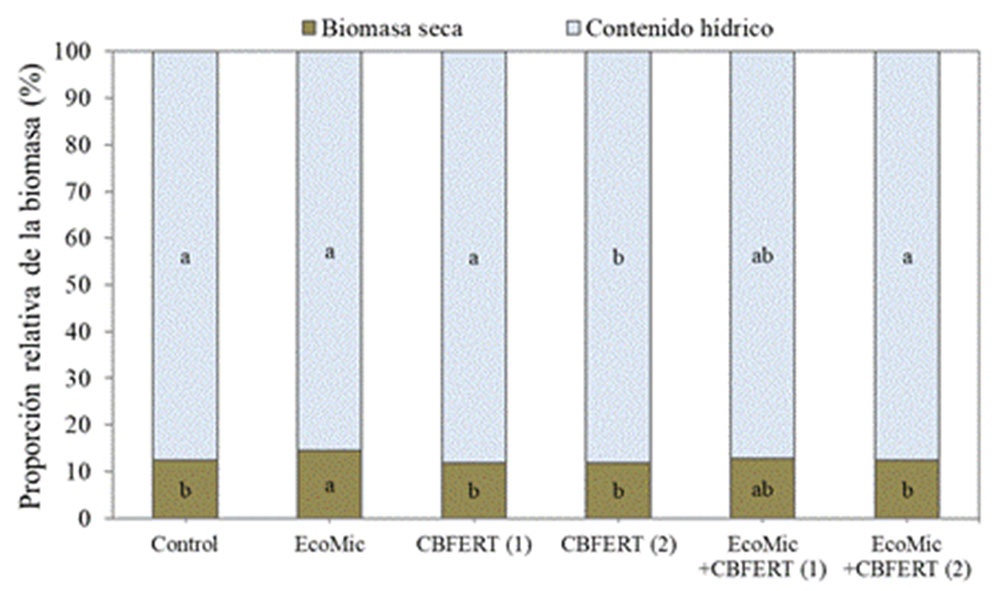
Using alternatives to chemical fertilizers continues to be a priority for sustainable agriculture in Cuba. EcoMic® and CBFERT are ecological fertilizers of national production with promising results; however, their combined effect on plant growth has not been sufficiently explored. The present study was conducted with the objective of evaluating the effect of the simple and combined use of EcoMic® and CBFERT on the growth of tomato seedlings (Solanum lycopersicum L. cv. L-43) in trays. A completely randomized design with a factorial arrangement was employed. The treatments included seedlings that were either untreated or inoculated with EcoMic® biofertilizer, in conjunction with three levels of CBFERT (0, 1, and 2 applications). The evaluations were carried out on 20 seedlings selected at random from each treatment. The variables measured included leaf number, stem length and diameter, biomass (both fresh and dry weight), and water content. The results demonstrated a differentiated response in tomato seedling growth between one and two applications of CBFERT, either alone or in combination with EcoMic®. At this early stage of the crop, CBFERT applications may determine changes in seedling growth; however, the relative proportion of dry biomass is favored with EcoMic®. Consequently, the combination of EcoMic® and two applications of CBFERT allows to obtain healthy seedlings, with quality morphological and phenological parameters. Future trials should explore the applications of these biostimulants in crop production.
Article Details

This work is licensed under a Creative Commons Attribution-NonCommercial 4.0 International License.
Aquellos autores/as que tengan publicaciones con esta revista, aceptan los términos siguientes:
- Los autores/as conservarán sus derechos de autor y garantizarán a la revista el derecho de primera publicación de su obra, el cuál estará simultáneamente sujeto a la Licencia de reconocimiento-no comercial de Creative Commons 4.0 que permite a terceros compartir la obra siempre que se indique su autor y su primera publicación esta revista. Bajo esta licencia el autor será libre de:
- Compartir — copiar y redistribuir el material en cualquier medio o formato
- Adaptar — remezclar, transformar y crear a partir del material
- El licenciador no puede revocar estas libertades mientras cumpla con los términos de la licencia
Bajo las siguientes condiciones:
- Reconocimiento — Debe reconocer adecuadamente la autoría, proporcionar un enlace a la licencia e indicar si se han realizado cambios. Puede hacerlo de cualquier manera razonable, pero no de una manera que sugiera que tiene el apoyo del licenciador o lo recibe por el uso que hace.
- NoComercial — No puede utilizar el material para una finalidad comercial.
- No hay restricciones adicionales — No puede aplicar términos legales o medidas tecnológicas que legalmente restrinjan realizar aquello que la licencia permite.
- Los autores/as podrán adoptar otros acuerdos de licencia no exclusiva de distribución de la versión de la obra publicada (p. ej.: depositarla en un archivo telemático institucional o publicarla en un volumen monográfico) siempre que se indique la publicación inicial en esta revista.
- Se permite y recomienda a los autores/as difundir su obra a través de Internet (p. ej.: en archivos telemáticos institucionales o en su página web) antes y durante el proceso de envío, lo cual puede producir intercambios interesantes y aumentar las citas de la obra publicada. (Véase El efecto del acceso abierto).
References
Aldasoro, G. J. (2017). Disponibilidad hídrica y fijación de nitrógeno en leguminosas: Fisiología, metabolismo y proteómica [Tesis de Doctorado]. Universidad Pública de Navarra, Pamplona, España.
Ávila-Amador, C., Algentel-Martínez, L., Peñuelas-Rubio, O., González-Aguilera, J., & Fonseca-Reyna, I. (2022). Response of the tomato crop (Solanum lycopersicum L.) to the application of QuitoMax® in salinity conditions. Research, Society and Development, 11(12), e10111233870.
Cabrera, R. Y. L., Miranda, I. E., & Santana, B. Y. (2016). Efectividad y momentos de aplicación del biofertilizante EcoMicâ en la producción de Solanum lycopersicum L. var. Mamonal 21. Avances, 18(1), 76-85, ISSN: 1562-3297, Publisher: Centro de Información y Gestión Tecnológica. CIGET.
Canciano, F. J., Valladares, R. M., Velázquez, B. J., & Darianne, H. A. J. (2019). Propuesta de aprovechamiento de residuales generados en la producción del CBFERT. Revista Centro Azúcar, 46(5), 91-95, ISSN: 2223-4861.
Castañeda, W., Toro, M., Solorzano, A., & Zúñiga, D. D. (2020). Production and nutritional quality of tomatoes (Solanum lycopersicum var. Cerasiforme) are improved in the presence of biochar and inoculation with arbuscular mycorrhizae. American Journal of Plant Sciences, 11(3), 426-436, Publisher: Scientific Research Publishing.
Chafai., W., Haddioui, K., Serghini, C. H., Labazi, H., AlZain, M. N., Noman, O., Parvez, M. K., Addi, M., & Khalid, A. (2023). Impact of Arbuscular mycorrhizal Fungal Strains Isolated from Soil on the Growth, Yield, and Fruit Quality of Tomato Plants under Different Fertilization Regimens. Horticulturae, 23(9), 973.
Espinosa, W., Ríos, C., & Díaz, T. (2021). Producción ecológica del tomate Solanum Lycopersicum L. (var. Campbell 28) con el uso de zeolita natural mezclada con estiércol vacuno. Centro Agrícola, 48(1), 23-27.
Fernández, J., Hernández, D. M. I., & Salgado, P. J. M. (2021). Sistemas de biofertilización en el cultivo del tomate (Solanum lycopersicum L.). Avances, 23(4), 384-396.
Fornaris, S. A. A., Castillo, F. J., & Echavarría, H. J. (2022). Efecto de dosis foliar y edáfica del lixiviado microbiano en la producción de tomate (Solanum Lycopersicum l.). Ciencia en su PC, 1(3), 88-101, ISSN: 1027-2887, Publisher: Centro de Información y Gestión Tecnológica de Santiago de Cuba.
Hernández, J., Pérez, J., Bosch, I., & Castro, S. (2015). Clasificación de los suelos de Cuba 2015 (Ediciones INCA, Vol. 93). Ediciones INCA, San José de Las Lajas, Mayabeque, Cuba.
Iftikhar, S., Saleem, M., Ahmad, K., & Jaffri, S. (2019). Synergistic mycoflora-natural farming mediated biofertilization and heavy metals decontamination of lithospheric compartment in a sustainable mode via Helianthus annuus. International Journal of Environmental Science and Technology, 16(2), 6735-6752, ISSN: 1735-1472, Publisher: Springer.
Minag-Cuba. (2020). Manual práctico para uso de bioproductos y fertilizantes líquidos. Ministerio de la Agricultura (MINAG), La Habana, Cuba.
Minitab. (2015). Minitab 17: Gretting started with Minitab 17 (p. 87). MinitabInc, Pennsylvania.
Montero, L., Duarte, C., León, M., Cun, R., & Rodríguez, B. (2008). Fertirrigación ecológica en el cultivo del tomate en condiciones protegidas. Revista Ciencias Técnicas Agropecuarias, 17(3), 18-21, ISSN: 1010-2760, Publisher: Universidad Agraria de La Habana Fructuoso Rodríguez Pérez.
Morales, G. D., Rodríguez, L. L., Dell’Amico, R. J., Jerez, M. E., & Estrada, P. W. (2018). Efecto de dos bioestimulantes y hongos micorrízicos en plantas de tomate sembradas a altas temperaturas. Cultivos Tropicales, 39(3), 41-48.
Pilatuña, Q. M. F., González, P. M. M., Mero, G. M. E., & Risco, A. D. (2021). Evaluación agronómica de bacterias fijadoras de nitrógeno aisladas de suelos andinos en plántulas de lechuga y tomate. Investigación Agraria, 23(1), 47-52, ISSN: 2305-0683, Publisher: Universidad Nacional de Asunción.
Reyes-Pérez, J. J., Enríquez-Acosta, E. A., Ramírez-Arrebato, M. A., Rodríguez-Pedroso, A. T., & Falcón-Rodríguez, A. (2020). Efecto de ácidos húmicos, micorrizas y quitosano en indicadores del crecimiento de dos cultivares de tomate (Solanum lycopersicum L.). Terra Latinoamericana, 38(3), 653-666, ISSN: 0187-5779, Publisher: Sociedad Mexicana de la Ciencia del Suelo AC.
Rivera, R., Fernández, F., Ruiz, L., González, P. J., Rodríguez, Y., Pérez, E., & Ruiz, S. M. (2020). Manejo, integración y beneficios del biofertilizante micorrízico EcoMic en la producción agrícola (R. Rivera (ed), 151:). Ediciones INCA, San José de las Lajas, San Jose de las Lajas Mayabeque, Cuba.
Santana-Baños, Y., Ruiz, S. M., Miranda, I. E., & Hernández, H. C. (2024). Respuesta a la inoculación de tres cepas de hongos micorrízicos arbusculares en plantas de tomate. Revista de la Facultad de Ciencias, 13(2), 117-127, ISSN: 2357-5549.
Santana-Baños, Y., del Busto-Concepción, A., González-Fuentes, Y., Aguiar-González, I., Carrodeguas-Díaz, S., Páez Fernández, P. L., & Díaz-Lugo, G. (2016). Efecto de Trichoderma harzianum Rifai y FitoMas-E® como bioestimulantes de la germinación y crecimiento de plántulas de tomate. Centro agrícola, 43(3), 5-12, ISSN: 0253-5785, Publisher: 1977, Editorial Feijóo.
Supithak, A., Wongsuwan, W., & Vongsarnpigoon, L. (2016). Application of Minitab 17 Statistical Software to Analysis of Students of the Faculty of Engineering, Thai-Nichi Institute of Technology. Journal of Engineering and Digital Technology (JEDT), 4(1), 17-21, ISSN: 2774-0617.