Avocado Crops Evapotranspiration and Irrigation demand at Güira de Melena-Alquizar Region, Cuba
Article Sidebar
Main Article Content
Abstract
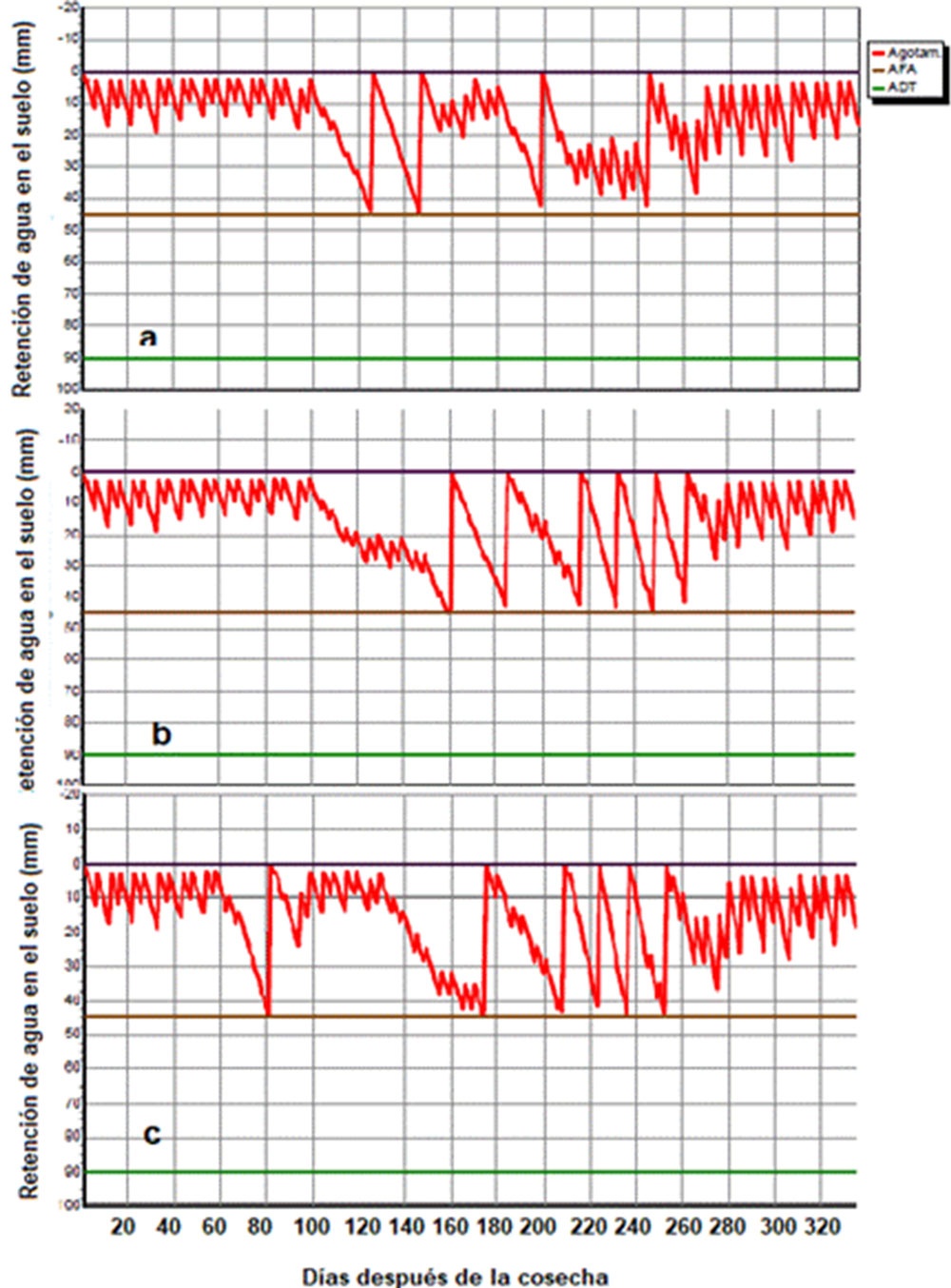
Avocado is a fruit of economic and nutritional importance: and in Cuba, crop policy about this crop is aimed at increasing yields and planted areas. Although numerous agronomic studies have been conducted on this crop in the Country, there are no national reports on water and irrigation requirements. Therefore, this study aimed to determine crop evapotranspiration (ETc) and irrigation demand for the area comprised of the municipalities of Güira de Melena and Alquízar in Artemisa Province, using the CropWat 8.0 program with decadal average values of climate variables obtained for the Güira de Melena-Alquízar Station, collected from the National Agrometeorological Bulletin of the Institute of Meteorology, and 48 year historical rainfall series from a rain gauge located in the study area. The results indicate that under the conditions studied, crop evapotranspiration in the months of November to February reaches the lowest values and from this date onwards the ETc increases until reaching its maximum value in the months of April to May (4,5 mm/day) coinciding with the period of development and thickening of the fruit, the total irrigation demand for the harvest to harvest period fluctuated depending on the probability of rainfall, with values of 258,6, 308,1 and 363,2 mm, distributed in 5, 7 and 7 irrigations for the years of 25, 50 and 80% probability, respectively.
Article Details

This work is licensed under a Creative Commons Attribution-NonCommercial 4.0 International License.
Aquellos autores/as que tengan publicaciones con esta revista, aceptan los términos siguientes:
- Los autores/as conservarán sus derechos de autor y garantizarán a la revista el derecho de primera publicación de su obra, el cuál estará simultáneamente sujeto a la Licencia de reconocimiento-no comercial de Creative Commons 4.0 que permite a terceros compartir la obra siempre que se indique su autor y su primera publicación esta revista. Bajo esta licencia el autor será libre de:
- Compartir — copiar y redistribuir el material en cualquier medio o formato
- Adaptar — remezclar, transformar y crear a partir del material
- El licenciador no puede revocar estas libertades mientras cumpla con los términos de la licencia
Bajo las siguientes condiciones:
- Reconocimiento — Debe reconocer adecuadamente la autoría, proporcionar un enlace a la licencia e indicar si se han realizado cambios. Puede hacerlo de cualquier manera razonable, pero no de una manera que sugiera que tiene el apoyo del licenciador o lo recibe por el uso que hace.
- NoComercial — No puede utilizar el material para una finalidad comercial.
- No hay restricciones adicionales — No puede aplicar términos legales o medidas tecnológicas que legalmente restrinjan realizar aquello que la licencia permite.
- Los autores/as podrán adoptar otros acuerdos de licencia no exclusiva de distribución de la versión de la obra publicada (p. ej.: depositarla en un archivo telemático institucional o publicarla en un volumen monográfico) siempre que se indique la publicación inicial en esta revista.
- Se permite y recomienda a los autores/as difundir su obra a través de Internet (p. ej.: en archivos telemáticos institucionales o en su página web) antes y durante el proceso de envío, lo cual puede producir intercambios interesantes y aumentar las citas de la obra publicada. (Véase El efecto del acceso abierto).
References
Allen, R. G., Pereira, L. S., Raes, D., & Smith, M. (2006). Evapotranspiración del cultivo: Guías para la determinación de los requerimientos de agua de los cultivos (Estudio FAO Riego y Drenaje 56, Vol. 298). FAO.
Cañizares, Z. J. (1973). Los aguacateros. Edición Revolucionaria.
Cid, G., López, T., González, F., Herrera, J., & Ruiz, M. E. (2012). Características físicas que definen el comportamiento hidráulico de algunos suelos de Cuba. Ingeniería Agrícola, 2(2), 25-31.
Cisneros-Zayas, E., González-Robaina, F., Herrera-Puebla, J., Duarte-Díaz, C., & Matos-Cremé, H. (2020). Influencia de la programación del riego en los consumos energéticos. Ingeniería Agrícola, 10(4), 3-11.
Climent, J. (2020). Cultivo del Aguacate. Formación y Transferencia-Ficha Técnica. https://agroambient.juntaex.es/documents/163228750/169854881/Ficha+Aguacate.pdf/
Doorembos, J., & Kassan, A. H. (1979). Yield response to water (FAO Irrigation and Drainage Paper No. 33). FAO.
FAO. (2016). Cropwat 8.0 Example. https://www.fao.org/nr/water/docs/CROPWAT8.0_Ex.pdf
Ferreyra, R., & Selles, V. (2007). Manejo del riego y suelo en Palto (Boletín INIA-Instituto de Investigaciones Agropecuarias, No. 160). Instituto de Investigaciones Agropecuarias (INIA). https://hdl.handle.net/20.500.14001/7110
Ferreyra, R., & Seller, G. (2012). Aguacate. Respuesta del rendimiento de los cultivos al agua. En P. Steduto, T.C. Hsiao, E. Fereres, & D. Raes (Eds.), Estudio FAO Riego y Drenaje N° 66 (pp. 442-447). FAO.
Fontova, M., & García, E. (2000). Ingeniería de Riego. Editorial Félix Varela.
Greenhalgh, T. (2020). How much water does avocado farming consume? https://www.savemoneycutcarbon.com/learn-save/how-much-water-does-avocado-farming-consume/
Hoffman, H. F., & du Plessis, S. F. (1999). Seasonal water requirements of Avocados trees grown under sub-tropical conditions. Revista Chapingo Serie Horticultura, 5(%), 191-194.
Holzapfel, E., Alves de Souza, J., & Carvallo-Guerra, H. (2017). Response of avocado production to variations in irrigation levels. Irrigation Science, 35, 205-215. https://doi.org/10.1007/s00271-017-0533-0
IIFT. (2021). Los frutales en la soberanía alimentaria y nutricional de Cuba. Instituto de Investigaciones en Fruticultura Tropical, IIFT.
Jiménez, R., Parra, C., Pedrera, B., Hernández, L., Blanco, M., Martínez, F., & Álvarez, J. (2005). Manual práctico para el cultivo del aguacatero en Cuba. Unidad Científico Tecnológica de Base de Alquizar. Instituto de Investigaciones en Fruticultura Tropical.
Kaneko, T. (2016). Water requirements for’Hass’ avocado flowering and fruit development in New Zealand (Tesis de maestría, University of Waikato).
Matos-Cremé, H., Cisneros-Zayas, E., Herrera-Puebla, J., González-Robaina, F., & Duarte-Díaz, C. (2020). Contribución a la protección del recurso agua en el municipio Güira de Melena. Ingeniería Agrícola, 10(2), 5-14.
MINAG-Cuba. (2018). Programa para incrementar las áreas agrícolas con sistemas eficientes de riego de agua (Informe técnico 33). Ministerio de la Agricultura.
ONEI. (2019). Anuario Estadístico de Artemisa. Edición de 2019. Oficina Nacional de Estadísticas e Información. https://www.onei.cu
Smith, M. (1992). CROPWAT: a computer program for irrigation planning and management (Irrigation and Drainage Paper 46). Food and Agriculture Organization of the United Nations.
Singh, L. (2020). Advocado Irrigation. Literature Review. https://avocado.org.au/wp-content/uploads/2021/04/2020-Irrigation-Literature-Review-FINAL-Liz-Singh-AAL.pdf
Singh, S. (2019). Irrigating advocados. AgriHort. https://avocado.org.au/wp-content/uploads/2019/12/6.-Irrigating-Avocados-Shane-Singh-CQ-Final-191127.pdf
Tejeda-Marrero, V. M., Herrera-Puebla, J., Sarmiento-García, O., Cruz-Cruz, K., & Chaterlán-Durruthy, Y. (2022). Consumo de agua y coeficientes de cultivo en plantaciones de fomento de aguacate cv Govin. Revista Ciencias Técnicas Agropecuarias, 31(4).