Characterization of the Structural State of Ferralitic Soils in Semi-Protected Crops on the "Roma" Farm
Article Sidebar
Main Article Content
Abstract
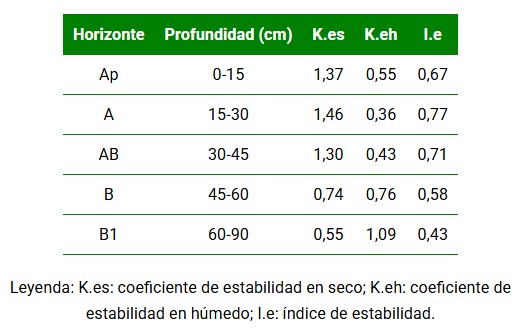
The soil structure is defined as the ability of the soil mass to disaggregate by itself into separations of different shapes and sizes, which can be evaluated through the stability of the aggregates. The following work was carried out with the aim of evaluating the impact of structural state in Ferralitic soils on the Roma farm, San Nicolás de Bari municipality, Mayabeque Province. The stability of the structure determines the degradation state of the soils and is an important parameter of their quality, summarizing both the negative and positive effects on agricultural management systems. Furthermore, it is very closely related to the formation of microaggregates, especially in Ferralitic soils. Samples were taken at different depths. Soil profile horizons were analyzed under dry and wet conditions by measuring the structural stability coefficient and the distribution of aggregates. It was evidenced that the values reflected for the dry stability coefficient in the upper horizons of the profile showed a good distribution of aggregates, which had high percentages in the ranges of 0.25 to 10 mm in diameter, indicating the presence of granular structure on the surface and abundant medium subangular blocks deeper down. However, from 45 to 90 cm deep in the profile, this distribution is affected, as larger aggregates of the mainly prismatic block type begin to form.
Article Details

This work is licensed under a Creative Commons Attribution-NonCommercial 4.0 International License.
Aquellos autores/as que tengan publicaciones con esta revista, aceptan los términos siguientes:
- Los autores/as conservarán sus derechos de autor y garantizarán a la revista el derecho de primera publicación de su obra, el cuál estará simultáneamente sujeto a la Licencia de reconocimiento-no comercial de Creative Commons 4.0 que permite a terceros compartir la obra siempre que se indique su autor y su primera publicación esta revista. Bajo esta licencia el autor será libre de:
- Compartir — copiar y redistribuir el material en cualquier medio o formato
- Adaptar — remezclar, transformar y crear a partir del material
- El licenciador no puede revocar estas libertades mientras cumpla con los términos de la licencia
Bajo las siguientes condiciones:
- Reconocimiento — Debe reconocer adecuadamente la autoría, proporcionar un enlace a la licencia e indicar si se han realizado cambios. Puede hacerlo de cualquier manera razonable, pero no de una manera que sugiera que tiene el apoyo del licenciador o lo recibe por el uso que hace.
- NoComercial — No puede utilizar el material para una finalidad comercial.
- No hay restricciones adicionales — No puede aplicar términos legales o medidas tecnológicas que legalmente restrinjan realizar aquello que la licencia permite.
- Los autores/as podrán adoptar otros acuerdos de licencia no exclusiva de distribución de la versión de la obra publicada (p. ej.: depositarla en un archivo telemático institucional o publicarla en un volumen monográfico) siempre que se indique la publicación inicial en esta revista.
- Se permite y recomienda a los autores/as difundir su obra a través de Internet (p. ej.: en archivos telemáticos institucionales o en su página web) antes y durante el proceso de envío, lo cual puede producir intercambios interesantes y aumentar las citas de la obra publicada. (Véase El efecto del acceso abierto).
References
Álvarez, R., & Steinbach, H.S. (2006). Efecto del sistema de labranza sobre la materia orgánica. Materia orgánica: Valor agronómico y dinámica en suelos pampeanos. Facultad de Agronomía, Universidad de Buenos Aires, 69-78.
Bateman, A.M., Erickson, T. E., Merritt, D.J., Veneklaas, E. J., & Muñoz, M. (2019). Water availability drives the effectiveness of inorganic amendments to increase plant growth and substrate quality. Catena, 182, 104 116.
Bernal, A., Hernández, A., Mesa, M., Rodríguez, O., González, P.J., & Reyes, R. (2015). Características de los suelos y sus factores limitantes de la región de murgas, provincia La Habana. Cultivos tropicales, 36(2), 30-40.
Bernal, A., & Hernández, A. (2017). Influencia de diferentes sistemas de uso del suelo sobre su estructura. Cultivos Tropicales, 38(4), 50-57.
Bernal, A., Hernández, A., González, P.J., & Cabrera, A. (2019). Caracterización de dos tipos de suelos dedicados a la producción de plantas forrajeras. Cultivos Tropicales, 40(3).
Burrell, L. D., Zehetner, F., Rampazzo, N., Wimmer, B., & Soja, G. (2016). Long-term effects of biochar on soil physical properties. Geoderma, 282, 96-102.
Buschiazzo, D.E., Panigatti, J. L., & Unger, P.W. (1998). Tillage effects on soil properties and crop production in the subhumid and semiarid Argentinean Pampas. Soil and Tillage Research, 49(1-2), 105-116.
Carfagno, P., Irigoin, J., Civeira, G., & Irigoin, N. (2021). Cuidar el suelo, es cuidar la vida. Asociación Argentina de la Ciencia del Suelo, Argentina.
Chavarría, F. (2009). Diseño de Relleno Sanitario para el municipio de San Ramón. Departamento de Matagalpa.
Díaz-Zorita, M., & Basanta, M. (1999). Efectos de seis años de labranzas en un Hapludol del noroeste de Buenos Aires, Argentina. Ciencia del Suelo, 17(1), 31-36.
Dorant, J.W., A. Jones, M. Arshad & J. Gilley. (2000). Determinants of soil quality and heath. In: Soil Quality and Soil Erosion, Lal R. (ed.) CRC Press: Boca Raton, FL. Pp. 17-38.
Durán, S., & Acosta, R. (2018). Suelos, degradación, recuperación y manejo en el trópico. Editorial Científico Técnica. La Habana 2018. Instituto Cubano del Libro.
Febles J.M., Febles J., Sobrinho, M.B.A., Tolón, A., Lastra‐Bravo, X., & Botta, G. F. (2019). Resilience of Red Ferralitic soils in the karst regions of Mayabeque Province, Cuba. Land degradation & development, 30(1), 109-116.
Ferreras, L., Toresani, S., Faggioli, V. & Galarza, C. (2015). Sensibilidad de indicadores biológicos edáficos en un Argiudol de la Región Pampeana Argentina. Revista Spanish Journal of Soil Science, 5(3).
Garcia, P.A. (2009). Erosion Processes and Control (Doctoral dissertation, University of Arizona).
Hernández, A., Cabrera, A., Borges, Y., Vargas, D., Bernal, A., Morales, M., & Ascanio, M.O. (2013). Degradación de los suelos Ferralíticos Rojos Lixiviados y sus indicadores de la Llanura Roja de La Habana. Cultivos Tropicales, 34(3), 45-51.
Hernández, C.L., Ramos, J., del Pino, M., & López, I. (2007). Efecto del estiércol de vacuno en la estabilidad estructural y la actividad biológica de un suelo bajo manejo agrícola. Acta Biológica Venezuelica, 27(2), 19-30.
Hernández, J.A., Pérez, J.J.M., Bosch, I.D., & Speck, N.C. (2019). La clasificación de suelos de Cuba: Énfasis en la versión de 2015. Cultivos Tropicales, 40(1), ISSN: 0258-5936, Publisher: Ediciones INCA
Morales, M., Vantour, A., & Hernández, A. (2006). Contenidos y formas del nitrógeno, fósforo y potasio de los suelos cafetaleros de Nipe-Sagua-Baracoa. Revista Café y Cacao, 7(1), 3-10.
Morell, F., & Hernández, A. (2008). Degradación de las propiedades agrobiológicas de los suelos Ferralíticos rojos lixiviados por la influencia antrópica y su respuesta agroproductiva al mejoramiento. Agronomía Tropical, 58(4), 33-343.
Pulido, M., Gabriels, D., Cornelis, W., & Lobo, D. (2013). Comparing aggregate stability tests for soil physical quality indicators. Land Degradation & Development 26(8): 843-852. Available from: https://onlinelibrary.wiley.com/ https://doi.org/10.1002/ldr.2225/full11
Porta, J., Reguerín, M., & Roquero, C. (2003). Edafología para la agricultura y el medio ambiente, Tercera edición; Impreso en España, Ediciones Mundi-prensa, pp.929.
Sanzano, G.A., Corbella, R.D., García, J.R., & Fadda, G.S. (2005). Degradación física y química de un Haplustol típico bajo distintos sistemas de manejo de suelo. Ciencia del suelo, 23(1), 93-100.