Hydraulic Evaluation of Surface Irrigation with Discontinuous Flow in Ferruginous Nodular Gleysol Soil
Article Sidebar
Main Article Content
Abstract
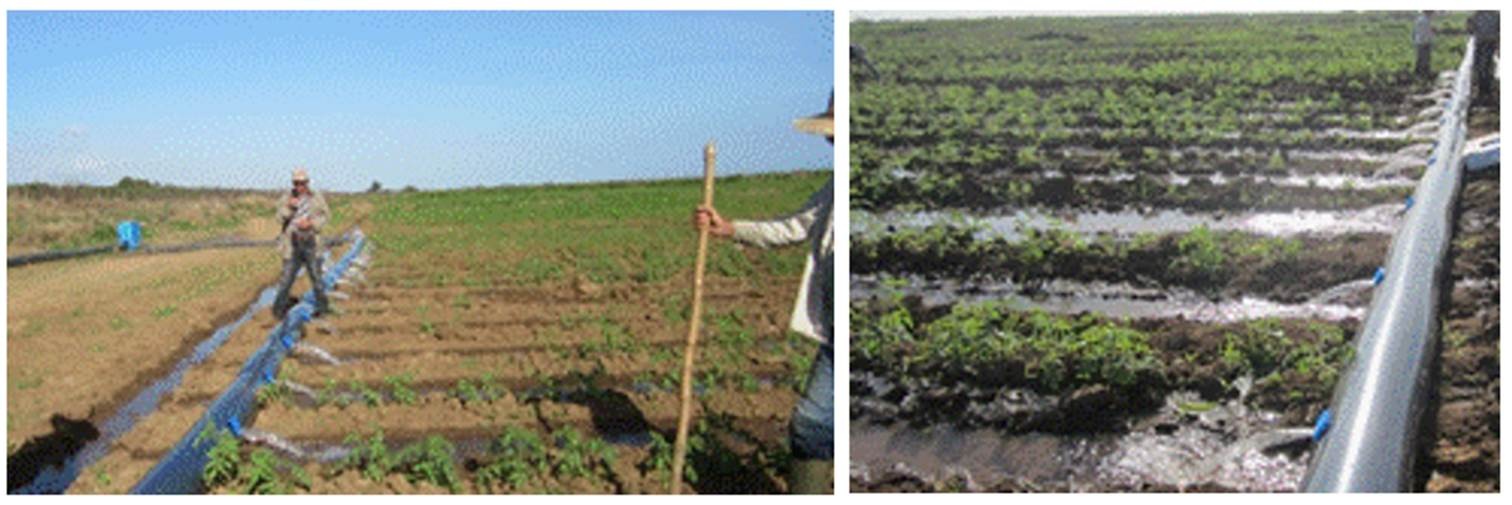
The objective of this work was to determine different hydraulic and design parameters of the surface irrigation technology with discontinuous flow compared to traditional surface irrigation in a Ferruginous Nodular Gleysol soil. The study was carried out in the farm "Julio Noris" belonging to the Base Business Unit "Sierra Maestra" in Pinar del Rio province, with an area of 3 ha dedicated to tomato (Solanum lycopersicum L) cultivation. Three variants were applied for the study, I (3 forward cycles and flow rate of 1,0 L s-1); II (4 forward cycles and flow rate of 0,6 L s-1) which were compared with the traditional variant III Witness (continuous flow and flow rate of 1,0 L s-1). The results show that for this type of soil with furrows 130 m long, the best variant is I, applying four irrigation pulses of variable times and flow rate of 0,6 L s-1, with which a water application efficiency of 69,23% is achieved. Irrigation with discontinuous flow compared to traditional irrigation improves water application efficiency by 29,55% and decreases the arrival time of the water advance front at the end of the furrow by 17,1 minutes.
Article Details

This work is licensed under a Creative Commons Attribution-NonCommercial 4.0 International License.
Aquellos autores/as que tengan publicaciones con esta revista, aceptan los términos siguientes:
- Los autores/as conservarán sus derechos de autor y garantizarán a la revista el derecho de primera publicación de su obra, el cuál estará simultáneamente sujeto a la Licencia de reconocimiento-no comercial de Creative Commons 4.0 que permite a terceros compartir la obra siempre que se indique su autor y su primera publicación esta revista. Bajo esta licencia el autor será libre de:
- Compartir — copiar y redistribuir el material en cualquier medio o formato
- Adaptar — remezclar, transformar y crear a partir del material
- El licenciador no puede revocar estas libertades mientras cumpla con los términos de la licencia
Bajo las siguientes condiciones:
- Reconocimiento — Debe reconocer adecuadamente la autoría, proporcionar un enlace a la licencia e indicar si se han realizado cambios. Puede hacerlo de cualquier manera razonable, pero no de una manera que sugiera que tiene el apoyo del licenciador o lo recibe por el uso que hace.
- NoComercial — No puede utilizar el material para una finalidad comercial.
- No hay restricciones adicionales — No puede aplicar términos legales o medidas tecnológicas que legalmente restrinjan realizar aquello que la licencia permite.
- Los autores/as podrán adoptar otros acuerdos de licencia no exclusiva de distribución de la versión de la obra publicada (p. ej.: depositarla en un archivo telemático institucional o publicarla en un volumen monográfico) siempre que se indique la publicación inicial en esta revista.
- Se permite y recomienda a los autores/as difundir su obra a través de Internet (p. ej.: en archivos telemáticos institucionales o en su página web) antes y durante el proceso de envío, lo cual puede producir intercambios interesantes y aumentar las citas de la obra publicada. (Véase El efecto del acceso abierto).
References
Allende, C. (2017). Manual de cultivo del tomate al aire libre Chile: Andrea Torres P. Instituto de Desarrollo Agropecuario-Instituto de Investigaciones Agropecuarias, Chile.
Carbajal, L. C. M. (2004). Metodología para el mejoramiento del uso del agua de riego empleando el sistema de riego intermitente [Tesis (Magíster Scientiae)]. Universidad Nacional Agraria La Molina, Facultad de Ingeniería Agrícola, Lima, Perú.
Cid, G.; López, T.; González, F.; Herrera, J.; & Ruiz, M.E. (2012). Características físicas que definen el comportamiento hidráulico de algunos suelos de Cuba, Ingeniería Agrícola, 2(2): 25-31.
Criddle, W. D. (1956). Methods for evaluating irrigation systems (Issue: 82). Soil Conservation Service, US Department of Agriculture.
Cuesta, T.; Neira, X.; Alvarez, C.; & Cancela, J. (2004). Evaluation of water-use in traditional irrigation An application to the lemons Valley irrigation district, northwest of Spain, Agricultural Water Management, 68.
GOC-Cuba. (2020). “Resolución 17/2020” Instituto Nacional de Recursos Hidráulicos. (GOC-2020-557-O61). La Habana, Cuba. Gaceta Oficial de la República de Cuba, 35pp. ISSN: 0864-0793, e-ISSN: 1682-7511.
Gómez, O.; Casanova, A.; Laterrot, H.; & Hanais, G. (2000). Mejora genética y manejo del cultivo del tomate para la producción en el caribe. Instituto de Investigaciones “Liliana Dimitrova”. La Habana. Cuba. ISBN: 959-7111-07-1.
Hernández, J. A., Pérez, J. J. M., Bosch, I. D., & Speck, N. C. (2019). La clasificación de suelos de Cuba: Énfasis en la versión de 2015. Cultivos Tropicales, 40(1), ISSN: 0258-5936, Publisher: Ediciones INCA.
Hongolo, E. J.; Perez, Y;. & Cruz, R. 2020. Evaluación del riego superficial en el cultivo de tomate (Solanum lycopersicum L.). Avances, 22(2), 194-207.
IS-Cuba. (1975). Clasificación genética de los suelos de Cuba, Instituto de Suelos. II. Academia de Ciencias de Cuba, La Habana, Cuba, 25pp.
López, M. L. M. (2017). Manual Técnico del Cultivo de Tomate, Costa Rica: Laura Ramírez Cartín, INTA.
Playán, E.; Lecina, S.; Isidoro, D.; Dechmi, F.; Causapé, J.; & Faci, M. (2005). Irrigation evaluation and simulation at the Irrigation District V of Bardenas 73 (Spain), Agricultural Water Management, 73: 223-245, ISSN: 0378-3774, e-ISSN: 1873-2283.
Raine, S.; Mcclumont, D.; & Smith, R. (1998). The Effect of Variable Infiltration on Desing and Management Guidelines for Surface Irrigation. National, Inst. Centre for Engineering in Agriculture: The University of Southern Queensland, Queensland 4350, Australia.
Reyes, J.; Rodríguez, J.A.; & Pujol, R. (2005). Desarrollo del Riego Intermitente en Cuba, ventajas de esta técnica en el riego por superficie, Ministerio de la Agricultura, Instituto de Investigaciones de Riego y Drenaje, Informe de Investigación, La Habana, Cuba.
Rodríguez, G..; Santana, S.M.; Brown, M.O.; & Alonso de la Paz, F. (2013). Riego por surco con caudal intermitente asociado al cultivo de la cebolla y su eficiencia en las pérdidas de suelo y agua por escorrentía, Revista Ciencias Técnicas Agropecuarias, 22(4): 50-54. ISSN: 1010-2760, e-ISSN: 2071-0054.
Sánchez, F. J. D. (2018). Diseño hidráulico del riego por pulsos en las condiciones de la UCTB Pulido. Intituto de Investigacines de Igeniería Agrícola; Univesidad Tecnológica de La Habana “José Antonio Echeverría”; Centro de Investigacines Hidráulicas, La Habana Cuba.
Smith, R., Gillies, M., Shanahan, M., Campbell, B., & Williams, B. (2009). Evaluating the Performance of Bay Irrigation in the GMID. Irrigation and Drainage Conference 2009, Irrigation Australia Ltd, Swan Hill, Vic, Australia.
Zabala, S. M. (2013). Recomendaciones para mejorar la eficiencia en el riego discontinuo programando la valvula automatica. Facultad de Agronomía de Buenos Aires, Av. San Martín :. ingcatalinaromay@hotmail.com 4453C1417DSE, CABA.