Spectral Signature Determination in Oryza Latifolia: in Rice Cultivation (Oryza sativa L.)
Article Sidebar
Main Article Content
Abstract
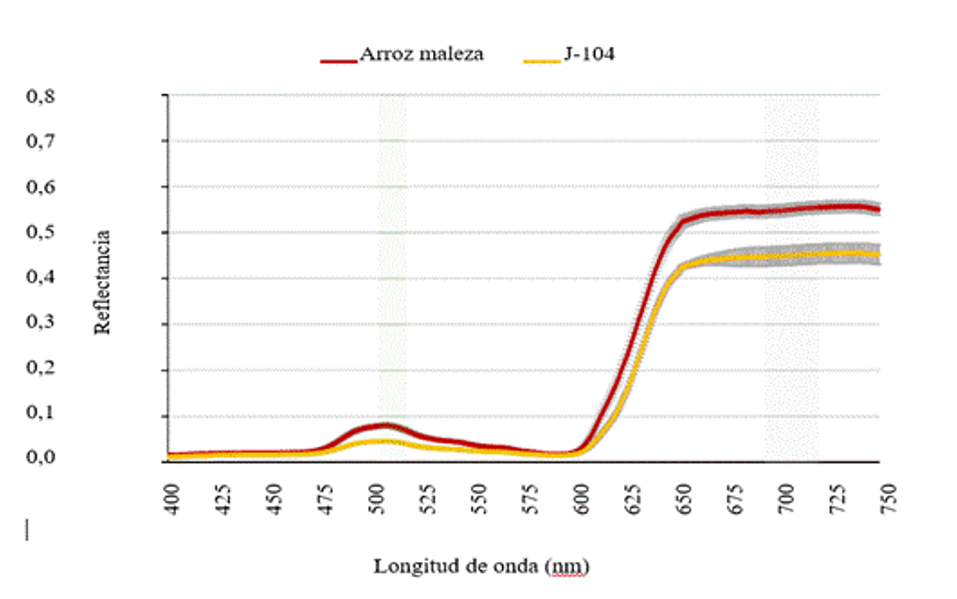
Oryza latifolia Desv. is a species present in commercial rice cultivation in Cuba, known as a weed that is difficult to control. In order to generate site-specific strategies where this plant grows, reflectance measurements of the weed were carried out to create spatial distribution maps that discriminate it. The reflectance of the weed was measured in three stages of its development in the UBPC production bases “El Cedro”, “Sur del Jíbaro” and “Las Nuevas”. In addition, the reflectance of the commercial rice varieties was measured: INCA LP-7 and IACUBA-41 in “El Cedro”, J-104 in “Sur del Jíbaro” and IACUBA-32 and IACUBA-41 for “Las Nuevas”, in the vegetative and reproductive stages. For this, 20 measurements were made for each variety and weedy rice, in each location and stage of development. An ANOVA and Duncan test were performed. The results showed significant differences (p˂0.05) for mean wavelength values in the NIR band, between the reflectance of weedy rice and the rice varieties, for each of the evaluations. In addition, in the green band there were also some significant differences between the reflectance of the species, so both bands demonstrated potential for discrimination. Likewise, the spectral signature of weedy rice in the plots with sandy and clayey soil textures was different, but it should be noted that not only the texture but also other environmental and physiological factors influence reflectance.
Article Details

This work is licensed under a Creative Commons Attribution-NonCommercial 4.0 International License.
Aquellos autores/as que tengan publicaciones con esta revista, aceptan los términos siguientes:
- Los autores/as conservarán sus derechos de autor y garantizarán a la revista el derecho de primera publicación de su obra, el cuál estará simultáneamente sujeto a la Licencia de reconocimiento-no comercial de Creative Commons 4.0 que permite a terceros compartir la obra siempre que se indique su autor y su primera publicación esta revista. Bajo esta licencia el autor será libre de:
- Compartir — copiar y redistribuir el material en cualquier medio o formato
- Adaptar — remezclar, transformar y crear a partir del material
- El licenciador no puede revocar estas libertades mientras cumpla con los términos de la licencia
Bajo las siguientes condiciones:
- Reconocimiento — Debe reconocer adecuadamente la autoría, proporcionar un enlace a la licencia e indicar si se han realizado cambios. Puede hacerlo de cualquier manera razonable, pero no de una manera que sugiera que tiene el apoyo del licenciador o lo recibe por el uso que hace.
- NoComercial — No puede utilizar el material para una finalidad comercial.
- No hay restricciones adicionales — No puede aplicar términos legales o medidas tecnológicas que legalmente restrinjan realizar aquello que la licencia permite.
- Los autores/as podrán adoptar otros acuerdos de licencia no exclusiva de distribución de la versión de la obra publicada (p. ej.: depositarla en un archivo telemático institucional o publicarla en un volumen monográfico) siempre que se indique la publicación inicial en esta revista.
- Se permite y recomienda a los autores/as difundir su obra a través de Internet (p. ej.: en archivos telemáticos institucionales o en su página web) antes y durante el proceso de envío, lo cual puede producir intercambios interesantes y aumentar las citas de la obra publicada. (Véase El efecto del acceso abierto).
References
Analytical Spectral Devices. (2020). Reflectance, Spectral Reflectance and Wavelength range. An introduction to reflectance, and ASD measurements – Level 1. [Presentación de diapositivas].
Arrieta, E. G., Sánchez, E., Vargas, S., Lobo, J., Quesada, T., & Espinoza, A. M. (2005). The weedy rice complex in Costa Rica. I. Morphological study of relationships between commercial rice varieties, wild Oryza relatives and weedy types. Genetic Resources and Crop Evolution, 52, 575-587, ISSN: 0925-9864, DOI: https://doi.org/10.1007/s10722-004-6109-x, Publisher: Springer.
Castro, E. H. A. (1999). Manejo de arroces contaminantes en las áreas productoras de arroz comercial de Costa Rica. Organización de Nciones Unidas para la Agricultura y Alimentación (Ed.), Taller global de control de arroz rojo, 19-24.
Castro, M. A. I. (2013). Discriminación de infestaciones de malas hierbas crucíferas en cultivos anuales de invierno utilizando imágenes de alta resolución espacial mediante métodos basados en píxeles, objetos y redes neuronales para su control de precisión [Tesis Doctoral, Universidad de Córdoba]. https://helvia.uco.es/xmlui/bitstream/handle/10396/9477/2013000000708.pdf?sequenc e=1&isAllowed=y
Cid, R. E., & Moltoni, A. (2010). El uso de U.A.V (Unmanaged Aerial Vehicles) en Agricultura de Precisión, enfocado prioritariamente hacia el manejo de malezas. 9o Curso de Agricultura de Precisión y 4a Expo de Máquinas Precisas. Manfredi, Córdoba, Argentina, Manfredi, Córdoba, Argentina.
Delouche, J. C., Burgos, N. R., Gealy, D. R., Zorilla, G., & Labrada, R. (2007). El problema de los arroces maleza. Arroces maleza—Origen, biología, ecología y control. Organización de las Naciones Unidas para la Alimentación y la Agricultura (FAO). https://www.fao.org/3/a1023s/a1023s.pdf
Hernández, R. (2017). Metodología para discriminación de malezas basada en la respuesta espectral de la vegetación [Trabajo de investigación presentado como requisito para optar al título de Magister en Geomática., Universidad Nacional de Colombia. Bogotá, Colombia], https://repositorio.unal.edu.co/handle/unal/59816
Jiménez, B. M. (2021). Importancia de los factores climáticos en el cultivo de arroz: Importance of climate factors in rice crop. Ciencia y Tecnología Agropecuaria, 6(1), 28-34, ISSN: 2805-6604.
Pinciroli, M., Ponzio, N., & Salsamendi, M. (2018). El arroz alimento de millones. https://elibro- net.ezproxy.sibdi.ucr.ac.cr/es/ereader/sibdi/66799?page=9
Thorp, K., & Tian, L. (2004). A review on remote sensing of weeds in agriculture. Precision Agriculture, 5(5), 477-508, ISSN: 1385-2256, DOI: https://doi.org/10.1007/s11119-004-5321-1, Publisher: Springer.
Vásquez, S. V., Vásquez, G. G. E., Piedrahíta, C. D., Lerner, H. S., Espinoza, E. F., & Valarezo, B. O. (2020). Control químico de malezas en fincas de arroz (Oryza sativa L.), en el sistema de riego y drenaje Babahoyo, Ecuador. Journal of Science and Research: Revista Ciencia e Investigación, 5(2), 66-79, ISSN: 2528-8083, DOI: https://doi.org/https://doi.org/10.5281/zenodo.3820767.
Woolston, C. (2014). Rice. Nature, 514(7524), S49. DOI: https://doi.org/10.1038/514S49a.
Zamora, A., Barboza, C., Lobo, J., & Espinoza, A. M. (2003). Diversity of native rice (Oryza Poaceae:) species of Costa Rica. Genetic Resources and Crop Evolution, 50, 855-870, ISSN: 0925-9864, DOI: https://doi.org/10.1023/A:1025998801637, Publisher: Springer.