Escenario hidrológico de la cuenca del río Quilca-Vítor-Chili: estimaciones actuales y futuras
Barra lateral del artículo
Contenido principal del artículo
Resumen
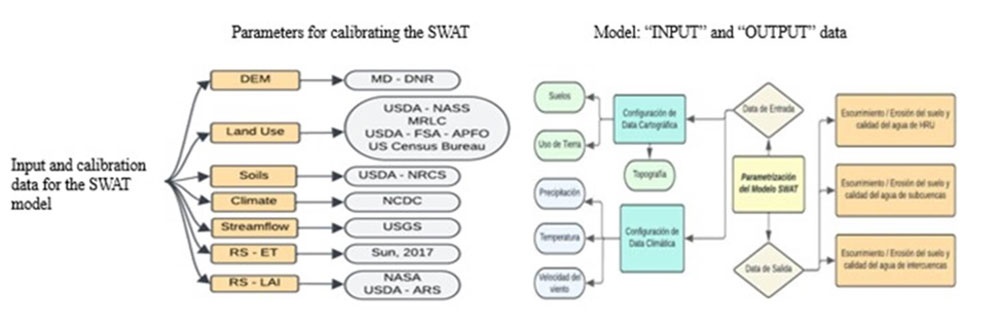
El estudio tuvo como objetivo estimar los escenarios hidrológicos actuales y futuros en la cuenca Quilca - Vitor - Chili para la demanda poblacional y agrícola. En el proceso metodológico se recopiló información climática e hidrológica de SENAMHI, así como datos del Modelo Digital del Terreno de alta resolución de la NASA. Los datos fueron procesados utilizando el modelo SWAT para la estimación hídrica. La eficiencia del modelo se midió mediante el coeficiente de determinación (R2), el índice de Nash-Sutcliffe (NSE) y el sesgo porcentual (PBIAS). El escenario hidrológico mostró caudales promedio anuales de 11,54 m³/s para el año 2024 y un ligero incremento de 14.87 m³/s para el año 2040 para una predicción de validación en el modelo SWAT de R² = 0,75, NSE = 0.72 y PBIAS = -18,4%. Se identifica que para los escenarios hidrológicos actuales y futuros existe estrés hídrico superior al 80% para lo cual es inminente implementar estrategias de gestión integrada de los recursos hídricos. En conclusión, el modelo SWAT logró simular con precisión el balance hídrico de la cuenca en contextos presentes y futuros, validando su eficacia como herramienta de análisis.
Detalles del artículo

Esta obra está bajo una licencia internacional Creative Commons Atribución-NoComercial 4.0.
Aquellos autores/as que tengan publicaciones con esta revista, aceptan los términos siguientes:
- Los autores/as conservarán sus derechos de autor y garantizarán a la revista el derecho de primera publicación de su obra, el cuál estará simultáneamente sujeto a la Licencia Creative Commons Attribution-NonCommercial 4.0 International (CC BY-NC 4.0) que permite a terceros compartir la obra siempre que se indique su autor y su primera publicación esta revista. Bajo esta licencia el autor será libre de:
- Compartir — copiar y redistribuir el material en cualquier medio o formato
- Adaptar — remezclar, transformar y crear a partir del material
- El licenciador no puede revocar estas libertades mientras cumpla con los términos de la licencia
Bajo las siguientes condiciones:
- Reconocimiento — Debe reconocer adecuadamente la autoría, proporcionar un enlace a la licencia e indicar si se han realizado cambios. Puede hacerlo de cualquier manera razonable, pero no de una manera que sugiera que tiene el apoyo del licenciador o lo recibe por el uso que hace.
- NoComercial — No puede utilizar el material para una finalidad comercial.
- No hay restricciones adicionales — No puede aplicar términos legales o medidas tecnológicas que legalmente restrinjan realizar aquello que la licencia permite.
- Los autores/as podrán adoptar otros acuerdos de licencia no exclusiva de distribución de la versión de la obra publicada (p. ej.: depositarla en un archivo telemático institucional o publicarla en un volumen monográfico) siempre que se indique la publicación inicial en esta revista.
- Se permite y recomienda a los autores/as difundir su obra a través de Internet (p. ej.: en archivos telemáticos institucionales o en su página web) antes y durante el proceso de envío, lo cual puede producir intercambios interesantes y aumentar las citas de la obra publicada. (Véase El efecto del acceso abierto).
Citas
ABBASPOUR, K. C. (2013). SWAT-CUP 2013: SWAT Calibration and Uncertainty Programs-A User Manual. Swiss Federal Institute of Aquatic Science and Technology. https://www.scirp.org/reference/referencespapers?referenceid=3048706
ANA (2023) “Plan actualizado de gestión de recursos hídricos de la cuenca Quilca Chili, actualizado al 2023,” Repositorio Institucional - ANA, Accessed: Junio. 08, 2025. Available: https://repositorio.ana.gob.pe/handle/20.500.12543/5656
DOUGLAS-MANKIN, N. K. R., SRINIVASAN, N. R., & ARNOLD, N. J. G. (2010). Soil and Water Assessment Tool (SWAT) model: current developments and applications. Transactions of the ASABE, 53(5), 1423-1431. https://doi.org/10.13031/2013.34915
DRENKHAN, F., & CASTRO-SALVADOR, S. (2023). Una aproximación hacia la seguridad hídrica en los Andes tropicales: desafíos y perspectivas. Revista Kawsaypacha Sociedad Y Medio Ambiente, 12. https://doi.org/10.18800/kawsaypacha.202302.a006
AUTOR, G. AND QUIJANO, J. F. (2018) “Estudio hidrológico de las cuencas Camaná, Majes, Sihuas, Quilca - Vittor - Chili con información satelital,” Universidad Nacional Agraria La Molina. Accessed: Junio. 08, 2025. Available: https://hdl.handle.net/20.500.12996/3530
Ghajarnia, N., Bende-Michl, U., Sharples, W., Carrara, E., & Tijs, S. (2025). Evolving patterns of compound heat and water stress conditions: Implications for agriculture futures in Australia. Agricultural Water Management, 316, 109573. https://doi.org/10.1016/j.agwat.2025.109573
Guug, S. S., Abdul-Ganiyu, S., & Kasei, R. A. (2020). Application of SWAT hydrological model for assessing water availability at the Sherigu catchment of Ghana and Southern Burkina Faso. HydroResearch, 3, 124-133. https://doi.org/10.1016/j.hydres.2020.10.002
CARPIO, F. J., QUISPE, Y. B., PEÑA, L. F., AND SULCA, O. P. (2022) “Hidrogeología de la cuenca del río Quilca - Vitor - Chili (132)” Repositorio Institucional INGEMMET, Accessed: Junio. 08, 2025. Available: https://repositorio.ingemmet.gob.pe/handle/20.500.12544/3885
Juma, L. A., Nkongolo, N. V., Raude, J. M., & Kiai, C. (2022). Assessment of hydrological water balance in Lower Nzoia Sub-catchment using SWAT-model: towards improved water governace in Kenya. Heliyon, 8(7), e09799. https://doi.org/10.1016/j.heliyon.2022.e09799x
Krause, P., Boyle, D. P., & Bäse, F. (2005). Comparison of different efficiency criteria for hydrological model assessment. Advances in Geosciences, 5, 89-97. https://doi.org/10.5194/adgeo-5-89-2005
Moriasi, N. D. N., Arnold, N. J. G., Van Liew, N. M. W., Bingner, N. R. L., Harmel, N. R. D., & Veith, N. T. L. (2007). Model Evaluation guidelines for systematic quantification of accuracy in watershed simulations. Transactions of the ASABE, 50(3), 885-900. https://doi.org/10.13031/2013.23153
Motschmann, A., Teutsch, C., Huggel, C., Seidel, J., León, C. D., Muñoz, R., Sienel, J., Drenkhan, F., & Weimer-Jehle, W. (2022). Current and future water balance for coupled human-natural systems - Insights from a glacierized catchment in Peru. Journal of Hydrology Regional Studies, 41, 101063. https://doi.org/10.1016/j.ejrh.2022.101063
Nevermann, H., Aminzadeh, M., Madani, K., & Shokri, N. (2024). Quantifying water evaporation from large reservoirs: Implications for water management in water-stressed regions. Environmental Research, 262, 119860. https://doi.org/10.1016/j.envres.2024.119860
Panda, C., Das, D. M., Sahoo, B. C., Panigrahi, B., & Singh, K. K. (2021). Spatio-temporal modeling of surface runoff in ungauged sub-catchments of Subarnarekha river basin using SWAT. MAUSAM, 72(3), 597-606. https://doi.org/10.54302/mausam.v72i3.1309
Ramos, D. R. L., & Delgado, E. F. B. (2022). Evaluación de la sostenibilidad de cuencas hidrográficas. Estudio de caso: Cuenca del Chili, Arequipa-Perú. Revista Alfa, 6(18), 453-462. https://doi.org/10.33996/revistaalfa.v6i18.182
SRTM | Datos terrestres de la NASA.” Accessed: Jun. 08, 2025. Available: https://www.earthdata.nasa.gov/data/instruments/srtm
Tran, T., Nguyen, B. Q., Vo, N. D., Le, M., Nguyen, Q., Lakshmi, V., & Bolten, J. D. (2022). Quantification of global Digital Elevation Model (DEM) - A case study of the newly released NASADEM for a river basin in Central Vietnam. Journal of Hydrology Regional Studies, 45, 101282. https://doi.org/10.1016/j.ejrh.2022.101282
Visera SIG - Balance hídrico de SENAMHI. Accessed: Jun. 08, 2025. Available: https://idesep.senamhi.gob.pe/balance-hidrico/
Weber, J. F., & Ocampo, S. B. (2019). Calibración del modelo hidrológico SWAT para una cuenca de la región serrana de Córdoba (Argentina). AQUA-LAC, 11(1), 34-54. https://doi.org/10.29104/phi-aqualac/2019-v11-1-03