Optimization of the Sugarcane Value Chain for the Mayabeque Distillery
Article Sidebar
Main Article Content
Abstract
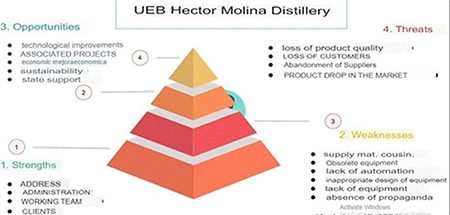
The value chain extends beyond the initial value of a product, increasing with the quality of its byproducts. In this sense, the sugar sector displays a value chain based on its raw material of great global significance, allowing sugar companies to increase profits from these resources. The situation at the "Héctor Molina Riaño" Distillery UEB (Bakery Industry Unit) has led to the development of research aimed at making improvements in the integrated management of the alcohol value chain in this entity. A documentary analysis was conducted on the topic addressed, a diagnosis of the production entity was performed, a SWOT matrix was applied, and, based on the presentation of an Ishikawa diagram, 10 problems were identified, for which 10 actions were proposed. Of the proposed actions, 80% were resolved in the short term, and 50% of them were resolved within 8 months. A technological framework for the production of alcohol and spirits was proposed for application in the distillery. Five categories for primary actions and four categories for supporting actions were identified, based on Porter's proposal, which was used as a as a reference for this work.
Article Details

This work is licensed under a Creative Commons Attribution-NonCommercial 4.0 International License.
Those authors that have publications with this journal accept the following terms:
1. They will retain their copyright and guarantee the journal the right of first publication of their work, which will be simultaneously subject to the License Creative Commons Attribution-NonCommercial 4.0 International (CC BY-NC 4.0) that allows third parties to share the work whenever its author is indicated and its first publication this journal. Under this license the author will be free of:
• Share — copy and redistribute the material in any medium or format
• Adapt — remix, transform, and build upon the material
• The licensor cannot revoke these freedoms as long as you follow the license terms.
Under the following terms:
• Attribution — You must give appropriate credit, provide a link to the license, and indicate if changes were made. You may do so in any reasonable manner, but not in any way that suggests the licensor endorses you or your use.
• NonCommercial — You may not use the material for commercial purposes.
• No additional restrictions — You may not apply legal terms or technological measures that legally restrict others from doing anything the license permits.
2. The authors may adopt other non-exclusive license agreements to distribute the published version of the work (e.g., deposit it in an institutional telematics file or publish it in a monographic volume) whenever the initial publication is indicated in this journal.
3. The authors are allowed and recommended disseminating their work through the Internet (e.g. in institutional telematics archives or on their website) before and during the submission process, which can produce interesting exchanges and increase the citations of the published work. (See the Effect of open access).
References
ARANA-BRAVO, J.J.: “Manejo de la fertilización en el cultivo de caña de azúcar (Saccharum officinarum), en el Ecuador”, 2021.
BAK, O.; SHAW, S.; COLICCHIA, C.; KUMAR, V.: “A systematic literature review of supply chain resilience in small-medium enterprises (SMEs): A call for further research”, IEEE Transactions on Engineering Management, 70(1): 328-341, 2020, ISSN: 0018-9391.
CALLE, M.J.G.; MATUTE, J.M.M.; MAXI, F.G.; ARMIJOS, A.: “Análisis de la cadena de valor de empresas del sector de elaboración de bebidas en Cuenca”, Observatorio Empresarial, 39-58, 2020, ISSN: 2661-6823.
CHÁVEZ-GARCÍA, E.M.; HARO-SOSA, G.L.: “Mejoramiento de la cadena de distribución de productos obtenidos a base de la caña de azúcar y manufacturados en el cantón Echeandía”, Uda akadem, (5): 38-59, 2020, ISSN: 2631-2611.
GONZÁLEZ, R.; MALDONADO, A.; SINMALEZA, L.: “Análisis de la cadena de valor en ingenios azucareros: Un enfoque para mercados emergentes”, Revista Iberoamericana de Agronegocios, 22(1): 45-62, 2018.
GUTIÉRREZ, H.; REYES, A.: “El mercado mundial del azúcar”, Tema central, 113: 57, 2003.
GUTIÉRREZ, J.D.: Protección de la Competencia en las Cadenas de Valor Agropecuarias en Colombia, 1994-2015 (Protection of Competition in Agricultural Value Chains in Colombia, 1994-2015), Inst. El desarrollo equitativo, competitivo y sostenible del sector agropecuario en Colombia". Bogotá: Banco de la República, Bogotá, Colombia, 2016.
HOCHREIN, S.; GLOCK, C.H.; BOGASCHEWSKY, R.; HEIDER, M.: “Strategic sourcing in the automotive supply chain: A systematic literature review”, International Journal of Production Economics, 166: 61-75, 2015, DOI: https://doi.org/10.1016/j.ijpe.2015.04.012.
LARA-MANJARREZ, I.A.; SÁNCHEZ-GUTIÉRREZ, J.: “Responsabilidad social empresarial para la competitividad de las organizaciones en México”, Mercados y negocios, 22(43): 97-118, 2021, ISSN: 2594-0163.
PORTER, M.E.: “Competitive advantage: creating and sustaining superior performance/Michael E”, Porter (z-lib. org). pdf, : 557, 1985.
PORTER, M.E.: Competitive advantage: Creating and sustaining superior performance, Ed. Simon and Schuster, 2008, ISBN: 1-4165-9584-8.
QUIMIS, L.Y.C.; VÉLEZ, N.T.F.; DELGADO, K.E.S.: “La Cadena de Valor como Herramienta Innovadora para la Sostenibilidad de la Comercialización de Hortalizas”, Dominio de las Ciencias, 8(1): 121-135, 2022, ISSN: 2477-8818.
RIQUELME, M.: “Cadena de Valor de Michael Porter ¿Que és y cuál es su importancia”, 2020.
TECNICA NA: Ranking global de países productores de azúcar, 2023.
TORRES, O.M.; ZUNINO, S.: “Cadena de Valor: Situación Actual en los Ingenios azucareros”, En: XXV Encuentro Nacional de Investigadores Universitarios del Área Contable y XV Simposio Regional de Investigación Contable (La Plata, 12 de diciembre de 2019), La Plata, 2019, ISBN: 2683-6734.