Reducing the Energy Cost of Mechanized Maize Agriculture Using Conservation Tillage
Article Sidebar
Main Article Content
Abstract
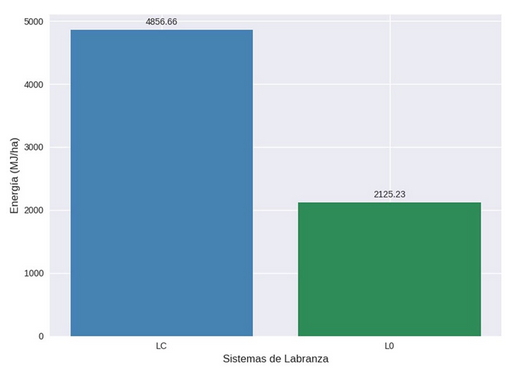
Agricultural mechanization in Cuba faces high energy costs due to intensive use of fossil fuels and heavy machinery. This study assessed the energy consumption of key mechanized operations in maize cultivation under two tillage systems: conventional and conservation (no-tillage). Results revealed significant differences (p < 0.0001) in fuel and energy use between systems. No-tillage reduced energy costs by 56.24% compared to conventional tillage, saving up to 25.45 L of diesel per hectare. These findings highlight the technical and economic feasibility of conservation tillage as a strategy to reduce energy dependence and mitigate environmental impacts in tropical agriculture.
Article Details

This work is licensed under a Creative Commons Attribution-NonCommercial 4.0 International License.
Aquellos autores/as que tengan publicaciones con esta revista, aceptan los términos siguientes:
- Los autores/as conservarán sus derechos de autor y garantizarán a la revista el derecho de primera publicación de su obra, el cuál estará simultáneamente sujeto a la Licencia de reconocimiento-no comercial de Creative Commons 4.0 que permite a terceros compartir la obra siempre que se indique su autor y su primera publicación esta revista. Bajo esta licencia el autor será libre de:
- Compartir — copiar y redistribuir el material en cualquier medio o formato
- Adaptar — remezclar, transformar y crear a partir del material
- El licenciador no puede revocar estas libertades mientras cumpla con los términos de la licencia
Bajo las siguientes condiciones:
- Reconocimiento — Debe reconocer adecuadamente la autoría, proporcionar un enlace a la licencia e indicar si se han realizado cambios. Puede hacerlo de cualquier manera razonable, pero no de una manera que sugiera que tiene el apoyo del licenciador o lo recibe por el uso que hace.
- NoComercial — No puede utilizar el material para una finalidad comercial.
- No hay restricciones adicionales — No puede aplicar términos legales o medidas tecnológicas que legalmente restrinjan realizar aquello que la licencia permite.
- Los autores/as podrán adoptar otros acuerdos de licencia no exclusiva de distribución de la versión de la obra publicada (p. ej.: depositarla en un archivo telemático institucional o publicarla en un volumen monográfico) siempre que se indique la publicación inicial en esta revista.
- Se permite y recomienda a los autores/as difundir su obra a través de Internet (p. ej.: en archivos telemáticos institucionales o en su página web) antes y durante el proceso de envío, lo cual puede producir intercambios interesantes y aumentar las citas de la obra publicada. (Véase El efecto del acceso abierto).
References
ASAE, E. (2006). Agricultural machinery management. ASAE Standard, 384-390.
De las Cuevas, M. H. R., Hernández, T. R., Paneque, R. P., & Herrera, P. M. I. (2009). Software para la determinación de los costos energéticos y de explotación de las máquinas agrícolas. Revista Ciencias Técnicas Agropecuarias, 18(2), 78-84.
Fernández-Ortega, J., Álvaro-Fuentes, J., Delgado, A., García-López, A. M., & Cantero-Martínez, C. (2025). Assessing management strategies for carbon storage in Mediterranean soils: Double-cropping, no-tillage, and nitrogen fertilization reduction. Soil and Tillage Research, 249, 106496.
Fluck, R. C. (1981). Net energy sequestered in agricultural labor. Transactions of the ASAE, 24(6), 1449-1455.
Fluck, R. C. (1985). Energy sequestered in repairs and maintenance of agricultural machinery. Transactions of the ASAE, 28(3), 738-0744.
Fluck, R. C. (2012). Energy in farm production. Elsevier.
Hernández, J. A., Pérez, J., Bosch, I., & Castro, S. (2015). Nueva versión de clasificación genética de los suelos de Cuba (Primera edición). Ediciones INCA, Mayabeque, Cuba.
Hetz, E., & Barrios, A. (1997). Reducción del costo energético de labranza/siembra utilizando sistemas conservacionistas en Chile. Agro-Ciencia, 13(1), 41-47.
Liang, X., Rehman, S. U., Zhiqi, W., Raza, M. A., Haider, I., Khalid, M. H. B., Saeed, A., Iqbal, Z., Fatima, S., & Siddiqa, A. (2025). Impacts of conservation tillage on agricultural land development: A review. Journal of Soil Science and Plant Nutrition, 25(1), 428-449.
Paneque, R. P., López, C. G., Mayans, C. P., Muñoz, G. F., Gaytán, R. J. G., & Romantchik, K. E. (2018). Fundamentos Teóricos y Análisis de Máquinas Agrícolas. Universidad Autónoma Chapingo, Texcoco, Edo. México, México. 456, ISBN: 978-607-12-0532-2.
Paneque, R. P. (2003). Sistema agropecuario integrado usando labranza cero. Revista Ciencias Técnicas Agropecuarias, 12(1), 1-5.
Rusinamhodzi, L., Berre, D., Thierfelder, C., Ridaura, S.-L., & Corbeels, M. (2025). Modelling the climate change adaptation potential of no-tillage maize systems in southern Africa. Mitigation and Adaptation Strategies for Global Change, 30(5), 36.
Stout, B. A. (2012). Handbook of energy for world agriculture. Elsevier.