Effect of Localized Irrigation on the Yield of Watermelon (Citrullus lanatus Thunb.)
Article Sidebar
Main Article Content
Abstract
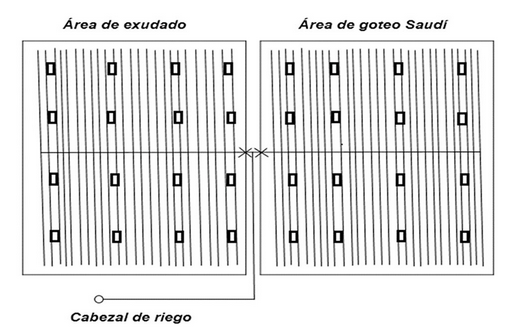
The study was conducted at the Experimental Station of the Institute of Agricultural Engineering Research in Artemisa Province, on compacted Red Ferralitic soil. The objective was to evaluate the effect of localized irrigation techniques (exudation and drip) on the yield of watermelon (Citrullus lanatus Thunb.). A 0.46 ha plot was divided into two equal parts, one irrigated with an exudation system and the other with drip irrigation. Hydraulic evaluation in each system was carried out through the study of emitter discharge uniformity, and crop yield components as well as agronomic water productivity were determined. Results showed that the highest coefficient of discharge uniformity was achieved with drip irrigation (88%), classified as good. The applied irrigation regime, combined with rainfall, maintained soil moisture within the optimal range (-20 kPa), preventing water stress and ensuring adequate crop development without water limitations. Exudation irrigation demonstrated agronomic advantages over drip irrigation, evidenced by greater average fruit length and an estimated yield 3% higher. Water productivity (5.8 kg/m³) was slightly superior compared to drip irrigation (5.7 kg/m³), indicating that both systems can be effectively used for watermelon cultivation.
Article Details

This work is licensed under a Creative Commons Attribution-NonCommercial 4.0 International License.
Aquellos autores/as que tengan publicaciones con esta revista, aceptan los términos siguientes:
- Los autores/as conservarán sus derechos de autor y garantizarán a la revista el derecho de primera publicación de su obra, el cuál estará simultáneamente sujeto a la Licencia de reconocimiento-no comercial de Creative Commons 4.0 que permite a terceros compartir la obra siempre que se indique su autor y su primera publicación esta revista. Bajo esta licencia el autor será libre de:
- Compartir — copiar y redistribuir el material en cualquier medio o formato
- Adaptar — remezclar, transformar y crear a partir del material
- El licenciador no puede revocar estas libertades mientras cumpla con los términos de la licencia
Bajo las siguientes condiciones:
- Reconocimiento — Debe reconocer adecuadamente la autoría, proporcionar un enlace a la licencia e indicar si se han realizado cambios. Puede hacerlo de cualquier manera razonable, pero no de una manera que sugiera que tiene el apoyo del licenciador o lo recibe por el uso que hace.
- NoComercial — No puede utilizar el material para una finalidad comercial.
- No hay restricciones adicionales — No puede aplicar términos legales o medidas tecnológicas que legalmente restrinjan realizar aquello que la licencia permite.
- Los autores/as podrán adoptar otros acuerdos de licencia no exclusiva de distribución de la versión de la obra publicada (p. ej.: depositarla en un archivo telemático institucional o publicarla en un volumen monográfico) siempre que se indique la publicación inicial en esta revista.
- Se permite y recomienda a los autores/as difundir su obra a través de Internet (p. ej.: en archivos telemáticos institucionales o en su página web) antes y durante el proceso de envío, lo cual puede producir intercambios interesantes y aumentar las citas de la obra publicada. (Véase El efecto del acceso abierto).
References
Allen, R. G. (2006). Evapotranspiración del cultivo: Guías para la determinación de los requerimientos de agua de los cultivos (Vol. 56). Food & Agriculture Org. (FAO).
Casado, E., & Sirgado, L. (2015). Ensayos y caracterización hidráulica de tuberías porosas para riego. ISBN; 84-9048-374-4, Publisher: Editorial Universitat Politècnica de València.
Chaterlán, Y., Duarte, C., Rosa, R., López, T., & Pereira, L. (2015). Estimation the water needs of some vegetables using the methodology of dual cultural coefficients. Ingeniería Agrícola, 5(1), 21-26, ISSN: 2227-8761.
Cid, G., López, T., González, F., Herrera, J., & Ruiz, M. E. (2012). Características físicas que definen el comportamiento hidráulico de algunos suelos de Cuba. Revista Ingeniería Agrícola, 2(2), 25-31, ISSN: 2306-1545, E-ISSN: 2227-8761.
Cui, J., Shao, G., Lu, J., Keabetswe, L., & Hoogenboom, G. (2019). Yield, quality and drought sensitivity of tomato to water deficit during different growth stages. Scientia agrícola, 77, e20180390. https://doi.org/10.1590/1678-992X-2018-0390
Cun, R., Puig, O., & Morales, C. (2009). Comportamiento del coeficiente de uniformidad del riego por microaspersión en condiciones de organoponicos y huerto intensivo. Revista Ciencias Técnicas Agropecuarias, 18(3), 35-39, ISSN: 1010-2760.
Cun, R., Reinaldo, M., & Aguilera, J. (2015). Evaluación de la aplicación del riego mediante microjets a diferentes alturas en condiciones de organoponico. Agrotecnia de Cuba, 39(4), 22-30, ISSN: 2414-4673.
Duarte, C. E., Valdés, P. J., Herrera, J., & Zamora, E. (2018). Predicción de normas netas de riego del frijol común en la zona occidental de Cuba. Ingeniería Agrícola, 8(2), 41-47.
Gan, Y., Siddique, K. H., Turner, N. C., Li, X.-G., Niu, J.-Y., Yang, C., Liu, L., & Chai, Q. (2013). Ridge-furrow mulching systems-An innovative technique for boosting crop productivity in semiarid rain-fed environments. Advances in agronomy, 118, 429-476, ISSN: 0065-2113.
González, F., López, T., & Herrera, J. (2015). Indicadores de productividad del agua por cultivos y técnicas de riego en Cuba. Revista Ciencias Técnicas Agropecuarias, 24(4), 57-63, ISSN: 2071-0054.
Herrera-Puebla, J., González-Robaina, F., Sarmiento-García, O., Cun-González, R., Chaterlán-Durruthy, Y., & Cisneros-Zayas, E. (2024). Coeficiente del tanque evaporímetro Clase A para estimar la evapotranspiración de referencia en la provincia Artemisa. Ingeniería Agrícola, 14(1), 1-12, ISSN: 2306-1545.
Kumar, A., Pandey, S. S., Kumar, D., & Tripathi, B. N. (2023). Genetic manipulation of photosynthesis to enhance crop productivity under changing environmental conditions. Photosynthesis Research, 155(1), 1-21, 0166-8595. https://doi.org/10.1007/s11120-022-00977-w
Liu, H., Li, H., Ning, H., Zhang, X., Li, S., Pang, J., Wang, G., & Sun, J. (2019). Optimizing irrigation frequency and amount to balance yield, fruit quality and water use efficiency of greenhouse tomato. Agricultural Water Management, 226, 105787, ISSN: 0378-3774. https://doi.org/10.1016/j.agwat.2019.105787
López, T., Duarte, C., González, F., & Cid, G. (2008). Actualización de propiedades físicas e hidrodinámicas para un sustrato en condiciones de organopónico. Revista Ciencias Técnicas Agropecuarias, 17(3), 1-5, ISSN: 1010-2760.
Martínez, A., Luna Jiménez, A. L., & Milián Vicente, B. A. (2015). Evaluación del sistema de riego por exudación como alternativa para el desarrollo agropecuario sustentable. Ingeniería Agronómica. Segundo Coloquio Desarrollo Agropecuario Sustentable
Merriam, J. L., & Keller, J. (1978). Farm irrigation system evaluation: A guide for management.
Ministerio de la Agricultura. (2019). Instructivo Técnico del Cultivo del Melón, Pepino y Calabaza. Dirección de la Agricultura, La Habana, Cuba.
Ministerio de la Agricultura. (2018). Política para la mecanización, el riego, el drenaje agrícola y el abasto de agua a los animales, Ministerio de la Agricultura, La Habana, Cuba.
Mohamed, Y., Bakheit, M. A., & Widaa, A. (2012). Effect of Irrigation Water Management on Growth of Date Palm offshoots (Phoenix dactylifera) under the River Nile State Conditions. U. of K. J. Agric. Sci. 20(3), 275-285.
Morales, D. M., Hernández J. A., Borges, B. Y., Morell P. F., Calderón V. M., & Rodríguez M. J. (2010). Características de tres perfiles de suelo Ferralítico rojo lixiviado en condiciones naturales bajo bosque. Revista Agrotecnia de Cuba, 34(1), 11-20.
Nadal, M., & Flexas, J. (2019). Variation in photosynthetic characteristics with growth form in a water-limited scenario: Implications for assimilation rates and water use efficiency in crops. Agric. Water Manage, 216, 457-472. https://doi.org/10.1016/j.agwat.2018.09.024.
NC 15097. (2007). Técnicas de riego. Riego localizado. Evaluación hidráulica. [Noma cubana]. Oficina Nacional de Normalización, La Habana, Cuba.
Neeraja, G., K. Malla, M., Reddy Y. V., & Praveen, R. (2001). Influence of irrigation and nitrogen levels on bulb yield, nutrient uptake and nitrogen use efficiencies in rabi onion (Allium cepa). Indian J. Agric. Sci. 71: 109-112.
Pérez, J., Sánchez, I., Mendoza, F., Inzunza, M., & Cueto, W. J. (2003). Productividad y rendimiento de sandía por efecto del agua en diferentes condiciones de manejo. Revista Chapingo Serie Horticultura, 9(1), 209-216.
Pérez H. R., & Álvarez A. M. C. (2005). Necesidades de riego de la caña de azúcar en Cuba. Ed: Academia, 219pp. ISBN 959-270-065-6.
Pier, J.W. & T.A. Doerge. (1995). Nitrogen and water interactions in trickle-irrigated watermelon. Soil Sci. Soc. Am. J. 59: 145-150.
Ramos, T., Cun, R., & Duarte, C. (2023). Evaluación técnica del riego localizado en una casa de cultivo de Santiago de Cuba. Ingeniería Agrícola, 13(1). ISSN-2306-1545, E-ISSN-2227-8761,
Rodríguez, A., Companioni, N., Freesneda, B., & Cañet, F. (2011). Manual Técnico para organopónicos, Huertos Intensivos y organoponía semiprotegida. Instituto de Investigaciones Fundamentales en Agricultura Tropical (INIFAT), La Habana, Cuba. ISBN: 978-959-72-10-48-1.
Rodríguez, M., Pérez, L., & Gómez, J. (2019). Evaluación del riego en sandía bajo condiciones climáticas variables en el Caribe. Revista Cubana de Agricultura, 53(2), 45-52.
Salcedo, F. R., Barrios, M., & Moraima. (2005). Distribución de agua en un sistema de microaspersión sobre un ultisol cultivado con Lima Tahití en el estado Monagas, Venezuela, Revista UDO Agrícola, 5(1): 88-95.
Silva, I. R., Novais, R. F., & Barros, N. F. (2018). Phosphorus availability and management in highly weathered tropical soils. Revista Brasileira de Ciência do Solo, 42, e017001. https://doi.org/10.1590/18069657rbcs20170001.
Sun, L., Li, B., Yao, M., Niu, D., Gao, M., Mao, L., et al. (2023). Optimising water and nitrogen management for greenhouse tomatoes in Northeast China using EWM TOPSIS-AISM model. Agric. Water Manage. 290, 108579. https://doi.org/10.1016/j.agwat.2023.108579.
Sun, Q., Zhang, H., Li, X., Zhao, Z., Li, Z., Zhang, P., Liu, S., Jiang, W., & Sun, X. (2023). Effects of drip tape layout and flow rate on water and nitrogen distributions within the root zone and summer maize yield in sandy tidal soil. Agronomy, 13(11), 2689. https://doi.org/10.3390/agronomy13112689
Thompson, T. L., & Doerge, T. A. (1995). Nitrogen and water rates for subsurface trickle-irrigated romaine lettuce. HortScience 30: 1233-1237.
Thompson, T. L., & Godin, R.E. (2002). Subsurface drip irrigation and fertigation of broccoli. I. Yield, quality, and nitrogen uptake. Soil Sci. Soc. Am. J. 66: 186-192.
Valdés, V. P. J. (2017). Predicción de las normas netas del riego del cultivo de frijol común en la zona occidental de Cuba. Trabajo de diploma en opción al título de Ingeniero Agrícola. San José de las Lajas, Mayabeque, Cuba,
Zhou, Y., He, J., Liu, Y., Liu, H., Wang, T., Liu, Y., Chen, W., Muhammad, T., & Li, Y. (2023). Aerated drip irrigation improves watermelon yield, quality, water and fertilizer use efficiency. Irrigation Science, 41(3), 739-748. https://doi.org/10.1007/s00271-023-00853-y.