Integrating the sugar agro-industry value chain into knowledge management through mathematical models
Article Sidebar
Main Article Content
Abstract
The integration of the sugar agroindustry value chain into knowledge management seeks to enhance efficiency, innovation, and sustainability in this sector. This approach involves connecting the different links of the value chain, from the field to commercialization, through strategies that enable the capture, analysis, transfer, and effective use of knowledge. This research was framed within the development of the project ‘Methodology for the Integrated Management of Sugarcane and Derivatives Value Chains in Sugar Agroindustrial Enterprises’, which is associated with a National Program. Its objective was to determine the existence of a relationship and dependency among key variables through mathematical models within the sugar agroindustry value chain. The analysis, based on data from the AZCUBA Group, allowed the identification of five dependent and five independent variables, from which five linear models were generated. The results show that none of the models reached an optimal level of statistical significance; however, three of them (CT - ACI, I - MMA, and FL - CP) present weak relationships that, although insufficient in their current state, constitute initial approximations with potential for improvement through variable transformations or the incorporation of new predictors. Despite the weak relationships found, the study provides a methodological foundation that can guide future work toward more robust and useful models for the integrated management of the sugar value chain.
Article Details

This work is licensed under a Creative Commons Attribution-NonCommercial 4.0 International License.
Those authors that have publications with this journal accept the following terms:
1. They will retain their copyright and guarantee the journal the right of first publication of their work, which will be simultaneously subject to the License Creative Commons Attribution-NonCommercial 4.0 International (CC BY-NC 4.0) that allows third parties to share the work whenever its author is indicated and its first publication this journal. Under this license the author will be free of:
• Share — copy and redistribute the material in any medium or format
• Adapt — remix, transform, and build upon the material
• The licensor cannot revoke these freedoms as long as you follow the license terms.
Under the following terms:
• Attribution — You must give appropriate credit, provide a link to the license, and indicate if changes were made. You may do so in any reasonable manner, but not in any way that suggests the licensor endorses you or your use.
• NonCommercial — You may not use the material for commercial purposes.
• No additional restrictions — You may not apply legal terms or technological measures that legally restrict others from doing anything the license permits.
2. The authors may adopt other non-exclusive license agreements to distribute the published version of the work (e.g., deposit it in an institutional telematics file or publish it in a monographic volume) whenever the initial publication is indicated in this journal.
3. The authors are allowed and recommended disseminating their work through the Internet (e.g. in institutional telematics archives or on their website) before and during the submission process, which can produce interesting exchanges and increase the citations of the published work. (See the Effect of open access).
References
AZCUBA: Plan de acción para la implementación de las medidas aprobadas para salvar al sector azucarero, Inst. Grupo AZCUBA, Publicaciones Azucareras, informe institucional, La Habana, Cuba, 2021.
CABALLERO, N.A.; MICHELENA, E.: “Competitividad del sector cañero-azucarero cubano: aporte potencial de la normalización a su perfeccionamiento”, Ingeniería Industrial, 44(3): 77-93, 2023, ISSN: 1815-5936.
FERNÁNDEZ, C.L.; RANGEL, M. de O.L.; GUERRA, B.C.W.; POZO, F.M.: “Modelación estadístico-matemática en procesos agrarios. Una aplicación en la Ingeniería Agrícola”, Revista Ciencias Técnicas Agropecuarias, 28(2), 2019, ISSN: 2071-0054.
GARCÍA, P.; LÓPEZ, R.: “Aplicaciones de la regresión lineal en la gestión de cadenas de valor agroindustriales”, Revista Iberoamericana de Estadística Aplicada, 15(1): 33-48, 2023.
MONTEMAYOR, T.J.A.; MUNGUÍA, L.J.; SEGURA, C.M.Á.; YESCAS, C.P.; OROZCO, V.J.A.; WOO, R.J.L.: “La regresión lineal en la evaluación de variables de ingeniería de riego agrícola y del cultivo de maíz forrajero”, Acta universitaria, 27(1): 40-44, 2017, ISSN: 0188-6266.
PARTIDO COMUNISTA DE CUBA: Lineamientos de la Política Económica y Social del Partido y la Revolución para el período 2021-2026, Inst. Editora Política del Comité Central del Partido Comunista de Cuba, La Habana, Cuba, 2021.
PORTER, M.E.: “Creating and sustaining superior performance”, Competitive advantage, 167: 167-206, 1985.
PORTER, M.E.: Competitive advantage: Creating and sustaining superior performance, Ed. Simon and Schuster, 2008, ISBN: 1-4165-9584-8.
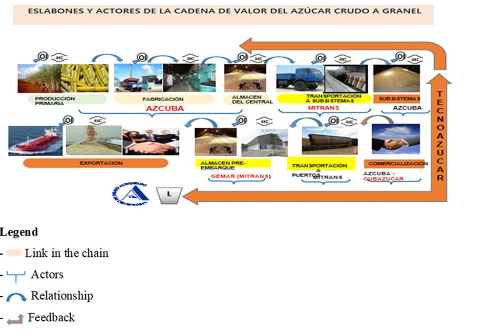
RUIZ, R.; SOTO, I.: “Cadena de valor del azúcar crudo en Cuba”, En: Memorias del Congreso Internacional Diversificación, La Habana, Cuba, 2022, ISBN: 978-959-7165-68-2.
SÁBATO, J.; BOTANA, N.: “La ciencia y la tecnología en el desarrollo futuro de América Latina”, En: The World Order Models Conference, Ed. Instituto de estudios peruanos, Bellagio, Italia, 1970.
VITALE, A.M.; FERNÁNDEZ, V.E.; CABRERA, S.M.: “Importance of knowledge management for the creation of value in Cuban companies”, 2020.