Integrated procedure for optimization of self-sustaining management of nutrients and wastes on farms in Mayabeque
Article Sidebar
Main Article Content
Abstract
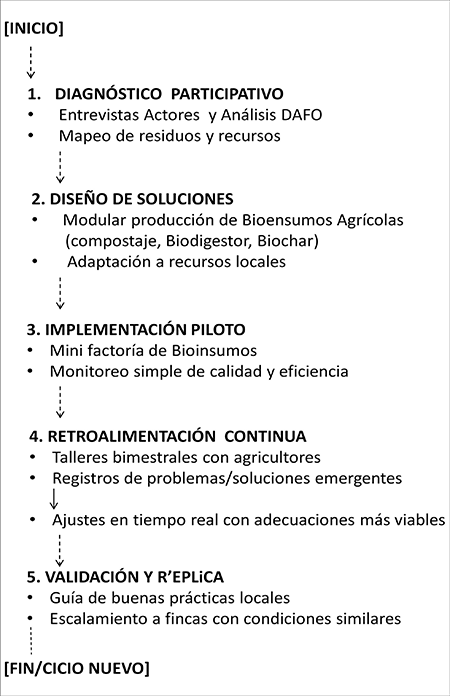
The objective of this research was to propose a procedure to integrate practical and adaptive self-management solutions in the management of nutrient flows, taking advantage of endogenous waste on local farms in Mayabeque, thus contributing to the transition towards a self-sustaining circular economy. The procedure was based on: (I) the determination of endogenous potential for waste generation and the limitations in the recirculated nutrient flow; (II) the identification of strategic actions; (III) the design of a comprehensive adaptive procedure. A procedure is derived that articulates a cyclical adaptive system of nutrient flows from endogenous waste generated, recirculated, and integrated into the production process on a local farm, to ensure the basis for self-management in the production of agricultural bioinputs with accessible technologies. The estimated total investment benefits were approximately $485 USD for La Esperanza and $1280 USD for Nuestra Señora. Self-sufficiency in animal feed increased by 95% on the first farm, while on the second farm, N and K deficits were reduced by 50% through more efficient waste management.
Article Details

This work is licensed under a Creative Commons Attribution-NonCommercial 4.0 International License.
Those authors that have publications with this journal accept the following terms:
1. They will retain their copyright and guarantee the journal the right of first publication of their work, which will be simultaneously subject to the License Creative Commons Attribution-NonCommercial 4.0 International (CC BY-NC 4.0) that allows third parties to share the work whenever its author is indicated and its first publication this journal. Under this license the author will be free of:
• Share — copy and redistribute the material in any medium or format
• Adapt — remix, transform, and build upon the material
• The licensor cannot revoke these freedoms as long as you follow the license terms.
Under the following terms:
• Attribution — You must give appropriate credit, provide a link to the license, and indicate if changes were made. You may do so in any reasonable manner, but not in any way that suggests the licensor endorses you or your use.
• NonCommercial — You may not use the material for commercial purposes.
• No additional restrictions — You may not apply legal terms or technological measures that legally restrict others from doing anything the license permits.
2. The authors may adopt other non-exclusive license agreements to distribute the published version of the work (e.g., deposit it in an institutional telematics file or publish it in a monographic volume) whenever the initial publication is indicated in this journal.
3. The authors are allowed and recommended disseminating their work through the Internet (e.g. in institutional telematics archives or on their website) before and during the submission process, which can produce interesting exchanges and increase the citations of the published work. (See the Effect of open access).
References
ALTIERI, M.A.: “Agroecología: principios y estrategias para diseñar sistemas agrarios sustentables”, Agroecología: el camino hacia una agricultura sustentable, 34, 2002.
AZAPAGIC, A.: “Systems approach to corporate sustainability: a general management framework”, Process Safety and Environmental Protection, 81(5): 303-316, 2003, ISSN: 0957-5820.
BÁEZ, N.; LOK, S.; GÓMEZ, C.: “Determination of the environmental economic value of a tropical typical dairy farm of Mayabeque, Cuba”, Cuban Journal of Agricultural Science, 55(2), 2021.
CASIMIRO, L.: “Bases metodológicas para la resiliencia socioecológica de fincas familiares en Cuba”, 2016.
CASIMIRO, L.; CASIMIRO, J.A.: “How to make prosperous and sustainable family farming in Cuba a reality”, Elementa: Science of the Anthropocene, 6, 2018.
CHAVE, J.; RÉJOU, M.; BÚRQUEZ, A.; CHIDUMAYO, E.; COLGAN, M.S.; DELITTI, W.B.; DUQUE, A.; EID, T.; FEARNSIDE, P.M.; GOODMAN, R.C.: “Improved allometric models to estimate the aboveground biomass of tropical trees”, Global change biology, 20(10): 3177-3190, 2014, ISSN: 1354-1013.
COSTO, L.; NUNEZ, L.; AMPATZIDIS, Y.: “ Un nuevo índice de banda visible para estimar valores de NDVI”. Computadoreas y electronica en la agricultura 172. Mayo 2020. ScienceDirect. https://doi.org/10.1016/compag.2020.105334.
DENGSHENG, L.; LU, M.; CHEN, L.: “Un estudio sobre métodos de estimación de biomasa en área basados en teledetecciones en ecosistemas forestales”, Revista Internacional de la Tierra, 9(1): 63-105, 2016, DOI: https://doi.org/10,1080/17538947-2014.990526.
DÍAZ, Y.; MENDIOLA, L.; GONZÁLEZ, A.; NAVARRO, Y.; DÍAZ, A.; CHAO, C.: “Biofiltración de efluentes líquidos de la industria petrolera con materiales naturales”, Ingeniería Hidráulica y Ambiental, 43(1): 12-24, 2022, ISSN: 1680-0338.
ELIZONDO, J.A.: “Calidad y consumo de morera (Morus alba), ramio (Bohemeria nivea (L) Gaud) y sorgo negro forrajero (Sorghum almum) en cabras.”, Agronomía mesoamericana, : 209-213, 2004, ISSN: 2215-3608.
FAO: Evaluación de la sostenibilidad en sistemas agropecuarios. Enfoque y metodología, [en línea], Inst. Organización de las Naciones Unidas para la Alimentación y la Agricultura (FAO), Roma, Italia, 2016, Disponible en: https://www.fao.org.
FAO: Feed inventory and feed balance, [en línea], Inst. Organización de las Naciones Unidas para la Alimentación y la Agricultura (FAO), FAO. Animal Feed Resources, Roma, Italia, 2018, Disponible en: https://openknowledge.fao.org.
FAO: Balance de nutrientes en la Agricultura, [en línea], Inst. Organización de las Naciones Unidas para la Alimentación y la Agricultura (FAO), Manual de alimentación animal para pequeños productores., Roma, Italia, 2021, Disponible en: https://openknowledge.fao.org.
FAO: Guía de alimentación de animales para climas tropicales, [en línea], Inst. Organización de las Naciones Unidas para la Alimentación y la Agricultura (FAO), Roma, Italia, 2022, Disponible en: https://openknowledge.fao.org.
FERNÁNDEZ, D.: Monitoreo satelital de la resiliencia agrícola en Cuba, [en línea], Universidad Agraria de La Habana, San José de las Lajas, Mayabeque, Cuba, Tesis Doctoral, San Jose de las Lajas Mayabeque, Cuba, 2020, Disponible en:http://tesisrepo.sld.cu/123456789/3456.
FUNDORA, L.R.; MARTÍN, G.M.; MIRANDA, I.; RIVERAA, R.A.; DUQUE, Y.R.: “Caracterización agroproductiva de fincas de la provincia Mayabeque, Cuba”, Pastos y Forrajes, 47, 2024, ISSN: 0864-0394.
GONZÁLEZ, L.; PÉREZ, M.; RODRIGUEZ, J.A.: “Evaluación del estrés post ciclónico en cultivos tropicales mediante índices espectrales”, Boletín técnico del INIVIT, 15(3): 45-58, 2021, ISSN: 1028-3296, DOI: https://doi.org/10.20396/boletininivit.v13i3.45-58.
GONZÁLEZ, R.: Bioinsumos a pequeña escala en Cuba, Inst. Instituto Nacional de Ciencias Agrícolas, Informe técnico de Introducción de resultados de Investigación, San Jose de las Lajas Mayabeque, CUBA, 2023.
HERNÁNDEZ, R.: “Recuperación de biomasa vegetal en frutales después de eventos climáticos extremos”, Revista Cubana de Ciencias Forestales, 6: 112-125, 2020, ISSN: 2310-3469.
INCA-CUBA: Tecnologías de bioensumos en Cuba. Recomendaciones nutricionales para suelos cubanos, Inst. Instituto Nacional de Ciencias Agrícolas, Informe técnico de Introducción de resultados de Investigación, San José de Las Lajas, Mayabeque, Cuba, 2020.
INCA-CUBA: Protocolos agroecológicos cubanos, Inst. Instituto Nacional de Ciencias Agrícolas, Informe técnico de Introducción de resultados de Investigación, San José de Las Lajas, Mayabeque, Cuba, 2023.
INIA-CUBA: Guía de biodigestores para pequenos productores, Inst. INIA, 2020.
INIVIT-CUBA: Requerimientos nutricionales de cultivos tropicales, Inst. Instituto Nacional de Viandas Tropicales INIVIT, Informe técnico de Introducción de resultados de Investigación, Villa Clara, Cuba, 2023.
INSMET-CUBA: Reportes de las Estaciones metereológicas, Instituto de Metereología de Cuba. 2024. http://www.insmet.cu.
IPCC: Guidelines for national greenhouse gas inventories, Ed. repared by the National Greenhouse Gas Inventories Programme. Eggleston HS, Buendia L, Miwa K, Ngara T, Tanabe K, editors. Published: IGES, Japan, repared by the National Greenhouse Gas Inventories Programme. Eggleston HS, Buendia L, Miwa K, Ngara T, Tanabe K, editors. Published: IGES, Japan ed., Japan, 2019.
LÓPEZ, R.; GARCÍA, M.; MARTINEZ, J.: “Impacto de huracanes en la cobertura vegetal, analisis de cambios en el NDVI y mumbrales de resiliencia en ecossitemas tropicales”, Revista Ciencias Ambientales, 15(2): 45-60, 2020, DOI: https://doi.org/10.38142/ijesss.
MMA-ONU: Manual de bioensumos para biofábricas de la Asociación de productores agroecológicos de las Islas de Maipo-APADIM, [en línea], Inst. Ministerio del Medio ambiente-ONU, Santiago de Chile, Financiado en el marco proyecto GEFSEC ID 5135, Santiago de Chile, Chile, 35 p., Encargada a: Ecodaya consultores, 2021, Disponible en: https://gefmontana.mma.gob.cl.
NC-CUBAPK: “Catálogo de Normas Cubanas. APK”. 2020. NC:10390,1999. https://www.cubapk.com.
NC-CUBAPK: “Catálogo de Normas Cubanas. APK”. 2020. NC:39, 1999. https://www.cubapk.com.
NOGUEIRA, D.; MEDINA, A.; MEDINA, Y.E.; EL ASSAFIRI, Y.: “Matriz DAFO y análisis CAME, herramientas de control de gestión: caso de aplicación”, Revista Universidad y Sociedad, 16(2): 34-45, 2024, ISSN: 2218-3620.
NORIEGA, A.: Biofábricas: La experiencia cubana, [en línea], Avance Agroindustrial 43-2 EEAOC ed., 44-46 p., 2024, ISBN: 0326-1131, Disponible en: https://www.eeaoc.gob.ar.
OCDE-FAO: Perspectivas Agrícolas 2020-2029, Inst. Organización de las Naciones Unidas para la Alimentación y la Agricultura (FAO), Roma, Italia, publisher: OECD Publishing, Paris/Food and Agriculture Organization of the United, 2020.
PALM, C.A.; GACHENGO, C.N.; DELVE, R.J.; CADISCH, G.; GILLER, K.E.: “Organic inputs for soil fertility management in tropical agroecosystems: application of an organic resource database”, Agriculture, ecosystems & environment, 83(1-2): 27-42, 2001, ISSN: 0167-8809, DOI: https://doi.org/10.1016/so167-8809(96)01136-2.
PANEQUE, V.M.: Manual de técnicas analíticas para análisis de suelo, foliar, abonos orgánicos y fertilizantes químicos, Ed. Ediciones INCA, 2002, ISBN: 959-7023-51-2.
QUIROGA, J.L.: “Bioeconomía: nuevo paradigma para el aprovechamiento de la agrodiversidad y los recursos naturales”, En: Conferencia Magistral Universidad Mayor de San Andrés, Sep. 2021, San Andrés, 2021, DOI: https://doi.org/10.13140/RG.2.2.13831.37280.
RESTREPO, R.: El ABC de la agricultura orgánica y harina de rocas, [en línea], Ed. SIMAS, 1ra Ed.-Managua: SIMAS, 2007 ed., Managua, Nicaragua, 262 p., publisher: Managua. SIMAS. N631.86.R436, 2007, ISBN: 978-99924-55-27-2, Disponible en:https://www.academia.edu/16385539.
RIVERA, R.; FERNÁNDEZ, F.; RUIZ, L.; PÉREZ, E.: Manejo integración y beneficios del bioestimulante micorrízico Ecomicen la producción agrícola, [en línea], Ed. INCA, INCA ed., San Jose de las Lajas Mayabeque, Cuba, 151 p., 2020, ISBN: 978-959-7258-05-6, Disponible en:https://ediciones.inca.edu.cu/files/liboros/benficios_del_Biofertilizante_micorriz96C3%ADzico.pdf
RODRÍGUEZ, E.: Tratamiento ecológico de semillas de tomate con agromateriales reciclados, Universidad Agraria de La Habana, Facultad de Agronomía, San José de las Lajas, Mayabeque, Cuba, Tesis en opción al título de Máster en Agroecología, San José de las Lajas, Mayabeque, Cuba, 2022.
SAN JUAN, Y.I.; RODRÍGUEZ, F.I.R.: “Modelos y herramientas para la vigilancia tecnológica”, Ciencias de la Información, 47(2): 11-18, 2016, ISSN: 0864-4659.
SÁNCHEZ, P.A.: Properties and management of soils in the Tropics, Ed. Cambridge University Press, vol. Cap.9. Nutrient Cycling and soil Fertility, Cambridge, USA, 2019.
TAIZ, L.: “Plant physiology and development”, 2025, ISSN: 019761423X.
VILLALPANDA, A.: “Manual guía de buenas prácticas de economía circular para una cadena alimentaria sostenible en Cuba”. Research Gate. 2024. Doi: https://doi.org/10.13140/RG2.2.24785.03683.
VILLAREAL, J.; CID, G.M.: " La aplicación de la entrevista semi estructurada en distintas modalidades". 2022 Rev. Hallasgos 21, 7(1) 52- 60. http://revistas.pudese.edu.ec/hallasgos21/. DOI: https://doi.org/10.69890. ISSN: 2528-7915.
USGS: "Imágenes Sentinel-2 (ESA) cortesia de Copernicus SCiHub". https://www.usgs.gov/centers/eros/data-citation?qt-science_suport_page_related_con. 2024.