Control of suction in forage mills without forced feeding during moringa processing
Article Sidebar
Main Article Content
Abstract
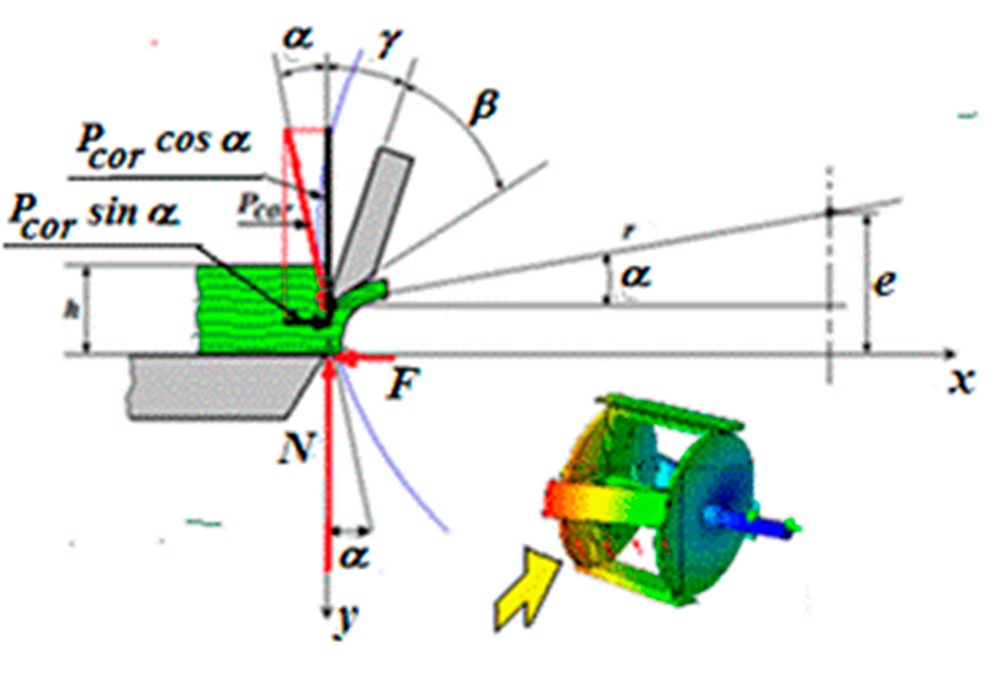
In Cuba, as an alternative to imported concentrates, the production and inclusion of protein-rich plants grown on farms is being promoted in animal diets. moringa (Moringa oleifera) is a prominent example, requiring adjustments to the parameters of forage mills to efficiently process this type of forage. On livestock farms, the predominant type of forage mill is one that does not use forced feeding, with the forage being drawn in by the cutting blades themselves. The mill's suction capacity, the size of the ground particles, and the load-capacity ratio depend on a set of machine design and operating parameters, as well as certain physical and mechanical properties of the processed material. This work derives, through conceptual mechanical-mathematical modeling of the interaction of a cutting element in a drum-type forage mill without forced feeding, the expressions that allow the calculation of the mill's design and operating parameters. These parameters ensure an efficient suction effect, with the required material flow and particle size, during the processing of a plant mass composed of thin stems, branches, and leaves. Additionally, a set of moringa properties, required as input data for the models, is experimentally determined. These properties are evaluated using specially developed software, thus determining, for this forage plant, the mill's operating parameters that guarantee efficient operation and the required particle size of the processed forage.
Article Details

This work is licensed under a Creative Commons Attribution-NonCommercial 4.0 International License.
Those authors that have publications with this journal accept the following terms:
1. They will retain their copyright and guarantee the journal the right of first publication of their work, which will be simultaneously subject to the License Creative Commons Attribution-NonCommercial 4.0 International (CC BY-NC 4.0) that allows third parties to share the work whenever its author is indicated and its first publication this journal. Under this license the author will be free of:
• Share — copy and redistribute the material in any medium or format
• Adapt — remix, transform, and build upon the material
• The licensor cannot revoke these freedoms as long as you follow the license terms.
Under the following terms:
• Attribution — You must give appropriate credit, provide a link to the license, and indicate if changes were made. You may do so in any reasonable manner, but not in any way that suggests the licensor endorses you or your use.
• NonCommercial — You may not use the material for commercial purposes.
• No additional restrictions — You may not apply legal terms or technological measures that legally restrict others from doing anything the license permits.
2. The authors may adopt other non-exclusive license agreements to distribute the published version of the work (e.g., deposit it in an institutional telematics file or publish it in a monographic volume) whenever the initial publication is indicated in this journal.
3. The authors are allowed and recommended disseminating their work through the Internet (e.g. in institutional telematics archives or on their website) before and during the submission process, which can produce interesting exchanges and increase the citations of the published work. (See the Effect of open access).
References
ALFIOROV, C.; PARA, J.; ARGÜELLES, J.; DÍAZ, R.: “Investigación del proceso de corte de la bermuda cruzada con órganos de corte rotatorios de eje vertical”, Ciencia y Técnica en la Agricultura, Serie Mecanización, La Habana. Cuba, 4(1), 1981.
ALVARADO, E.; JOAQUÍN, S.; ESTRADA, B.; MARTÍNEZ, J.; HERNÁNDEZ, J.: “Moringa oleifera Lam.: Una alternativa forrajera en la producción pecuaria en México”, Agro Productividad, 11(2): 106-110, 2018.
BARRIENTOS-RIVERA, J.L.; CALZADA-TORRES, A.J.; SOTO-CUETO, K.G.: “Diseño de una máquina picadora y recolectora de forraje con cuchillas simples para tractores agrícolas en el Valle del Mantaro”, 2023.
BASHAR, M.K.; HUQUE, K.S.; SARKER, N.R.; SULTANA, N.: “Quality assessment and feeding impact of Moringa feed on intake, digestibility, enteric CH4 emission, rumen fermentation, and milk yield”, Journal of Advanced Veterinary and Animal Research, 7(3): 521, 2020, DOI: https://doi.org/10.5455/javar.2020.g449.
BASOI, E.; VERNIAYER, O.; SMIRNOV, I.; SHAX, E.S.: “Teoría, construcción y cálculo de maquinaria agrícola”, Editorial Construcción de Maquinaria. Moscú, 1976.
CARMOLINGA, J.: Propuesta de una Máquina Ensiladora (Picadora de Forraje) para la Alimentación Animal, Inst. Universidad Autónoma Chapingo, Departamento de Ingeniería Mécánica Agrícola, Informe técnico, Texcoco de Mora, Edo. México, México, 1995.
FERNÁNDEZ, E.; MARTÍNEZ, A.: “Modelo matemático para la determinación de la potencia consumida en el proceso tecnológico de corte de tallos mediante órganos de cortes rotacionales de eje horizontal”, Revista Ciencias Técnicas Agropecuarias (Cuba), 1(3): 79-88, 1988.
GARAVITO, U.: “Moringa oleifera, alimento ecológico para ganado vacuno, porcino, equino, aves y peces, para alimentación humana, también para producción de etanol y biodiesel”, 18, 2008, Disponible en:http://www.engormix.com/MAavicultura/nutricion/articulos/moringaoleifera-t1891/141-p0.htm.
KEKANA, T.; MARUME, U.; MUYA, C.; NHERERA, F.: “Lactation performance and blood metabolites in lactating dairy cows micro-supplemented with Moringa oleifera leaf meal”, South African Journal of Animal Science, 49(4): 709-716, 2019, ISSN: 2221-4062, DOI: https://doi.org/10.4314/sajas.v49i4.12.
KOEGEL, R.; SHINNERS, K.; WALL, S.; FRONCZAK, F.; STRAUB, R.: “Radial blade and anvil forage cutterhead”, Transactions of the ASAE, 33(3): 695-0706, 1990.
MARTÍNEZ, A.; VALDÉS, P.; DÍAZ, J.; MATURELL, Y.; VEGA, D.: “Determinación de las condiciones de succión de la masa vegetal en los molinos desmenuzadores de tallos”, Revista Ciencias Técnicas Agropecuarias, 13(4): 1-10, 2004a, ISSN: 1010-2760.
MARTÍNEZ, A.; VALDÉS, P.; SUÁREZ, J.D.; MATURELL, Y.; VEGA, D.: “Modelo matemático racional para el cálculo de la potencia consumida en molinos forrajeros de tambor”, Revista Ciencias Técnicas Agropecuarias, 13(4): 0, 2004b, ISSN: 1010-2760.
MARTÍNEZ, R.A.: Contribución a la Modelación Matemática Racional Dirigida al Cálculo de Parámetros en Procesos de Aplicación en la Agricultura, [en línea], Universidad Agraria de La Habana (UNAH), Tesis en opción al grado científico de Doctor en Ciencias de Segundo Grado (Dr.Cs.), La Habana, Cuba, 2007, Disponible en: https://evea.unah.edu.cu.
MARTÍNEZ, R.A.: Libro de Texto Complementario: Cálculo de Parámetros en Máquinas Agrícolas Asistido por Computadora, [en línea], Ed. Entorno Virtual de Enseñanza-Aprendizaje (EVEA). Universidad Agraria de La Habana, vol. II Capitulo, San Jose de las Lajas Mayabeque, CUBA, 65-66 p., 2019, Disponible en: https://evea.unah.edu.cu.
MARTÍNEZ, R.A.; VALDÉS, H.P.: “Determinación de las condiciones de succión de la masa vegetal en molinos desmenuzadores de tallos”, Revista Ciencias Técnicas Agropecuarias, 13(4), 2004, ISSN: 2071-0054.
OLSON, M.E.; FAHEY, J.W.: “Moringa oleifera: un árbol multiusos para las zonas tropicales secas”, Revista mexicana de biodiversidad, 82(4): 1071-1082, 2011, ISSN: 1870-3453.
PADILLA, C.; FRAGA, N.; SUÁREZ, M.: “Efecto del tiempo de remojo de las semillas de moringa (Moringa oleifera) en el comportamiento de la germinación y en indicadores del crecimiento de la planta”, Revista Cubana de Ciencia Agrícola, 46(4): 419-421, 2012, ISSN: 0034-7485.
RIEZNIK, N.: “Combinadas Silo cosechadoras, Teoría y Cálculo”, Editorial MIR-Moscú.(en ruso), 1964.
RIZWAN, N.; RIZWAN, D.; BANDAY, M.: “Moringa oleifera: The miracle tree and its potential as nonconventional animal feed: A review”, Agricultural Reviews, 45(3): 369-379, 2024, ISSN: 0253-1496.
SÁBLIKOV, M.: “Investigación del Proceso de Corte de Tallos con Cuchillas”, Mecanización y Electrificación de la Agricultura, (2), 1963.
SHINNERS, K.; KOEGEL, R.; PRITZL, P.: “An upward cutting cut-and-throw forage harvester to reduce machine energy requirements”, Transactions of the ASAE, 34(6): 2287-2290, 1991.
SU, B.; CHEN, X.: “Current status and potential of Moringa oleifera leaf as an alternative protein source for animal feeds”, Frontiers in veterinary science, 7: 53, 2020, ISSN: 2297-1769, DOI: https://doi.org/10.3389/fvets.2020.00053.
VALDÉS, P.A.; MARTÍNEZ, A.: “Software para la determinación racional de los parámetros de trabajo de las picadoras de forraje del tipo tambor con alimentación manual”, Revista Ciencias Técnicas Agropecuarias, 20(2): 80-85, 2011, ISSN: 2071-0054.
VALDÉS, P.A.; MARTÍNEZ, A.; VALENCIA, Y.; BRITO, E.: “Influencia del momento de inercia del tambor y de diferentes ángulos de alimentación constantes sobre el calibre de las partículas de forraje procesado con picadores del tipo de tambor con alimentación manual. Parte I”, Revista Ciencias Técnicas Agropecuarias, 19(3): 53-56, 2010, ISSN: 2071-0054.
VALDÉS, P.A.; MARTÍNEZ, A.; VALENCIA, Y.; BRITO, E.: “Validación del modelo de cálculo de la potencia consumida por las picadoras de forraje del tipo de tambor con alimentación manual”, Revista Ciencias Técnicas Agropecuarias, 21(2): 05-10, 2012, ISSN: 2071-0054.