Evaluación de la aplicación de HeberNem-S® en el cultivo de papaya a cielo abierto
Barra lateral del artículo
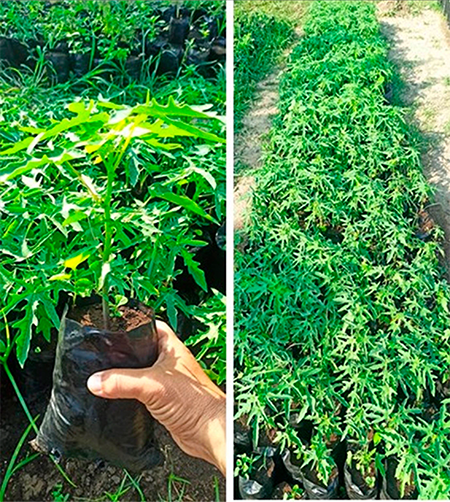
Contenido principal del artículo
Resumen
El bionematicida y biofertilizante HeberNem-S® se ha empleado exitosamente en cultivos protegidos y semiprotegidos, demostrando su efectividad para la estimulación de la germinación, el crecimiento y la floración. Sin embargo, su uso en cultivos no protegidos no ha sido suficientemente estudiado. El presente trabajo representa la primera evaluación del efecto de HeberNem-S® sobre el crecimiento vegetativo y productividad agrícola en el cultivo de papaya en condiciones de cielo abierto. El ensayo se desarrolló en la finca El Jibao, Camagüey, con posturas de la variedad Maradol Roja. Se siguió un esquema de 4 aplicaciones de HeberNem-S®: al momento del trasplante, 40, 100 y 160 días después. En las plantas tratadas, respecto a la comparación con el control absoluto, aumentaron significativamente indicadores morfofisiológicos como: altura de planta y diámetro del tallo. Además, se produjo un adelanto de la floración y la fructificación en las plantas que recibieron HeberNem-S®, con respecto al grupo testigo y a lo reportado para la variedad. También se incrementaron significativamente indicadores agroproductivos: número de flores y frutos por planta, longitud y diámetro de los frutos con madurez técnica y peso promedio de los frutos, con un rendimiento estimado de 87 kg/ha al finalizar el cultivo, superior a la media reportada en Cuba de 50 kg/ha. Con estos resultados se demuestra el efecto estimulador de HeberNem-S® sobre el crecimiento vegetativo y productividad agrícola en el cultivo de papaya en condiciones de cielo abierto.
Detalles del artículo

Esta obra está bajo una licencia internacional Creative Commons Atribución-NoComercial 4.0.
Aquellos autores/as que tengan publicaciones con esta revista, aceptan los términos siguientes:
- Los autores/as conservarán sus derechos de autor y garantizarán a la revista el derecho de primera publicación de su obra, el cuál estará simultáneamente sujeto a la Licencia Creative Commons Attribution-NonCommercial 4.0 International (CC BY-NC 4.0) que permite a terceros compartir la obra siempre que se indique su autor y su primera publicación esta revista. Bajo esta licencia el autor será libre de:
- Compartir — copiar y redistribuir el material en cualquier medio o formato
- Adaptar — remezclar, transformar y crear a partir del material
- El licenciador no puede revocar estas libertades mientras cumpla con los términos de la licencia
Bajo las siguientes condiciones:
- Reconocimiento — Debe reconocer adecuadamente la autoría, proporcionar un enlace a la licencia e indicar si se han realizado cambios. Puede hacerlo de cualquier manera razonable, pero no de una manera que sugiera que tiene el apoyo del licenciador o lo recibe por el uso que hace.
- NoComercial — No puede utilizar el material para una finalidad comercial.
- No hay restricciones adicionales — No puede aplicar términos legales o medidas tecnológicas que legalmente restrinjan realizar aquello que la licencia permite.
- Los autores/as podrán adoptar otros acuerdos de licencia no exclusiva de distribución de la versión de la obra publicada (p. ej.: depositarla en un archivo telemático institucional o publicarla en un volumen monográfico) siempre que se indique la publicación inicial en esta revista.
- Se permite y recomienda a los autores/as difundir su obra a través de Internet (p. ej.: en archivos telemáticos institucionales o en su página web) antes y durante el proceso de envío, lo cual puede producir intercambios interesantes y aumentar las citas de la obra publicada. (Véase El efecto del acceso abierto).
Citas
ALCÁNTARA, J.A.; A O; MICHEL, A.C.; SOLÍS, M.: “Respuesta de la fertilización orgánica, biológica y química en el rendimiento de dos genotipos de papayo”, Revista de Simulación y Laboratorio, 2(2): 51-54, 2015.
CAMPOS, J.M.; VÁZQUEZ, E.P.; GONZÁLEZ, L.V.; HERNÁNDEZ, A.T.; LEÓN, L.; RAMÍREZ, Y.; RAÍCES, M.: “Aislamiento y determinación de cepas bacterianas con actividad nematicida. Mecanismo de acción de C. paurometabolum C-924 sobre nemátodo”, Biotecnología Aplicada, 20(4): 248-252, 2003.
CARPIO, C.A.; JIMÉNEZ, J.A.A.; BAUTISTA, S.L.; SERNA, S.A.; VILLANUEVA, G.E.D.: “Rendimiento y rentabilidad de genotipos de papaya en función de la fertilización química, orgánica y biológica”, Revista Mexicana de Ciencias Agrícolas, 10(3): 575-558, 2019.
CRESPO DE ARMAS, R.: “Evaluación del efecto del ecomic® en el crecimiento y rendimiento del cultivo del papayo (carica papaya l.) cv. gigante matancera.”, 2024.
CUETO, L.M.; MESA, J.R.: “Efecto de un biopreparado de microorganismos eficientes en vivero y trasplante de fruta bomba (Carica papaya, L.) en la Cooperativa de Crédito y Servicios Manuel Ascunce, Cienfuegos”, Revista científica Agroecosistemas, 6(3): 103-111, 2018, ISSN: 2415-2862.
DÍAZ, M.F.; REYES, O.R.; PARDILLO, T.B.; CAMPOS, J.M.; MESA, L.: “Evaluación de dosis de HeberNem para el control de Meloidogyne incognita Chitwood en condiciones de cultivos protegidos”, Centro Agrícola, 40(1): 57-62, 2013.
ESCAMILLA, J.L.; SAUCEDO, C.; MARTÍNEZ, M.T.; MARTÍNEZ, A.; SÁNCHEZ, P.; SOTO, R.M.: “Fertilización orgánica, mineral y foliar sobre el desarrollo y la producción de papaya cv. Maradol”, Terra latinoamericana, 21(2): 157-166, 2003.
FUNDORA-SÁNCHEZ, L.R.; DELGADO-ÁLVAREZ, A.; CABRERA-RODRÍGUEZ, J.A.; MARTÍN-ALONSO, G.M.: “Efecto del bioproducto QuitoMax® en el cultivo del papayo (Carica papaya L.) en fase de vivero”, Cultivos Tropicales, 42(3), 2021, ISSN: 0258-5936.
GÓMEZ, L.D.T.: Efecto de la biofertilización con EcoMic® en el cultivo de la papaya (Carica papaya L.) en condiciones de producción, [en línea], ],. Universidad Central «Marta Abreu» de Las Villas, Cuba, Tesis de Diploma, Santa Clara, Villa Clara, Cuba, 68 p., 2019, Disponible en:https://dspace.uclv.edu.cu/items/1a90cabc-ae3d-4ee0-9b36-aea23355d1e5.
LOZANO, C.M.G.; SANTAMARÍA, B.F.: “Uso de biofertilizantes en la producción de planta de papaya maradol”, Instituto Nacional de Investigaciones Forestales, Agrícolas y Pecuarias. Centro de Investigación Regional Sureste. Campo Experimental Mocochá, Mérida, Yucatán. Folleto para productores, (2), 2013.
MARIN, M.; MENA, J.; FRANCO, R.; PIMENTEL, E.; SÁNCHEZ, I.: “Effects of the bacterial-fungal interaction between Tsukamurella paurometabola C 924 and Glomus fasciculatum and Glomus clarum fungi on lettuce microrrizal colonization and foliar weight”, Biotecnología Aplicada, 27: 48-51, 2010, ISSN: 1027-2852.
MARÍN, M.; WONG, I.; GARCÍA, G.; MORÁN, R.; BASULTO, R.; PIMENTEL, E.; MENA, J.: “Actividad antagónica in vitro de Tsukamurella paurometabola C-924 frente a fitopatógenos”, Revista de Protección Vegetal, 28(2): 132-137, 2013, ISSN: 1010-2752.
MARÍN, M.; WONG, I.; MENA, J.; MORÁN, R.; PIMENTEL, E.; SÁNCHEZ, I.; BASULTO, R.; MOREIRA, A.: “Zea mays L. plant growth promotion by Tsukamurella paurometabola strain C-924”, Biotecnol Apl, 30(2): 105-10, 2013b.
MENA, J.; PIMENTEL, E.; VELOZ, L.; HERNÁNDEZ, A.; LEÓN, L.; RAMÍREZ, Y.; SÁNCHEZ, I.; MENCHO, J.; LÓPEZ, A.; PUJOL, M.: “Aislamiento y determinación de cepas bacterianas con actividad nematicida. Mecanismo de acción de C. paurometabolum C-924 sobre nematodos”, Biotecnología Aplicada, 20(4): 248-252, 2003.
MESA, J.R.; CARVAJAL, R.; ALMOGUEA, M.: “Efecto de los Microorganismos Eficientes (ME) en la producción de posturas de fruta bomba (Carica papaya L.) en la Empresa Agropecuaria Horquita”, Revista Agroecosistemas, 3(1): 372-378, 2015.
PEÑA, H.; DÍAZ, J.; MARTINEZ, T.: Fruticultura Tropical, Ed. Editorial Félix Varela, La Habana, Cuba, 2006.
QUIÑONES-AGUILAR, E.E.; LÓPEZ-PÉREZ, L.; HERNÁNDEZ-ACOSTA, E.; FERRERA-CERRATO, R.; RINCÓN-ENRÍQUEZ, G.: “Simbiosis micorrízica arbuscular y fuentes de materia orgánica en el crecimiento de Carica papaya L.”, Interciencia, 39(3): 198-204, 2014, ISSN: 0378-1844.
VERA, R.; CASTRO, A.L.; VALVERDE, Y.A.; CHOEZ, J.E.: “Efecto del uso de cuatro tipos de sustratos para la producción de plántulas de papaya (Carica papaya L.) en condiciones de vivero”, Roca, 17(4): 388-407, 2021, ISSN: 2074-0735.