Cambio climático y demanda de riego del arroz (Oriza sativa L.) en Cuba
Barra lateral del artículo
Contenido principal del artículo
Resumen
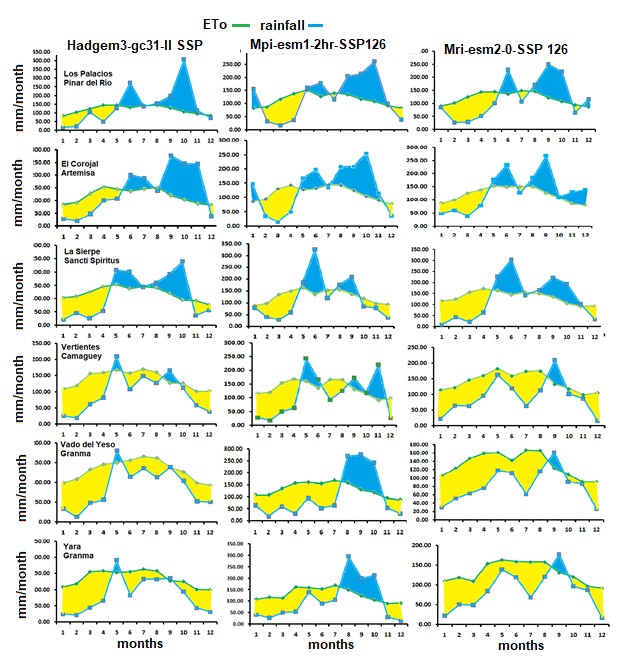
Dado los posibles efectos del cambio climático (CC), expresados en el aumento de las temperaturas y la disminución de las lluvias, se prevé entre los principales impactos motivado por el CC para el cultivo del arroz en el país la reducción de la superficie de cultivo, debido a la menor disponibilidad de agua, cosechas de menor calidad y magnitud total. Teniendo en cuenta lo anterior, y la importancia de este cultivo para el país este trabajo se propuso estudiar el efecto de la variación de las lluvias utilizando el escenario climático SSP1 2.6 y tres modelos climáticos regionales (Hadgem3- gc31-ll-SSP12.6, Mpi-esm1-2-hr-SSP126 y Mri-esm2-0-SSP126), con variables climáticas hasta el año 2050, utilizando el programa CropWat 8.0 para el cálculo de la demanda de riego en seis sitios distribuidos en la región Occidental (2), Central (2) y Oriental (2) del país. Con independencia del modelo estudiado para la evaluación de las precipitaciones hubo una disminución de los valores desde occidente hacia el oriente, con promedios de 1644, 1467,5 y 1239,1 mm año-1 para la zona occidental, central y oriental, respectivamente; la demanda del agua fue superior en el modelo Hadgem3-gc31 con norma bruta promedio de los 6 sitios estudiados de 1337,5 mm para un ciclo de 130 días y superior en un 5,8 y 4,3 % para los modelos Mpi-esm1-2hr-SSP126 y Mri-esm2-0-126, respectivamente Se sugiere continuar los estudios sobre el tema incluyendo el posible efecto de las temperaturas en la disminución tanto del ciclo como del rendimiento del cultivo.
Detalles del artículo

Esta obra está bajo una licencia internacional Creative Commons Atribución-NoComercial 4.0.
Aquellos autores/as que tengan publicaciones con esta revista, aceptan los términos siguientes:
- Los autores/as conservarán sus derechos de autor y garantizarán a la revista el derecho de primera publicación de su obra, el cuál estará simultáneamente sujeto a la Licencia Creative Commons Attribution-NonCommercial 4.0 International (CC BY-NC 4.0) que permite a terceros compartir la obra siempre que se indique su autor y su primera publicación esta revista. Bajo esta licencia el autor será libre de:
- Compartir — copiar y redistribuir el material en cualquier medio o formato
- Adaptar — remezclar, transformar y crear a partir del material
- El licenciador no puede revocar estas libertades mientras cumpla con los términos de la licencia
Bajo las siguientes condiciones:
- Reconocimiento — Debe reconocer adecuadamente la autoría, proporcionar un enlace a la licencia e indicar si se han realizado cambios. Puede hacerlo de cualquier manera razonable, pero no de una manera que sugiera que tiene el apoyo del licenciador o lo recibe por el uso que hace.
- NoComercial — No puede utilizar el material para una finalidad comercial.
- No hay restricciones adicionales — No puede aplicar términos legales o medidas tecnológicas que legalmente restrinjan realizar aquello que la licencia permite.
- Los autores/as podrán adoptar otros acuerdos de licencia no exclusiva de distribución de la versión de la obra publicada (p. ej.: depositarla en un archivo telemático institucional o publicarla en un volumen monográfico) siempre que se indique la publicación inicial en esta revista.
- Se permite y recomienda a los autores/as difundir su obra a través de Internet (p. ej.: en archivos telemáticos institucionales o en su página web) antes y durante el proceso de envío, lo cual puede producir intercambios interesantes y aumentar las citas de la obra publicada. (Véase El efecto del acceso abierto).
Citas
ACHARJEE, T.K.; LUDWIG, F.; VAN HALSEMA, G.; HELLEGERS, P.; SUPIT, I.: “Future changes in water requirements of Boro rice in the face of climate change in North-West Bangladesh”, Agricultural water management, 194: 172-183, 2017, ISSN: 0378-3774.
AGRAWAL, A.; SRIVASTAVA, P.K.; TRIPATHI, V.K.; MAURYA, S.; SHARMA, R.; DJ, S.: “Future projections of crop water and irrigation water requirements using a bias-corrected regional climate model coupled with CROPWAT”, Journal of Water and Climate Change, 14(4): 1147-1161, 2023, ISSN: 2040-2244.
ALEMÁN, L.A.; MENESES, J.; MARTINEZ, J.; POLÓN, R.; HERRERA, J.; LEÓN, O.: Manejo del agua., Ed. Ministerio de la agricultura, Instituto de Granos, Instructivo técnico del arroz ed., vol. I, La Habana, Cuba, 2020, ISBN: 978-959-285-065-1.
ALLEN, R.G.; PEREIRA, L.S.; RAES, D.; SMITH, M.: “Evapotranspiración del cultivo: guías para la determinación de los requerimientos de agua de los cultivos”, Roma: FAO, 298(0), 2006.
ASCANIO, O.; BOUZA, H.; HERNANDEZ, A.; AGAFONOV, O.: “Principales propiedades fisicas e hidrofisicas de los suelos arroceros de Cuba.”, Ciencia y Tecnica en la Agricultura. Serie Riego y Drenaje, 3, 1980.
BOUMAN, B.A.M.; HAEFELE, S.M.; HIZZI, G.; PENG, S.; HSIAO, T.C.: Respuesta del rendimiento de los cultivos al Agua, Ed. International Rice Research Institute, Estudio FAO Riego y Drenaje, FAO ed., vol. 56, Roma, Italia, 2012, ISBN: 971-22-0219-4.
CARRAZANA, J.A.; MARTÍNEZ, J.; COLOM, L.; FONTOVA, M.: “Uso Eficiente del agua en el Cultivo del Arroz”, En: VIII Seminario Internacional del Uso Integral del Agua. INRH, Cuba, Ed. Instituto Nacional de Recursos, Hidráulicos, La Habana, Cuba, 2013.
CID, G.; LÓPEZ, T.; GONZÁLEZ, F.; HERRERA, J.; RUIZ, M.E.: “Características físicas que definen el comportamiento hidráulico de algunos suelos de Cuba”, Revista Ingeniería Agrícola, 2(2): 25-31, 2012, ISSN: 2306-1545.
CISNEROS, E.; HERRERA, J.; CUN, R.; GONZÁLEZ, F.; CHATERLAN, Y.; DOMÍNGUEZ, C.: Estimación de las normas totales netas de riego en tres polos arroceros de Cuba, Inst. Instituto de Investigaciones de Ingeniería Agrícola (IAgric), Informe técnico de Introducción de resultados de Investigación, La Habana, Cuba, 10 p., 2023.
CITMA-CUBA: Tercera Comunicación Nacional a la Convención Marco de las Naciones Unidas sobre Cambio Climático, Ed. Ministerio de Ciencia, Tecnología y Medio Ambiente, República de Cuba, La Habana, Cuba, 2020, ISBN: 978-959-300-170-0.
DING, Y.; WANG, W.; SONG, R.; SHAO, Q.; JIAO, X.; XING, W.: “Modeling spatial and temporal variability of the impact of climate change on rice irrigation water requirements in the middle and lower reaches of the Yangtze River, China”, Agricultural water management, 193: 89-101, 2017, ISSN: 0378-3774.
ENVIRONMENT AND CLIMATE CHANGE CANADA: CMIP6 and Shared Socioeconomic Pathways overview, [en línea], ClimateScenarios.Canada, 2023, Disponible en: https://ClimateScenarios.Canada.ca/?Page=cmip6-OverviewNotes.
FAO: CropWat 8.0 for windows 2000-2008, Food Agricultural Organization (FAO), Rome, Italy, 2008.
FAO: Cropwat 8.0 for windows user guide, Food Agricultural Organization (FAO), Rome, Italy, 2009.
FAO: Cropwat 8.0 for windows user guide, Food Agricultural Organization (FAO), Rome, 2016.
GILANIPOUR, J.; GHOLIZADEH, B.: “Prediction of rice water requirement using FAO-CROPWAT model in North Iran under future climate change”, Preprints, 2016.
GUTIÉRREZ, S.D.; LAU, S.B.: “Metodología para la formación del precio del arroz en Cuba”, Revista Cubana De Finanzas Y Precios, 3(1): 91-101, 2019.
HASTARAI, A.A.; WIBOWO, A.; TAMBUNAN, M.P.; PUTRO, D.A.: “Projection of The Effect of Climate Change on Crop Water Requirements for Rice Plants in Majalengka Regency”, En: IOP Conference Series: Earth and Environmental Science, Ed. IOP Publishing, vol. 1111, p. 012021, 2022, ISBN: 1755-1315.
HERRERA-PUEBLA, J.; HERVIS-GRANDA, G.; GONZÁLEZ-ROBAINA, F.; DUARTE-DÍAZ, C.: “Estudio sobre el balance hídrico del arroz en Cuba”, Ingeniería Agrícola, 9(3), 2019, ISSN: 2227-8761.
HERRERA-PUEBLA, J.; MENESES-PERALTA, J.; DUARTE-DÍAZ, C.; GONZÁLEZ-ROBAINA, F.; HERVÍS-GRANDA, G.: “Determination of Crop Coefficients for Estimating Evapotranspiration in a Paddy Field in Cuba”, Revista Ciencias Técnicas Agropecuarias, 29(3): 05-20, 2020, ISSN: 1010-2760.
INRH-CUBA: Resolución 287/2015, Anexo 2. ÍNDICES DE CONSUMO: Normas de Riego Netas Totales para los Cultivos Agrícolas, Inst. Instituto Nacional de Recursos Hidráulicos, Presidencia del INRH, La Habana, Cuba, 2015.
IPCC: Cambio climático 2021. Bases físicas. Resumen para responsables de políticas, Contribución del Grupo de Trabajo I al Sexto Informe de Evaluación del Grupo Intergubernamental de Expertos sobre el Cambio Climático, La Habana, Cuba, 40 p., 2021, ISBN: 978-92-9169-358-0.
JANUTA, A.: “Que significan los cinco futuros del informe de la ONU sobre el clima”, Euronews. es. euronews. com, 2021.
KYU, S.L.; TRUONG, A.D.: “Predicting future water demand for Long Xuyen Quadrangle under the impact of climate variability”, En: Acta Geophysica, 2018,
DOI: https://doi.org/10.1007/s11600-018-0176-4.
MARTÍNEZ, J.; HERRERA, J.; MENESES, J.: Los suelos para el cultivo del arroz y su relación con el riego. En: Manejo integrado del riego en el cultivo del arroz, Inst. Instituto de Investigaciones del Arroz- Instituto de Ingeniería Agrícola, Informe de proyecto, La Habana, Cuba, 2017.
ONEI-CUBA: Anuario Estadístico de Cuba 2022, La Habana, Cuba, 2022, ISBN: 978-959-7119-62-3.
RENAULT, D.: Rice is Life. International Year of Rice, [en línea], FAO, Rome, Italy, 2004, Disponible en: www.rice.org.
SAMAKÉ, M.: Familias de curvas de infiltración para los suelos arroceros cubanos y sus aplicaciones en el diseño de sistemas de riego para estos suelos, Instituto Superior Agropecuario de la Habana (ISCAH)-Instituto de Investigaciones de Riego y Drenaje (IIRD), Tesis en Opción al Grado de MSc.,
Provincia Habana, Cuba, 1998.
SIMEÓN, F.: “Características de las propiedades hidrofísicas de los principales suelos agrícolas de Cuba”, Voluntad hidráulica, 16(49-50): 16-23, 1979.
SMITH, M.: CROPWAT: A computer program for irrigation planning and management, Ed. Food & Agriculture Org., 1992, ISBN: 92-5-103106-1.