Predicción a futuro de las normas netas de riego del cafeto en diferentes escenarios productivos
Barra lateral del artículo
Contenido principal del artículo
Resumen
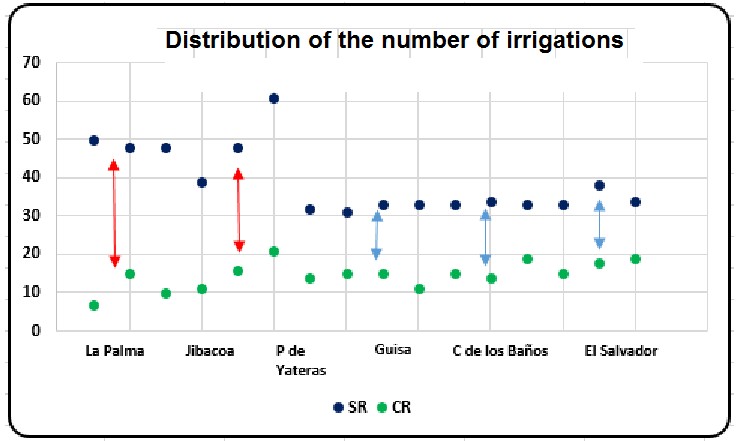
El trabajo se desarrolló con el objetivo de estimar a futuro las normas netas totales de riego del cafeto según la variabilidad climática en diferentes zonas productoras del grano en Cuba. Para ello fueron seleccionados sitios representativos donde se cultiva el cafeto en los cuatro macizos montañosos de Cuba. Se tomaron los datos climáticos del modelo PRECIS en el escenario climático RCPs 4.5, recomendado por el Instituto de Meteorología de Cuba para evaluar el manejo del agua en función de las regiones climáticas y cultivos como el cafeto. Para la estimación de las normas de riego a mediano plazo (2050), en función de los pronósticos de variabilidad climática se utilizó el programa de modelación CROPWAT 8.0. Por último, se compararon las normas de riego obtenidas con las que aparecen en la Resolución 17/2020 del Instituto Nacional de Recursos Hidráulicos. Las estimaciones de las normas netas totales de riego para el cafeto según la variabilidad climática en los próximos años para los sitios de estudio indican que habrá un incremento de las mismas entre un 8,8 % en La Palma, que equivalen a 8 447,0 m3·ha-1 y un 40,5 % en Palenque de Yateras (8 793,0 m3·ha-1). Las mayores diferencias entre las normas netas totales y las normas netas reducidas para el escenario RCP 4.5 se tienen en la región occidental y central las que varían entre 48 % y 78 %, siendo menores para la región oriental donde están en el rango de 17 % a 51 %. Al comparar las obtenidas con las de la resolución 17/2020, estas son superiores entre un 8,8 % y 40,5 % lo que indica que habrá una fuerte presión sobre los recursos hídricos en las zonas cafetaleras estudiadas.
Detalles del artículo

Esta obra está bajo una licencia internacional Creative Commons Atribución-NoComercial 4.0.
Aquellos autores/as que tengan publicaciones con esta revista, aceptan los términos siguientes:
- Los autores/as conservarán sus derechos de autor y garantizarán a la revista el derecho de primera publicación de su obra, el cuál estará simultáneamente sujeto a la Licencia Creative Commons Attribution-NonCommercial 4.0 International (CC BY-NC 4.0) que permite a terceros compartir la obra siempre que se indique su autor y su primera publicación esta revista. Bajo esta licencia el autor será libre de:
- Compartir — copiar y redistribuir el material en cualquier medio o formato
- Adaptar — remezclar, transformar y crear a partir del material
- El licenciador no puede revocar estas libertades mientras cumpla con los términos de la licencia
Bajo las siguientes condiciones:
- Reconocimiento — Debe reconocer adecuadamente la autoría, proporcionar un enlace a la licencia e indicar si se han realizado cambios. Puede hacerlo de cualquier manera razonable, pero no de una manera que sugiera que tiene el apoyo del licenciador o lo recibe por el uso que hace.
- NoComercial — No puede utilizar el material para una finalidad comercial.
- No hay restricciones adicionales — No puede aplicar términos legales o medidas tecnológicas que legalmente restrinjan realizar aquello que la licencia permite.
- Los autores/as podrán adoptar otros acuerdos de licencia no exclusiva de distribución de la versión de la obra publicada (p. ej.: depositarla en un archivo telemático institucional o publicarla en un volumen monográfico) siempre que se indique la publicación inicial en esta revista.
- Se permite y recomienda a los autores/as difundir su obra a través de Internet (p. ej.: en archivos telemáticos institucionales o en su página web) antes y durante el proceso de envío, lo cual puede producir intercambios interesantes y aumentar las citas de la obra publicada. (Véase El efecto del acceso abierto).
Citas
BALTAZAR, P.I.; CHIPANA, M.G.: Estudio del comportamiento hidráulico relacionado a la uniformidad de aplicación, mediante el método de riego por aspersión en la estación experimental choquenaira. Revista de Investigación e Innovación Agropecuaria y de Recursos Naturales, 3(3), 18-29, 2016, ISSN: 2409-1618.
CAMEJO, N.; DÍAZ, Y.; HERRERA, J.: Requerimientos de agua de los cultivos sorgo, maíz y frijol en la “UEB Sierra Maestra” en el municipio Los Palacios, 72pp. Tesis (en opción al título de Ingeniero Hidráulico), Universidad Tecnológica de La Habana-CUJAE, La Habana, Cuba.
CENTELLA, A.: La estimación del clima futuro y los escenarios climáticos [Parte 1 y 2], Instituto de Meteorología. La Habana. Cuba, La Habana, Cuba, 2017.
CID, G.; LÓPEZ, T.; GONZÁLEZ, F.; HERRERA, J.; RUIZ, M.E.: “Características físicas que definen el comportamiento hidráulico de algunos suelos de Cuba”, Revista Ingeniería Agrícola, 2(2): 25-31, 2012, ISSN: 2306-1545.
CISNEROS, E.; REY, R.; ZAMORA, E.; GONZÁLEZ, F.: “Influencia del manejo del riego en el rendimiento del cafeto”, Revista Ciencias Técnicas Agropecuarias, 15(2): 42-46, 2006, ISSN: 1010-2760.
CISNEROS-ZAYAS, E.; GONZÁLEZ-ROBAINA, F.; MARTÍNEZ-VARONA, R.; LÓPEZ-SEIJAS, T.; REY-GARCÍA, Á.R.: “Respuesta productiva del cafeto al manejo del riego. Función agua-rendimiento”, Revista Ciencias Técnicas Agropecuarias, 24(4): 5-11, 2015, ISSN: 2071-0054.
CORTÉS, B.C.A.; BERNAL, P.J.; DÍAZ, A.E.; MÉNDEZ, M.J.: Uso del modelo AquaCrop para estimar rendimientos para el cultivo de maíz en los departamentos de Córdoba, Meta, Tolima y Valle del Cauca, Inst. FAO, Informe técnico proyecto de cooperación técnica TCP/COL/3302, Córdoba, Meta, Tolima y Valle del Cauca, Colombia, 62 p., 2013.
DÍAZ, Y.; HERRERA, J.; GONZÁLEZ, F.: Estimación de los requerimientos de agua del sorgo (Sorgum vulgare L. Monech) en la región Los Palacios en Cuba, Ingeniería Agrícola, 6(4): 3-10, 2016, ISSN-2306-1545, e-ISSN-2227-8761.
FLORES, G. H.; OJEDA, W. B.; FLORES, H.; SIFUENTES, E.; MEJIA, E.: Simulación del rendimiento de Maíz (Zea mays L.) en el norte de Sinaloa usando el modelo Aquacrop. Agrociencia, 47(4): 347-359, 2013.
GARCÍA. R.Y, RAMÍREZ B.M, PAUMIER F.Y.: La actividad cafetalera en la comunidad del plan turquino de farallones de Moa. DELOS. Desarrollo Local Sostenible Grupo Eumed.net/Universidad de Málaga y Red Académica Iberoamericana Local Global Indexada en IN-Recs; LATINDEX; DICE; ANECA; ISOC y DIALNETVol 6. Nº 16 Febrero 2013. www.eumed.net/rev/delos/16
GOC-CUBA: “Resolución 17- 2020 Instituto Nacional de Recursos Hidráulicos (INRH)”, Gaceta Oficial de la República de Cuba: 35, ISSN: 0864 I-0793, e-ISSN: 1682-7511, GOC 2020-557-061, 2020.
GONZÁLEZ-ROBAINA, F.; CISNEROS-ZAYAS, E.; MONTILLA, E.: “Respuesta al déficit hídrico del cafeto (Coffea arabica L.) en diferentes fases de desarrollo”, Revista Ciencias Técnicas Agropecuarias, 26(3): 4-11, 2017, ISSN: 2071-0054.
HERNÁNDEZ, A.; ASCANIO, M.; MORALES, M.; CABRERA, A.: Correlación de la nueva versión de clasificación genética de los suelos de Cuba con las clasificaciones internacionales y nacionales: una herramienta útil para la investigación, docencia y producción agropecuaria, Inst. Instituto Nacional de Ciencias Agrícolas (INCA), La Habana, Cuba, 18-59 p., 2005.
HERNÁNDEZ-JIMÉNEZ, A.; PÉREZ-JIMENÉZ, J.M.; MESA-NÁPOLES, Á.; FUENTES-ALFONSO, E.; BOSCH-INFANTE, D.: Nueva versión de la clasificación genética de los suelos de Cuba., Ed. Instituto de suelos, 1999.
IPCC: Sexto Informe de Evaluación, 2023.
IS-CUBA: clasificación genética de los suelos de cuba, Ed. Editorial Academia, La Habana, Cuba, primera ed., La Habana, Cuba, 28 p., 1980.
JÄGERMEYR, J.; MÜLLER, C.; RUANE, A.C.; ELLIOTT, J.; BALKOVIC, J.; CASTILLO, O.; FAYE, B.; FOSTER, I.; FOLBERTH, J.A.; FUCHS, K.; GUARIN, J.R.; HEINKE, J.; HOOGENBOOM, G.; LIZUMI, T.; JAIN, A. K.; KELLY, D.; KHABAROV, N.; LANGE, S.; ROSENZWEIG, C.: Climate impacts on global agriculture emerge earlier in new generation of climate and crop models. Nature Food, 2(11), 873-885, 2021.
DOI: http://doi.org/10.1038/s43016-021-00400-y.
LEGRÁ, E.: Comunicación personal. Director general del grupo Café, Cacao y Coco perteneciente al Grupo Agroforetal (GAF) del Ministerio de la Agricultura (Minag)., 2022.
NELSON, G.C., ROSEGRANT, M.W., KOO, J., ROBERTSON, R., SULSER, T., ZHU, T., RINGLER, C., MSANGI, S., PALAZZO, A.; BATKA, M., MAGALHAES, M., VALMONTE-SANTOS, R., EWING, M. Y LEE, D.: Cambio Climático. El impacto en la agricultura y los costos de adaptación. Instituto Internacional de Investigación sobre Políticas Alimentarias IFPRI. Washington, D.C. 30pp, 2009.
PÉREZ, R.; ÁLVAREZ, M.: Necesidades de Riego de la Caña de Azúcar en Cuba, Ed. Academia, primera ed., La Habana, Cuba, 219 p., 2005, ISBN: 959-270-065-6.
PLANOS, E.O.: Síntesis informativa sobre impactos del cambio climático y medidas de adaptación en Cuba., Ed. Sello Editorial AMA, La Habana, La Habana, Cuba, 2014, ISBN: 959-300-044-5.
ROJAS, O.E. Determinación del potencial agroecológico del café (Coffea arabica) en Costa Rica. Turrialba 39(3): 279-287, 2018.
VALDÉS, C.R.; VENTO, D.H.: “Estudio del contenido de los principales productos de la fotosíntesis en plantas de Coffea arabica L. var. Caturra cultivadas bajo diferentes dosis de nitrógeno”, Cultivos Tropicales, 6(1): 111-122, 1984.
VALDÉS, R.; BARRERA, M.; POMBO, F.; VENTO, D.: “Caracterización del sistema de pigmentos foytosintéticos en plantas de cafetos”, Revista Chapingo, Horticultura, 4: 29-32, 1995.
VASALLO-RODRÍGUEZ, L., MONTES-ESPÍN, R., ESCARRÉ-ESTEVE, A., BONET-JORNET, A., FERNÁNDEZ-SANTANA, I.: Los cafetales de sombra y la conservación de la diversidad biológica. El contexto cubano. Revista Científica Agroecosistemas, 8(3), 122-126, 2020.