Use of artificial genetic algorithm for genetic improvement of cattle in Angola
Article Sidebar
Main Article Content
Abstract
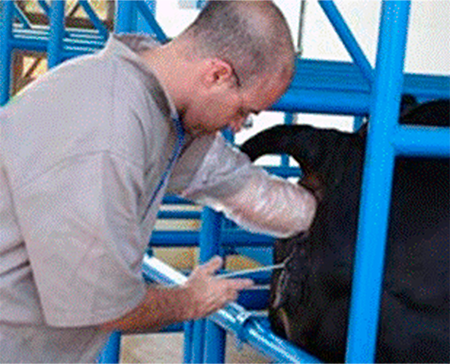
The general objective of this work is to use the artificial genetic algorithm as a tool for the genetic improvement of cattle in Angola.The use of this tool for genetic improvement of cattle aims to increase meat and milk production through the selection and crossing of animals with desirable characteristics.The Angolan government has invested in livestock development programs, including cattle restocking and genetic improvement.Genetic improvement of livestock in Angola, as in other regions, seeks to improve the genetic characteristics of animals to increase the production of meat, milk, or other desired characteristics, such as precocity and meat quality. This is done through the selection of animals with good characteristics, the use of techniques such as artificial insemination, and the management of herds to ensure genetic evolution over time. Thus, genetic improvement has contributed not only to generating a more productive and precocious animal, but also to gain resistance to adverse environments, diseases and parasites.The results demonstrate that artificial insemination has been the most successful and effective reproduction biotechnology in animal production in Angola, being responsible for genetic increase rates in dairy farming of around 1.0 to 1.5%.It has revolutionized the commercial dairy cattle population in recent years, allowing the dissemination of superior genotypes on a large scale.
Article Details

This work is licensed under a Creative Commons Attribution-NonCommercial 4.0 International License.
Those authors that have publications with this journal accept the following terms:
1. They will retain their copyright and guarantee the journal the right of first publication of their work, which will be simultaneously subject to the License Creative Commons Attribution-NonCommercial 4.0 International (CC BY-NC 4.0) that allows third parties to share the work whenever its author is indicated and its first publication this journal. Under this license the author will be free of:
• Share — copy and redistribute the material in any medium or format
• Adapt — remix, transform, and build upon the material
• The licensor cannot revoke these freedoms as long as you follow the license terms.
Under the following terms:
• Attribution — You must give appropriate credit, provide a link to the license, and indicate if changes were made. You may do so in any reasonable manner, but not in any way that suggests the licensor endorses you or your use.
• NonCommercial — You may not use the material for commercial purposes.
• No additional restrictions — You may not apply legal terms or technological measures that legally restrict others from doing anything the license permits.
2. The authors may adopt other non-exclusive license agreements to distribute the published version of the work (e.g., deposit it in an institutional telematics file or publish it in a monographic volume) whenever the initial publication is indicated in this journal.
3. The authors are allowed and recommended disseminating their work through the Internet (e.g. in institutional telematics archives or on their website) before and during the submission process, which can produce interesting exchanges and increase the citations of the published work. (See the Effect of open access).
References
BARUSELLI, P.S.: “Evolução da inseminação artificial em fêmeas bovinas de corte e de leite no Brasil”, Boletim eletônico do Departamento de Reprodução Animal/FMVZ/USP, 4, 2020.
BARUSELLI, P.S.; CATUSSI, B.L.C.; ABREU, L.Â. de; ELLIFF, F.M.; SILVA, L. da G. da; BATISTA, E.S.; CREPALDI, G.A.: “Evolução e perspectivas da inseminação artificial em bovinos”, Revista Brasileira de Reprodução Animal, 43(2): 308-314, 2019.
BURKHART, M.C.; RUIZ, G.: “Neuroevolutionary representations for learning heterogeneous treatment effects”, Journal of Computational Science, 71: 102054, 2023, ISSN: 1877-7503.
DE CARVALHO, B.C.; CHITITTI, G.M.; IMBELLONI, J.C.G.: Inseminação artificial em gado bovino,[en línea], 2021, Disponible en:https://sistemafamato.org.br/senarmt/wp-content/uploads/sites/2/2023/08/Cartilha-84-MT-Inseminacao-Artificial-em-Bovinos.pdf.
FERREIRA, A.M.; FERREIRA DE SÁ, W.; VIANA, J.H.M.; CAMAGO, L.S.A.: Inseminação artificialem gado bovino, [en línea], Inst. Portal Embrapa recursos genéticos e biotecnologia e gado de leite, 2021, Disponible en:https://www.embrapa.br/agencia-de-informacao/.
GERGES, F.; ZOUEIN, G.; AZAR, D.: “Genetic algorithms with local optima handling to solve sudoku puzzles”, En: Proceedings of the 2018 international conference on computing and artificial intelligence, pp. 19-22, 2018.
JANSEN, T.; WEYLAND, D.: “Analysis of evolutionary algorithms for the longest common subsequence problem”, En: Proceedings of the 9th annual conference on Genetic and evolutionary computation, pp. 939-946, 2007.
LARSON, G.; FULLER, D.Q.: “The evolution of animal domestication”, Annual review of ecology, evolution, and systematics, 45(1): 115-136, 2014, ISSN: 1543-592X.
LUQUE-RODRIGUEZ, M.; MOLINA-BAENA, J.; JIMENEZ-VILCHEZ, A.; ARAUZO-AZOFRA, A.: “Initialization of feature selection search for classification”, Journal of Artificial Intelligence Research, 75: 953-983, 2022, ISSN: 1076-9757.
MINAGRIF: Melhoramento genético do gado bovino, [en línea], Inst. Ministério de agricultura e florestas. Orgão oficial da Republica de Angola., Luanda, Angola, 2021, Disponible en:https://faolex.fao.org/docs/pdf/ang215085.pdf.
PÉTROWSKI, A.; BEN-HAMIDA, S.: Evolutionary algorithms, Ed. John Wiley & Sons, vol. 9, 2017, ISBN: 1-84821-804-4.
POULSON, L.J.J.: Formação e desenvolvimento do sistema agroalimentar do milho na província do Huambo/Angola, Ed. Universidade Regional de Blumenau (Brazil), 2024, ISBN: 979-8-3103-4446-4.
ROSA, A. do N.; MARTINS, E.N.; MENEZES, G.R. de O.; SILVA, L.O.C. da: Melhoramento genético aplicado em gado de corte: Programa Geneplus-Embrapa, Ed. Embrapa, 2013, ISBN: 85-7035-256-5.
TAVARES, J.; MACHADO, P.; CARDOSO, A.; PEREIRA, F.B.; COSTA, E.: “On the evolution of evolutionary algorithms”, En: European Conference on Genetic Programming, Ed. Springer, pp. 389-398, 2004.
TOMOIAGĂ, B.; CHINDRIŞ, M.; SUMPER, A.; SUDRIA-ANDREU, A.; VILLAFAFILA-ROBLES, R.: “Pareto optimal reconfiguration of power distribution systems using a genetic algorithm based on NSGA-II”, Energies, 6(3): 1439-1455, 2013, ISSN: 1996-1073.
WEIBLEN, R.; NOGUEIRA, A.: Melhoramento genético animal 2., Porto Alegre: Editora da UFRGS, 2015.
ZART, A.L.; NICACIO, A.C.; DO GITO, A.A.; GONDO, A.; SOUZA., A.: Melhoramento genético aplicado em gado de corte: Programa Geneplus-Embrapa, Ed. Embrapa, editores técnicos: António do Nascimento Rosa [et al]. ed., Brasília, DF : Embrapa, 256 p., 2013, ISBN: 978-85-7035-256-9.