Water demand for rice (Oryza sativa L.) in a Dark Plastic Gleyed soil
Article Sidebar
Main Article Content
Abstract
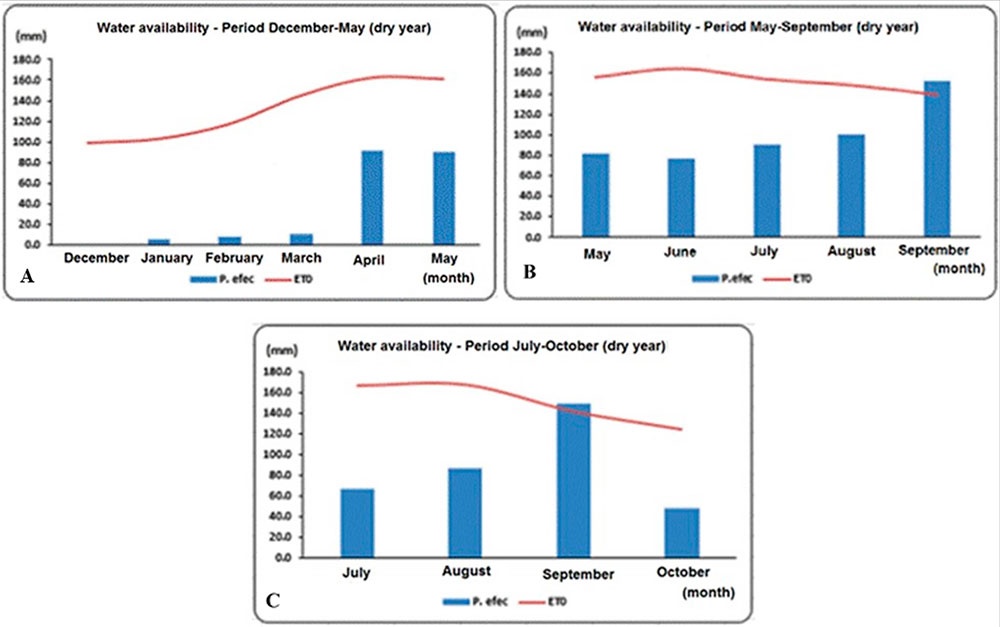
With the aim of determine the irrigation requirements of rice planted in a Dark Plastic Gley soil, a research was carried out in areas of the "Fernando Echenique" Agroindustrial Company located in the province of Granma, Cuba. To this end, a study was carried out of the 2008-2020 rainfall series from the rain gauge located in the study area, where the wet, medium, and dry hydrological years were defined. The climatic variables for determining the reference evapotranspiration were taken from the National Agrometeorological Bulletin issued by the Meteorology Institute. Using the CropWat program, the total net requirements for rice were estimated at different planting seasons and crop cycle durations. The results shows that for a dry year in the May-December period the water consumption is 9 110,4 m3·ha-1, in the May-September period the rice needs 7913,0 m3·ha-1 and for the July-October period it is 6 596,0 m3·ha-1 for to life cycle of 130 days. For to life cycle of 140 days the requirements plows ace follows: May-December 9654,0 m3·ha-1, May-September 4399,0 m3·ha-1 and for the July-October period it is 7072,0 m3·ha-1. When comparing the total net standards proposed by the Resolution 17/2020 for an average cycle of 140 days and to year with to 75 % probability of rainfall, the irrigation requirements obtained in this study are between 19,3 and 42,5 % higher depending on the planting season.
Article Details

This work is licensed under a Creative Commons Attribution-NonCommercial 4.0 International License.
Those authors that have publications with this journal accept the following terms:
1. They will retain their copyright and guarantee the journal the right of first publication of their work, which will be simultaneously subject to the License Creative Commons Attribution-NonCommercial 4.0 International (CC BY-NC 4.0) that allows third parties to share the work whenever its author is indicated and its first publication this journal. Under this license the author will be free of:
• Share — copy and redistribute the material in any medium or format
• Adapt — remix, transform, and build upon the material
• The licensor cannot revoke these freedoms as long as you follow the license terms.
Under the following terms:
• Attribution — You must give appropriate credit, provide a link to the license, and indicate if changes were made. You may do so in any reasonable manner, but not in any way that suggests the licensor endorses you or your use.
• NonCommercial — You may not use the material for commercial purposes.
• No additional restrictions — You may not apply legal terms or technological measures that legally restrict others from doing anything the license permits.
2. The authors may adopt other non-exclusive license agreements to distribute the published version of the work (e.g., deposit it in an institutional telematics file or publish it in a monographic volume) whenever the initial publication is indicated in this journal.
3. The authors are allowed and recommended disseminating their work through the Internet (e.g. in institutional telematics archives or on their website) before and during the submission process, which can produce interesting exchanges and increase the citations of the published work. (See the Effect of open access).
References
ALLEN, R.G.; PEREIRA, L.; RAES, D.; SMITH, M.: “Evapotranspiration-Guidelines for computing crop water requirements”, FAO Irrigation and drainage paper, 56: 300, 2006, ISSN: 92-5-304219-2.
BOUMAN, B.; LAMPAYAN, R.M.; TUONG, T.P.: Water management in irrigated rice: coping with water scarcity, Ed. International Rice Research Institute, Los Baños, Philippines, International Rice Research Institute, Los Baños, Philippines, 2007, ISBN: 971-22-0219-4.
BOUMAN, B.A.M.; HAEFELE, S.M.; HIZZI, G.; PENG, S.; HSIAO, T.C.: Respuesta del rendimiento de los cultivos al agua, Ed. Estudio FAO Riego y Drenaje 56, Roma, Italy, Steduto, P.; T.C. Hsiao; E. Fereres&D. Raes Ed. ed., 2012, ISBN: 978-92-5-308564-4.
CAMEJO, B.L.E.; DUARTE, N.L.; RIVERÓN, L.A.R.: “El riego del arroz (Oryza sativa L.) con limitación de agua en suelos oscuros plásticos del municipio Cham-bas”, Universidad y Ciencia, 6(Especial UNICA): 61-78, 2017, ISSN: 2227-2690.
DÍAZ, S.S.H.; MOREJÓN, R.R.; PÉREZ, L.N.: “ISRA LP-24. Nuevo cultivar de arroz (Oryza sativa L.) de ciclo medio, obtenido por hibridaciones”, Cultivos Tropicales, 42(4), 2021, ISSN: 0258-5936.
FAO: Program CropWat 8.0, Rome, Italy, 2009.
FAO: Perspectivas de cosechas y situación alimentaria - Informe trimestral mundial N° 2, julio 2020, Inst. FAO, Roma, Italia., Roma, Italia., 2020.
GOC-CUBA: “Resolución 17- 2020 Instituto Nacional de Recursos Hidráulicos (INRH)”, Gaceta Oficial de la República de Cuba, : 35, GOC 2020-557-061, 2020, ISSN: 0864 I-0793, e-ISSN: 1682-7511.
HERNAIZ, S.; ALVARADO, J.: “Manejo del agua en el arrozal”, Arroz, Manejo Tecnológico. Instituto de Investigaciones Agropecuarias, Chillán, Chile, : 49-68, 2007.
HERRERA, J.; HERVIS, G.; GONZÁLEZ, F.; DUARTE, C.: “Estudio sobre el balance hídrico del arroz en Cuba”, Ingeniería Agrícola, 9(3), 2019, ISSN: 2227-8761.
HERRERA, J.; MENESES, J.; DUARTE, C.; GONZÁLEZ, F.; HERVÍS, G.: “Determinación del coeficiente de cultivo para la estimación de la evapotranspiración del arroz en Cuba”, Revista Ciencias Técnicas Agropecuarias, 29(3): 5-20, 2020, ISSN: 2071-0054.
IIG-CUBA: Instructivo Técnico del cultivo del Arroz, Inst. Instituto de Investigaciones de Granos (IIG), Imprenta EAS-MINAG, La Habana, Cuba, 142 p., 2020.
INSMET-CUBA: Reportes de las estaciones metereológicas de Cuba, Inst. Instituto de Meteorología. La Habana. Cuba, La Habana, Cuba, 2024.
MAQUEIRA, L.: “Relación de los procesos fisiológicos del desarrollo y de variables meteorológicas, con la formación del rendimiento en el cultivo del arroz (Oryza sativa L.) en Los Palacios, Pinar del Río”, Instituto Nacional de Ciencias Agrícolas (INCA), San José de las Lajas, Mayabeque, Cuba, 2014.
PÉREZ, R.; ÁLVAREZ, M.: “Necesidades de Riego de la Caña de Azúcar en Cuba”, Editorial Academia-IIRD, Formato digital. C. Habana, Cuba, Capítulos, 2(3): 4, 2005.
POLÓN, R.: “Prácticas agroecológicas para disminuir las afectaciones del arroz rojo (Oryza sativa L.). I. Rotación con Soya, manejo del agua y laboreo del suelo en húmedo”, Cultivos Tropicales, 24(2): 45-49, 2003, ISSN: 1819-4087.
REYES, D.N.: El cultivo de arroz. (Oryza sativa). Manual técnico para consultores agrícolas y productores, La Habana, Cuba, 51 p., 2003.
RUIZ, S.: “Requerimientos de agua en el cultivo del arroz en la UEB “Sierra Maestra”, Los Palacios, Pinar del Río, Universidad Tecnológica de La Habana, Facultad de Ingeniería Civil, Centro de Investigaciones Hidráulicas (CIH) Instituto de Investigaciones Agrícolas (IAgric), Eng”, 2014.
STEDUTO, P.; C HSIAO, T.; FERERES, E.; RAES, D.: “Respuesta del rendimiento de los cultivos al agua”, 2012, ISSN: 1020-4393.