Translate PaperTechnical Notehttp://opn.to/a/qctOl

Develop of a system for the mensuration of the energy efficiency of solar cells

  [*] Author for correspondence: Ivelisse Almanza-Fundora, e-mail: ivelisse@unica.cu


ABSTRACT

This document deals with the development of a system for the measurement of the solar power and the electric power generated by the solar cells of a photovoltaic panel, in order to assess energy efficiency in the conversion of light energy into electrical energy. So the first thing is to calibrate the light power emitted a tungsten lamp, taking into account the temperature of the filament and the emittance of the tungsten as a function of temperature and wavelength. The temperature of the filament is determined by measuring the resistance as a function of the voltage and amperage of the filament power and using the dependence of the resistivity of tungsten with temperature. The luminous power that emits the filament is calibrated with phototransistors and photodiodes patterns Siemens, photoelectric units (Lux, lx) and in unit of energy (W/m2). With the I-v characteristics of the cell, the Voc open circuit voltage and intensity of current in short circuit Isc determines the maximum electrical power supplied by the cell, which divided between the light output provides the efficiency rating conversion of light energy into electricity by the photovoltaic cell. Studied cells have an open circuit (Voc) of 4.6 V voltage, intensity of current in short circuit (Isc) of 87 mA and efficiency of 12.4% with irradiation of 399,6 W/m2. Key words: solar cells, energy efficiency measurements.

Keywords:
power luminous lot; electric power; photovoltaic panel.

INTRODUCTION

In the search for alternative energy sources, but at the same time, to protect the environment, contemporary governments have taken the decision to use the Sun as a great source of energy because it is infinite and inexhaustible . In Cuba, from the energy revolution motivated by Commander in Chief Fidel Castro Ruz, since the beginning of the last decade, a great effort is being developed in the development of systems for the use of solar energy, both for the direct heating, as in its conversion into electricity in solar photovoltaic panels. The importance of this issue is such today that it has been reflected in the guideline No. 253 of economic policy and Social Revolution drawn in the 6th Congress of the Communist Party of Cuba PCC (Partido Comunista de Cuba) (2011), in terms of the development of reliable and accurate systems to measure energy resources that the country has, with special relevance to solar energy.

In photovoltaic systems, it is essential to measure the efficiency of solar cells, since this lets to know how much power of solar radiation (W/m2) each of them absorbs, which also requires to know exactly, how much solar energy reaches each location per unit area in one second (Daniels, 1981). Then, the amount of solar energy and conversion into electric energy efficiency are the two fundamental parameters to measure and control in all photovoltaic solar energy system (Böer, 1979; Green, 1982; Alan et al., 1990; Bacus, 2001; Doherty y Malone, 2001; Ginley et al., 2008).

To better understand the essence of this work, it is convenient to wonder: what is solar energy? It is the radiant energy produced in the Sun, as a result of nuclear fusion reactions, which arrives on Earth through space in packets of energy called photons (light), that interact with the atmosphere and Earth surface. Life on Earth would not exist without the presence of the Sun (Kreith y Kreider, 1978; Iqbal, 1983; Manrique, 1984; Nelson, 2003; Espejo Marín, 2004). The planet would be too cold, plants do not grow or it would not have any life, except some bacteria. Energy resources come directly or indirectly from the Sun. Fossil fuels are plants and very old trees, which grew thanks to the sunlight and have been compressed over millions of years. Wind energy and hydraulics are generated through processes driven by the Sun. The fuel wood is obtained from trees, which could not grow without sunlight (Kreith y Kreider, 1978; Böer, 1979; Daniels, 1981; Espejo Marín, 2004; Berri, 2014). The conversion of solar radiation into electrical energy is done by means of photovoltaic cells (Bacus, 2001; Doherty y Malone, 2001; Ginley et al., 2008).

The efficiency of solar cells is crucial to reduce the costs of PV systems, since their production is the most expensive of the whole system. (Iqbal, 1983).The photovoltaic effect occurs when the solar cell material (silicon or other semiconductor material) absorbs part of the photons from the Sun. Then, the absorbed photon liberates an electron, which is located in the interior of the cell. The efficiency of the cell is really the relationship between the amount of electrons released to electrical conduction and the amount of photons of light that reach the cell and it is called internal quantum efficiency (Böer, 1979; Harper, 2000; Doherty y Malone, 2001; Bahnemann, 2004; Berri, 2014).

Hence, it is clear that it is necessary to measure with precision and reliability, energy efficiency and electric power delivered solar panels for each specific application.

Therefore, it is determined as problematic situations, the low utilization of solar energy in Cuba and the province, the ignorance of the basic parameters of the solar cells and its mode of use, the lack of measurements of energy variables solar, equipment and methodologies to measure solar energy and the efficiency of cells and solar panels (Kreith y Kreider, 1978; Espejo Marín, 2004; Meinel y Meinel, 2013; Berri, 2014).

Therefore, it is declared as a research problem: how to measure with precision and accuracy the energy efficiency of cells and solar panels?

As objective of research, it is defined to develop a system for measuring the energy efficiency of solar cells, to be used in the design and installation of photovoltaic panels for a rational and efficient use of solar energy.

The photovoltaic phenomenon is determined at atomic level, as a photon falls on the bond between two atoms and breaks it. To achieve that break in a link with little energy, it is necessary that the atom is unstable, that is, it has incomplete its valence band and the number of electrons there, is different from eight (Shah et al., 1999; Harper, 2000; Wolfgang, 2002; Würfel, 2005; Ginley et al., 2008). Materials that have this feature in their atoms are semiconductors (Boer y Bhattacharya, 1994). In a pure semiconductor current produced by the movement of electrons is negligible due to the low value of free carriers. Therefore, impurities are added to the material to increase the free carriers and the new material obtained is called extrinsic semiconductor. Light is composed of a set of electromagnetic radiation of high frequency, this range is called light spectrum (García y Boix, 1996; Shah et al., 1999; John y William, 2006; Meinel y Meinel, 2013).

METHODS
Determination of the Radiation Intensity Emitted by the Filament

The intensity of the radiation, or irradiance E, emitted by a blackbody is proportional to the absolute temperature raised to four, according to Stefan-Boltzmann law:

Where:

σ is the Stefan-Boltzmann constant. For gray bodies as the tungsten filament:

Where ε (T) is the emittance of tungsten, which is also a function of temperature.

Then, knowing the temperature of the filament, irradiance or luminous power radiated per unit area of the filament can be determined (in units of W/m2).

Determination of the Filament Temperature T

The measurement of the temperature of the filament is made indirectly, by measuring its resistance according to the temperature. For a tungsten filament, its resistance is related to the temperature according to the equation.

Where:

T is the temperature in degrees Celsius and the α and β, coefficients valid for Wolfram are α = 4.82 10-3 / K and β = 6.76 10-7 /K2 , respectively.

The resistance of the filament R (T) is calculated by applying Ohm's law, from the voltmeter and ammeter indications.

The power of the lamp is the V•I product

Clearing t and bearing in mind that the absolute temperature T of the filament is T = t + 273, it is obtained

And the resistance at 0 ° C is:

The emissivity of the filament is given by

the total irradiance as a function of temperature.

MATERIALS
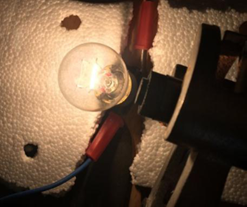
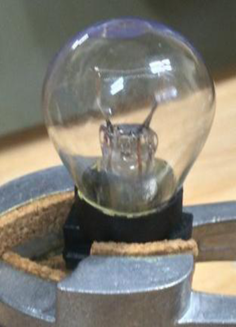
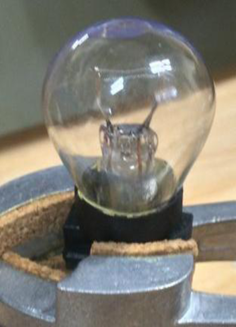
Light Bulb Tungsten 12 Volt

Then, the focus of reference used to check the calibration of the sensor used is displayed in Figure 1.
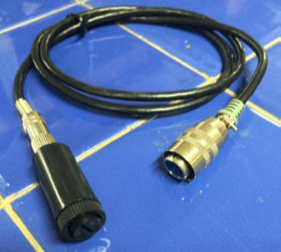
B04 light sensor

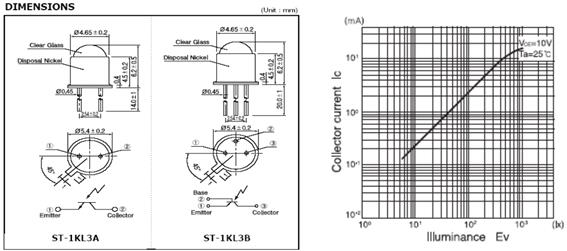
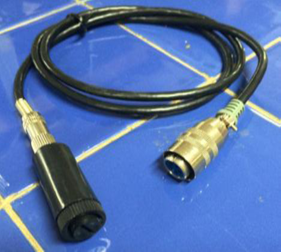
Figure 2 shows the used sensor for light intensity, formed by a phototransistor ST-1KL3A of the Korean firm Kodenchi.
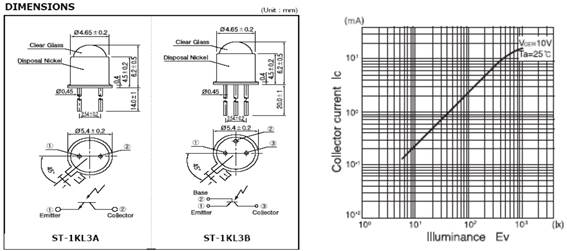
Transistor scheme is presented in Figure 3 along with its collector current characteristic vs. illuminance.

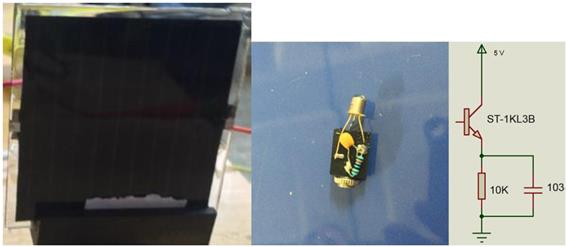
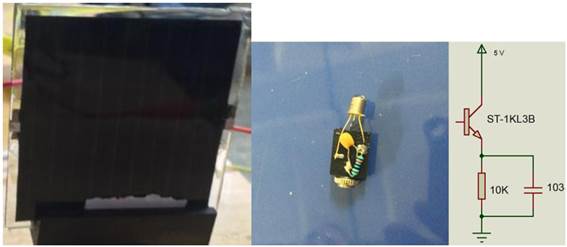
Figure 3 shows the wiring diagram of the sensor used to be able to find the emissivity (W⁄m2) of the tungsten bulb. There is a phototransistor of reference ST-1KL3A and a commercial of 10KΩ of precision resistance (the resistance was measured in the equipment XJ2811C LCR METER and it resulted 9.991 KΩ). In parallel to that resistance, there is a commercial, ceramic capacitor of 103 (it was measured on the computer XJ2811C LCR METER and the measurement resulted 8.787 pF).
SolarCell

For this work, a solar cell of low power (Figure 4) was used. The selection was made according to the options available on the market and by selecting the best electrical properties. The parameters taken into account were, among others, power, maximum voltage, maximum current, etc.
The electrical characteristics of the cells are:

  • Size 54.50 mm x 54.50 mm

  • Maximum power (Pm) = 0. 414W.

  • Maximum voltage of optimum work (Vm) = 4.6V.

  • Maximum optimal active current (Im) = 90mA.

  • Open circuit (VOC) voltage = 5V.

  • Short circuit (ICC) current = 100mA.

Servo Motors

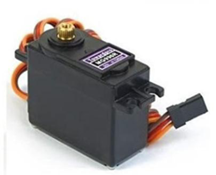
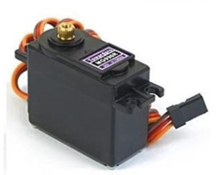
There are two servo motors used of series Towardpro MG9965 (Figure 5)
Specifications

  • Weight: 55 g

  • Dimensions: 40.7 x 19.7 x 42.9 mm approx.

  • Torque of shaft: 9.4 kgf•cm (4.8 V), 11 kgf•cm (6 V)

  • Operation speed: 0.17 s / 60th (4.8 V), 0.14 s / 60th (6 V)

  • Operating voltage: 4.8 V 7.2 V

  • Current range 500 mA--900 mA (6V)

  • Dead band width: 5 μs

  • Temperature range : 0 ° C - 55 ° C.

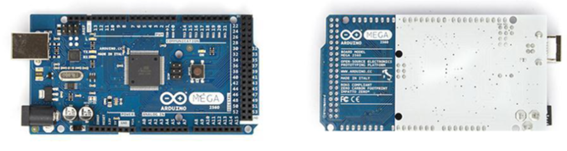
Arduino Mega 2560 (Figure 6)
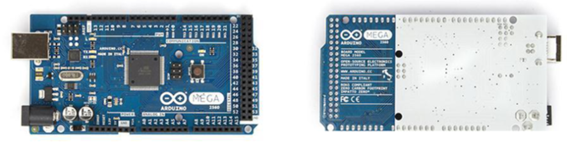
Arduino Mega 2560 is an electronic plate based on the Atmega2560. It has 54- input / output digital pins (of which 15 can be used as PWM outputs), 16 analog inputs, 4 UARTs (serial doors), a 16 MHz oscillator, a USB connection, a connector from power, an ICSP header, and a reset button. It contains everything needed to support the microcontroller, simply by connecting it to a computer with a USB cable or power with an AC adapter or the battery to DC to start. Mega is compatible with most shields designed for the Arduino Duemilanove or Diecimila.

With the voltage and the current and applying Ohm's law (Equation 5), the resistance of the tungsten bulb can be determined.

Measuring of electric power in the photocell and knowing the area of solar cell, the efficiency of the solar cell can be determined by:

RESULTS AND DISCUSSION
Determination of the Total Emission Powerof the Focus

Applying the equation, the resistance of the filament of tungsten lamp in variation with temperature was determined. R0 = 3.17 Ω / ° C, room temperature was 28 ° C, the filament resistance measured in a RLC gave 3.6 Ω (Figures 7 y 8).
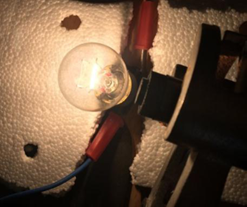
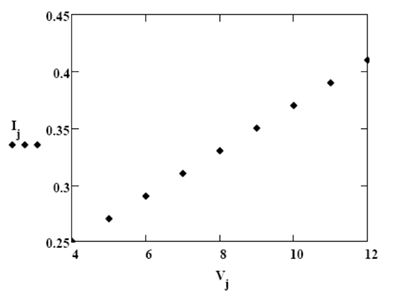
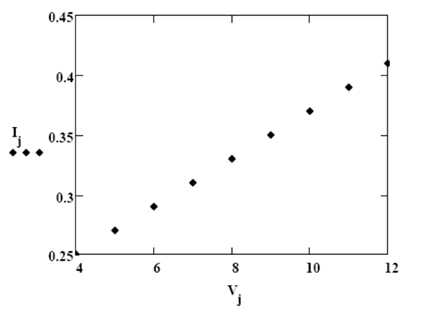
Figure 9 shows the graph obtained from voltage and current of tungsten bulb when the supply voltage is varied from 4 V to 12 V, in this case is linear.

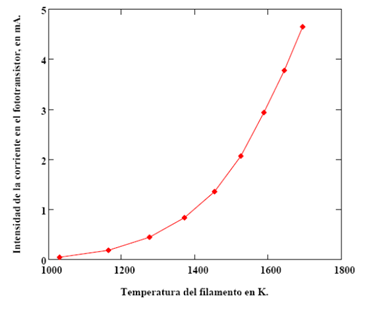
From the equation of absolute temperature of the filament that is given in K, it may be related to power supplied by the illumination sensor that is located in the following figure. It is possible to observe, in an excellent correlation (R2 = 0.978) with the Stefan-Boltzmann law of a dependency with T4.
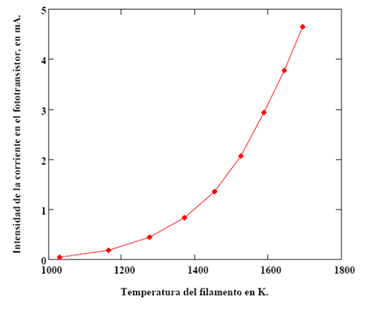
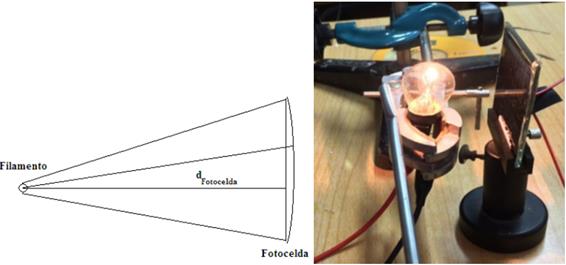
Figure 10 shows the assembly for the measurement of the solar cell efficiency, with the diagram to estimate the power that comes to it from the filament.
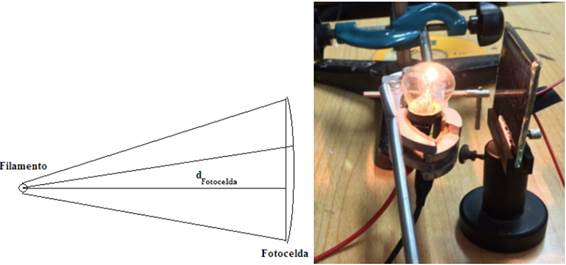
Luminous flux reaching the photoelectric cell is obtained from the equation of the vector intensity of the electric field as a function of the filament. This was correlated with the one obtained by measuring the photocurrent of the phototransistor and they are consistent with a 96% of coincidence between both measurements of the luminous flux in the cell. Then the maximum error in the measurement of irradiance and, therefore, of efficiency does not exceed 4%.

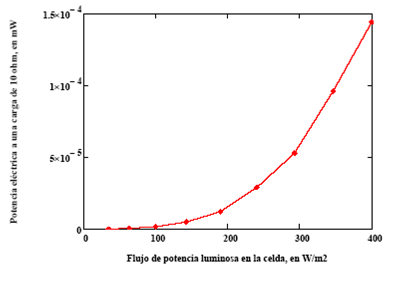
The following graph (Figure 11) shows the relationship between the electrical power delivered by the photocell and the illuminance received from tungsten filament:
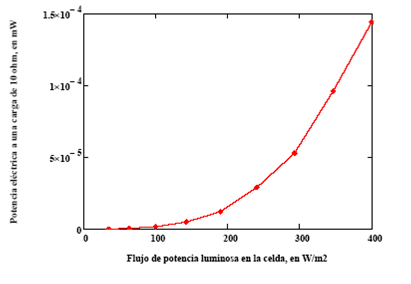
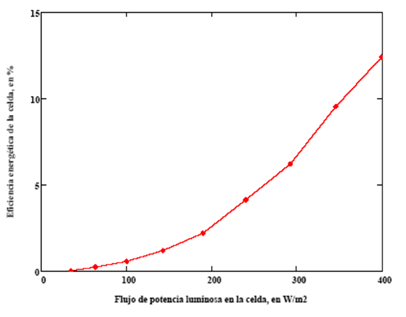
Measuring of electric power in the photocell and knowing the area of solar cell, the efficiency of the solar cell can be determined, in the Figure 12 the efficiency of the cell is shown with the flow that reaches the cell.
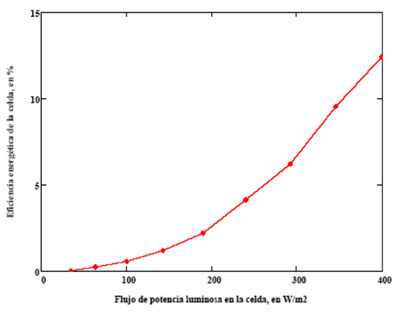
Then with a maximum of 399,4 W/m2 irradiance, this cell has a conversion efficiency of light energy into electricity of 12.4%.

CONCLUSIONS

  • Regulated light sources with high precision tungsten incandescent lamps were developed, with power light controlled from 0 up to 400 W/m2.

  • Calibrated light radiation sensors were mounted in correspondence with light patterns sources developed, which allows obtaining a measurable response of photocells to luminous radiation.

  • Four solar cells of high quality were studied for which the following mean values were obtained: an open circuit voltage Voc = 4.6 V, a current intensity in the short circuit Isc of 87 mA, with an irradiation of 399.6 W/m2.

  • The efficiency of conversion of solar energy into electricity by solar cells was 12.4%.
REFERENCES

1 

ALAN, H.; CROMER, H.; FERNÁNDEZ, F.J.: Physic in Science and Industry, Ed. McGraw-Hill, New York, USA, 1990.

2 

BACUS, C.E.: Solar Cells, Ed. IEEE Press, New York, USA, 2001.

3 

BAHNEMANN, D.: “Photocatalytic water treatment: solar energy applications”, Solar energy, 77(5): 445-459, 2004.

4 

BERRI, L.: “La energía solar en Cuba”, Energía y tú, 12(2): 34-45, 2014, ISSN: 1028-9925, E-ISSN: 2410-1133.

5 

BÖER, K.W.: “The physics of solar cells”, Journal of Applied Physics, 50(8): 5356-5370, 1979.

6 

BOER, K.W.; BHATTACHARYA, A.: “Survey of Semiconductor Physics-Vol. II: Barriers, Junctions, Surfaces and Devices”, Medical Physics-New York-Institute of Physics, 21(2): 327, 1994.

7 

DANIELS, F.: Uso directo de la energía solar, Ed. H. Blume, H. Blume ed., New York, USA, 1981.

8 

DOHERTY, M.F.; MALONE, M.F.: Conceptual design of distillation systems, Ed. McGraw-Hill Science/Engineering/Math, 2001.

9 

ESPEJO MARÍN, C.: “La energía solar fotovoltaica en España”, 2004.

10 

GARCÍA, de L.C.J.; BOIX, O.: Luminotecnia, Ed. Érica, São Paulo, Brasil, 1996.

11 

GINLEY, D.; GREEN, M.A.; COLLINS, R.: “Solar energy conversion toward 1 terawatt”, Mrs Bulletin, 33(4): 355-364, 2008.

12 

GREEN, M.A.: “Solar cells: operating principles, technology, and system applications”, 1982.

13 

HARPER, G.E.: El ABC del alumbrado y las instalaciones eléctricas en baja tensión, Ed. Limusa, 2000.

14 

IQBAL, M.: An introduction to Solar Radiation, Ed. Academic Press, Toronto, Canada, 1983.

15 

JOHN, A.D.; WILLIAM, A.B.: “Solar engineering of thermal processes”, America, 2006.

16 

KREITH, F.; KREIDER, J.F.: Principles of solar engineering, Ed. Addison Wesley, USA, 230 p., 1978.

17 

MANRIQUE, J.A.: Energía Solar. Fundamentos y Aplicaciones Fototérmicas, Ed. Harla, 1984.

18 

MEINEL, A.; MEINEL, B.: Solar Energy, Ed. Addison Wesley, New York, USA, 2013.

19 

MEINEL, A.B.; MEINEL, M.P.: Aplicaciones de la energía solar, Ed. Reverte, 1982.

20 

MORALES, A.: “Diseño optimo y realización de celdas solares de silicio para producción industrial”, Revista Mexicana de Física, (49), 2014, ISSN: 0035-001X.

21 

NELSON, J.: The physics of solar cells, Ed. World Scientific Publishing Company, 2003.

22 

PCC (PARTIDO COMUNISTA DE CUBA): Lineamientos de la Política Económica y Social del Partido y la Revolución, [en línea], VI Congreso del Partido Comunista de Cuba, La Habana, Cuba, 48pp., 2011, Disponible en:Disponible en:http://www.cubadebate.cu/wp-content/uploads/2011/05/tabloide_debate_lineamientos.pdf , [Consulta: 28 de febrero de 2018].

23 

SHAH, A.; TORRES, P.; TSCHARNER, R.; WYRSCH, N.; KEPPNER, H.: “Photovoltaic technology: the case for thin-film solar cells”, science, 285(5428): 692-698, 1999.

24 

WOLFGANG, B.K.: Survey of Semiconductor Physics, Springer, Oklahoma, USA, 701-719 p., 2002.

25 

WÜRFEL, P.: Physics of solar cells, Ed. Wiley-vch Weinheim, vol. 1, 2005.


Received: 15/01/2018

Accepted: 10/12/2018


Ivelisse Almanza Fundora, profesora, Universidad de Ciego de Ávila Máximo Gómez Báez, Facultad de Ciencias Técnicas, Ciego de Ávila, Cuba. Carretera a Morón km 9½, CP: 65300, Teléfono (33) 217009, Fax 5333 225768, e-mail: ivelisse@unica.cu

Regla Ramona García Fernández, e-mail: rgarcia@unica.cu

Francisco García Reina, e-mail: pancho@unica.cu

The authors of this work declare no conflict of interest.

This article is under license Creative Commons Attribution-NonCommercial 4.0 International (CC BY-NC 4.0)

The mention of commercial equipment marks, instruments or specific materials obeys identification purposes, there is not any promotional commitment related to them, neither for the authors nor for the editor.


Traducir DocumentoNota Técnicahttp://opn.to/a/qctOl

Desarrollo de un sistema para la medición de la eficiencia energética de celdas solares

  [*] Autor para correspondencia: Ivelisse Almanza-Fundora, e-mail: ivelisse@unica.cu


RESUMEN

El presente trabajo muestra el desarrollo de un sistema para la medición de la potencia luminosa solar y la potencia eléctrica generada por las celdas solares de un panel fotovoltaico, con el fin de evaluar la eficiencia energética en la conversión de la energía luminosa en energía eléctrica. Para esto lo primero es calibrar la potencia luminosa que emite una lámpara de tungsteno, teniendo en cuenta la temperatura del filamento y la emitancia del tungsteno en función de la temperatura y la longitud de onda. La temperatura del filamento se determina midiendo la resistencia en función del voltaje y el amperaje de alimentación del filamento y usando la dependencia de la resistividad del tungsteno con la temperatura. La potencia luminosa que emite el filamento es calibrada con fototransistores y fotodiodos patrones Siemens, en unidades fotoeléctricas (en lux, lx) y en unidades energéticas (W/m2). Con las características I-V de la celda, el voltaje a circuito abierto Voc y la intensidad de la corriente en cortocircuito Isc se determina la potencia eléctrica máxima suministrada por la celda, la cual dividida entre la potencia luminosa proporciona el valor de la eficiencia de conversión de energía luminosa en eléctrica por la celda fotovoltaica. Las celdas estudiadas tienen un voltaje a circuito abierto (Voc) de 4,6 V, una intensidad de la corriente en cortocircuito (Isc) de 87 mA y una eficiencia de 12,4% con una irradiación de 399,6 W/m2.

Palabras clave:
potencia luminosa solar; potencia eléctrica; panel fotovoltaico.

INTRODUCCIÓN

En la búsqueda de fuentes de energías alternativas, pero a su vez para proteger el medio ambiente, los Gobiernos contemporáneos han tomado la decisión de utilizar el Sol como una gran fuente de energía ya que es infinita e inagotable. En Cuba, a partir de la Revolución Energética impulsada por el Comandante en Jefe Fidel Castro Ruz desde principios de la década pasada, se viene desarrollando un gran esfuerzo en el desarrollo de sistemas para el aprovechamiento de la energía solar, tanto para el calentamiento directo, como en su conversión en energía eléctrica en paneles solares fotovoltaicos. La importancia de este tema es tal en la actualidad que ha quedado reflejada en el Lineamiento No. 253 de la Política Económica y Social de la Revolución trazada en el 6to Congreso del Partido Comunista de Cuba PCC (Partido Comunista de Cuba) (2011), en cuanto al desarrollo de sistemas confiables y precisos de medir los recursos energéticos con los que cuenta el país, con especial relevancia a la energía solar.

En los sistemas fotovoltaicos es imprescindible medir la eficiencia de las celdas solares, ya que esto permite saber cuánta potencia de radiación solar (W/m2) absorbe cada una de esta, para lo cual hay que conocer además con precisión cuanta energía solar llega a cada locación por unidad de área en un segundo (Daniels, 1981). Luego, la cantidad de energía solar y la eficiencia de conversión de esta en energía eléctrica son los dos parámetros fundamentales a medir y controlar en todo sistema fotovoltaico de aprovechamiento de la energía solar (Böer, 1979; Green, 1982; Alan et al., 1990; Bacus, 2001; Doherty y Malone, 2001; Ginley et al., 2008).

Para comprender mejor la esencia de este trabajo es conveniente preguntarse: ¿qué es la energía solar? Es la energía radiante producida en el Sol, como resultado de reacciones nucleares de fusión, que llegan a la Tierra a través del espacio en paquetes de energía llamados fotones (luz), que interactúan con la atmósfera y la superficie terrestres. Sin la presencia del sol no existiría vida en la tierra (Kreith y Kreider, 1978; Iqbal, 1983; Manrique, 1984; Nelson, 2003; Espejo Marín, 2004). El planeta sería demasiado frío, no crecerían las plantas ni habría vida alguna, excepto algunas Bacterias. Los recursos energéticos provienen directa o indirectamente del sol. Los combustibles fósiles son plantas y árboles muy antiguos, que crecieron gracias a la luz solar y han sido comprimidos durante millones de años. La energía eólica y la hidráulica son generadas mediante procesos conducidos por el sol (Meinel y Meinel, 1982; Manrique, 1984; Ginley et al., 2008; Morales, 2014). La madera para combustible es obtenida de los árboles, los cuales no podrían crecer sin luz solar (Kreith y Kreider, 1978; Böer, 1979; Daniels, 1981; Espejo Marín, 2004; Berri, 2014). La conversión de la radiación solar en energía eléctrica se realiza por medio de celdas fotovoltaicas (Bacus, 2001; Doherty y Malone, 2001; Ginley et al., 2008).

La eficiencia de las celdas solares es determinante para reducir los costos de los sistemas fotovoltaicos, ya que su producción es la más cara de todo el sistema (Iqbal, 1983). El efecto fotovoltaico se produce cuando el material de la celda solar (silicio u otro material semiconductor) absorbe parte de los fotones del sol. El fotón absorbido libera a un electrón que se encuentra en el interior de la celda. Realmente la eficiencia de la celda es la relación entre la cantidad de electrones liberados para conducción eléctrica y la cantidad de fotones de luz que llegan a la celda y es llamada eficiencia cuántica interna (Böer, 1979; Harper, 2000; Doherty y Malone, 2001; Bahnemann, 2004; Berri, 2014).

De aquí se desprende que es necesario medir con precisión y confiabilidad la eficiencia energética y la potencia eléctrica que entregan los paneles solares para cada aplicación en específico.

Determinándose como situaciones problémicas, el bajo aprovechamiento de la energía solar en Cuba y en la provincia, desconocimiento de los parámetros fundamentales de las celdas solares y su modo de empleo, no existencia de mediciones de las variables energéticas solares y la falta de equipamiento y metodologías de medición de la energía solar y la eficiencia de las celdas y paneles solares (Kreith y Kreider, 1978; Espejo Marín, 2004; Meinel y Meinel, 2013; Berri, 2014).

Se declara como objetivo de la investigación desarrollar un sistema para la medición de la eficiencia energética de celdas solares, para su empleo en el diseño y montaje de sistemas de paneles fotovoltaicos con el fin de un uso racional y eficiente de la energía solar.

El fenómeno fotovoltaico se determina a nivel atómico al poder incidir un fotón en el enlace entre dos átomos y romperlo, para que se permita esta ruptura en el enlace con poca energía es necesario que el átomo sea inestable, esto es, que tenga incompleta su banda de valencia y el número de electrones ahí contenidos sea diferente de ocho (Shah et al., 1999; Harper, 2000; Wolfgang, 2002; Würfel, 2005; Ginley et al., 2008). Los materiales que presentan esta característica en sus átomos son los semiconductores (Boer y Bhattacharya, 1994). En un semiconductor puro la corriente producida por el movimiento de los electrones es insignificante debido al bajo valor de portadores libres, por lo que se le añaden impurezas al material para aumentar los portadores libres, el nuevo material obtenido es llamado semiconductor extrínseco. La luz está compuesta de un conjunto de radiaciones electromagnéticas de alta frecuencia, a este rango se le llama espectro luminoso (García y Boix, 1996; Shah et al., 1999; John y William, 2006; Meinel y Meinel, 2013).

MÉTODOS
Determinación de la intensidad de la radiación emitida por el filamento

La intensidad de la radiación o irradiancia E emitida por un cuerpo negro es proporcional a la temperatura absoluta elevada a la cuatro, según la ley de Stefan- Boltzmann:

donde:

σ es la constante de Stefan-Boltzmann. Para los cuerpos grises como el filamento de tungsteno:

donde:

ε (T) es la emitancia del tungsteno que también es función de la temperatura.

Luego conociendo la temperatura del filamento se puede determinar la irradiancia o potencia luminosa radiada por unidad de área del filamento (en unidades de W/m2)

Determinación de la temperatura T del filamento

La medida de la temperatura del filamento se realiza indirectamente, midiendo su resistencia en función de la temperatura. Para un filamento de volframio, su resistencia se relaciona con la temperatura de acuerdo con la ecuación.

donde:

T es la temperatura en grados centígrados, y los coeficientes α y β, valen para el volframio respectivamente, α = 4.82 10-3 / K y β = 6.76 10-7 /K2 .

La resistencia del filamento R(T) se calcula aplicando la ley de Ohm, a partir de las indicaciones del voltímetro y del amperímetro.

La potencia de la lámpara es el producto V·I

Despejando t y teniendo en cuenta que la temperatura absoluta T del filamento es T=t+273, obtenemos.

Y la resistencia a 0 ºC es:

La emisividad del filamento viene dada por:

la irradiancia total en función de la temperatura.

MATERIALES
Bombillo Tungsteno 12 Voltio

A continuación, en la Figura 1 se mostrará el foco de referencia utilizado para comprobar la calibración del sensor utilizado.

Sensor de luz B04

En la Figura 2 se muestra el sensor utilizado para obtener la intensidad lumínica, formado por un fototransistor ST-1KL3A de la firma coreana Kodenchi.

El esquema del transistor se presenta en la Figura 3 junto a su característica corriente colector vs. luminancia. En la Figura 3 se observa el esquema eléctrico del sensor utilizado para poder hallar la emisividad (W⁄m2) del bombillo de tungsteno, se encuentra un fototransistor de referencia ST-1KL3A y una resistencia comercial de 10KΩ de precisión (Se midió la resistencia en el equipo XJ2811C LCR METER (Figura 3 dando como resultado 9,991 KΩ), en paralelo a esa resistencia se encuentra un capacitor cerámico, comercial de 103 (Se midió el capacitor en el equipo XJ2811C LCR METER (Figura 3 dando como resultado 8,787 pF).

Celda solar

Para este trabajo se utilizó una celda solar de baja potencia (Figura 4). La selección se hizo de acuerdo a las opciones presentes en el mercado y seleccionando la de mejores características eléctricas. Los parámetros tenidos en cuanta fueron entre otros; Potencia, Voltaje máximo, Corriente máxima etc.

Las características eléctricas de las celdas son:

  • Tamaños 54.50mm x 54.50 mm

  • Máxima potencia (Pm) = 0.414W.

  • Máximo voltaje de trabajo óptimo (Vm) = 4.6V.

  • Máxima corriente activa óptima (Im) = 90mA.

  • Voltaje de circuito abierto (VOC) = 5V.

  • Corriente de corto circuito (ICC) = 100mA.

Servomotor

Se utilizan dos servomotores de serie Towardpro MG9965, como se puede apreciar en la Figura 5

Especificaciones

  • Peso: 55 g

  • Dimensiones: 40,7 x 19,7 x 42,9 mm aprox.

  • Torque de eje: 9.4 kgf∙cm (4,8 V), 11 kgf∙cm (6 V)

  • Velocidad operación: 0,17 s/60º (4,8 V), 0,14 s/60º (6 V)

  • Voltaje de operación: 4,8 V a 7,2 V

  • Rango de corriente 500 mA--900 mA (6V)

  • Dead band width: 5 μs

  • Rango de Temperatura: 0 ºC-55 ºC.

Arduino Mega 2560 (Figura 6)

El Arduino Mega 2560 es una placa electrónica basada en el Atmega 2560. Cuenta con 54 pines digitales de entrada / salida (de los cuales 15 se pueden utilizar como salidas PWM), 16 entradas analógicas, 4 UARTs (puertas seriales), un oscilador de 16MHz, una conexión USB, un conector de alimentación, una cabecera ICSP, y un botón de reinicio. Contiene todo lo necesario para apoyar el microcontrolador; basta con conectarlo a un ordenador con un cable USB o el poder con un adaptador de CA o la batería a CC para empezar. La Mega es compatible con la mayoría de los escudos diseñados para el Arduino Duemilanove o Diecimila.

Con el voltaje y la corriente y aplicando la ley de Ohm (Ecuación 5), se puede determinar la resistencia de la bombilla de tungsteno.

Midiendo la potencia eléctrica en la fotocelda y sabiendo el área de la celda solar se puede hallar la eficiencia de la celda solar:

RESULTADOS Y DISCUSIÓN
Determinación del poder emisivo total del foco

Aplicando la ecuación 3, se determinó la resistencia del filamento de la lámpara de tungsteno en variación con la temperatura. R0=3,17 Ω/°C, la temperatura ambiente es de 28 °C, La resistencia del filamento medida en un RLC arrojó 3,6 Ω. (Figuras 7 y 8).

En la Figura 9 se observan la gráfica que se obtuvo de Voltaje y la corriente del bombillo de tungsteno cunado se varia el voltaje de la fuente de 4 V a 12 V, en este caso es lineal.

A partir de la ecuación de temperatura absoluta del filamento que esta dado en K se puede relacionar con la corriente suministrada por el sensor de iluminación que se encuentra en la Figura 9. Como se puede apreciar en una excelente correlación (R2 = 0,978) con la ley de Stefan-Boltzmann de una dependencia con T4.

En la Figura 10 se presenta el montaje para la medición de la eficiencia de la celda solar, con el diagrama para calcular la potencia que llega a esta desde el filamento.

A partir de la ecuación del vector intensidad del campo eléctrico en función del filamento se obtiene el flujo luminoso que llega a la celda fotoeléctrica. Este se correlacionó con el dado por la medición de la fotocorriente del fototransistor y están en concordancia con un 96% ce coincidencia entre ambas mediciones del flujo luminoso en la celda. Luego el error máximo en la medición de la irradiancia y por tanto de la eficiencia no sobrepasa el 4%.

En el siguiente gráfico (Figura 11) se presenta la relación entre la potencia eléctrica que entrega la fotocelda con la iluminancia que recibe del filamento de tungsteno:

Midiendo la de la potencia eléctrica en la fotocelda y sabiendo el área de la celda solar se puede hallar la eficiencia de la celda solar, en la Figura 12 se muestra la eficiencia de la celda con el flujo que llega a la celda

Luego con una irradiancia máxima de 399,4 W/m2 esta celda tiene una eficiencia de conversión de energía luminosa en eléctrica de un 12,4%.

CONCLUSIONES

  • Se desarrollaron fuentes calibradas de luz con lámparas incandescentes de tungsteno de alta precisión, con potencia luminoso controlada desde 0 hasta 400 W/m2

  • Se montaron sensores calibrados de radiación luminosa en correspondencia con las fuentes patrones de luz desarrollados, lo que permite obtener una respuesta medible de fotoceldas a la radiación luminosa.

  • Se estudiaron 4 celdas solares de alta calidad para las que se obtuvieron como valores medios un voltaje a circuito abierto Voc = 4,6 V, una intensidad de la corriente en cortocircuito Isc de 87 mA, con una irradiación de 399,6 W/m2.

  • La eficiencia de conversión de la energía solar en energía eléctrica por las celdas solares fue de 12,4%.